How Mamata's Trinamool unravelled at breakneck speed within 30 days
Mamata Banerjee, Bengal's OG street fighter who built the TMC from scratch, faces her sternest test yet as the party teeters on the brink of disintegration following a rebellion by 60 MLAs led by Ritabrata Banerjee. The big question is whether the party can remain united after losing power for the first time since 2011.
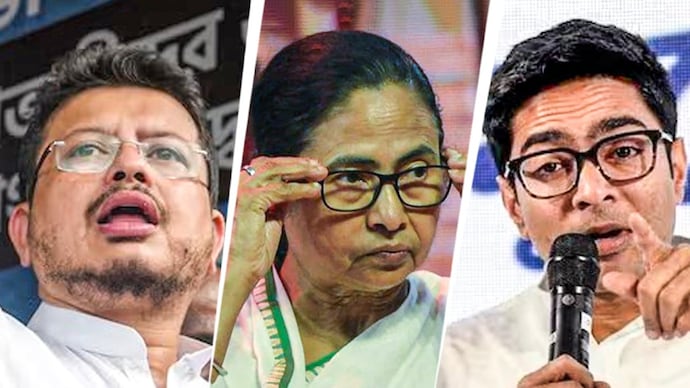


Exactly a month ago, something that was perceived to be unthinkable happened as the BJP secured a thumping win, ending the 15-year rule of Mamata Banerjee's Trinamool Congress (TMC). However, in these 30 days, Mamata has been grappling with a crisis even more damaging than the poll drubbing - a rebellion led by expelled leader Ritabrata Banerjee that has brought the TMC on the verge of disintegration. What is astonishing is how a party that appeared politically unassailable until recently unravelled at such breakneck speed, with over 100 councillors resigning and top leaders voicing dissent against the leadership almost every other day.
The fault lines started to emerge days after the results, where the BJP secured 207 seats, leaving the TMC with just 80. Leaders like Ritabrata and Riju Datta, who have also been expelled, started voicing resentment over the influence wielded by Mamata's nephew Abhishek Banerjee. However, the dissident leaders have stopped short of criticising Mamata, suggesting that much of the anger is directed towards Abhishek.
What has deepened the crisis for Mamata is several MLAs staying away from key internal meetings and protests. Last week, 60 of the 80 TMC MLAs skipped a meeting at Mamata's Kalighat residence. A protest, the first since the poll rout, held by Mamata against alleged post-poll violence, saw only eight MLAs and six MPs in attendance.
On the other hand, the party's grassroots structure has been dealt a crucial blow. Over the past four weeks, TMC representatives in zilla parishads, municipal corporations and municipalities have either resigned en masse or have been arrested in criminal cases. It came as the Suvendu Adhikari-led BJP government launched a crackdown on syndicate rings and extortion rackets.
In a desperate countermove, the Trinamool has dissolved all committees in a seeming bid to build the organisation afresh. Here's a timeline of how the turmoil in Trinamool escalated after May 4.
FIRST SIGNS OF INTERNAL RUMBLING
The first signs of internal rumbling came on May 19 when the Kolkata Municipal Corporation (KMC), headed by Mayor and Mamata Banerjee aide Firhad Hakim, issued notices to 17 properties allegedly linked to Abhishek Banerjee over claims of unauthorised construction.
The properties included those associated with Abhishek's parents, his company Leaps and Bounds, and "Shantiniketan", his residence on Kolkata's Harish Mukherjee Road. The civic body directed that the alleged unauthorised structures be demolished within seven days.
Questions over unity within the TMC surfaced again after numerous party legislators skipped its first major protest programme following the election defeat.
Only 35 of the 80 MLAs attended a sit-in near the Ambedkar statue inside the Assembly complex against alleged post-poll violence and hawker eviction drives. Speculation of an internal division gained momentum.
TMC'S 'PUSHPA' BOWS OUT
Amid the churn within the TMC, a key moment was the sudden withdrawal of Jahangir Khan, a close aide of Abhishek, from the Falta assembly repoll. Khan, who famously likened himself to 'Pushpa' (the role played by Allu Arjun) during his tense face-off in April with Uttar Pradesh IPS officer Ajay Pal Sharma, withdrew from the poll race just two days before voting.
Even more surprising was the reason given by Khan for his move. Addressing a press conference, Khan said he wanted peace and development for Falta. He also praised CM Suvendu Adhikari for announcing a special development package for the constituency.
MASS EXODUS OF TMC COUNCILLORS
Among the first announcements by the Suvendu administration was to conduct a review of decisions taken by local bodies under the previous regime. He also warned of strict action in case of irregularities.
What followed within days was a mass exodus of councillors from different municipalities. Till now, the number has well crossed over 100. In some municipalities, TMC councillors have stopped going to their offices altogether.
While the development has undoubtedly come as a setback to the TMC, for the BJP, it has opened a window to expand its influence in local governance institutions.
What further pinched the TMC is the stinging remarks by four-time MP Kakoli Ghosh Dastidar, who resigned from all organisational positions within the party. Dastidar, a long-time aide of Mamata, blamed decisions by the political consultancy firm I-PAC for the poll drubbing.
In fact, several TMC leaders have alleged that Mamata's control over her own party was curtailed as Abhishek began to run its affairs with the help of I-PAC.
ABHISHEK ATTACKED DURING SONARPUR VISIT
The anger against Abhishek was palpable as he came under attack during a visit to Sonarpur, where he had gone to meet families affected by post-poll violence. During the visit, eggs and stones were allegedly hurled at him, while BJP supporters raised slogans against the TMC leader.
Amid the chaos, security personnel escorted Banerjee from the area, with visuals showing him wearing a protective helmet. Following the incident, he was admitted to Apollo Hospital in Kolkata for treatment.
'SIGNGATE' ROCKS TRINAMOOL
At the heart of the rebellion in the TMC lies the forged signatures row. The controversy erupted after Abhishek, in his capacity as the party's general secretary, wrote to the Speaker proposing Sobhandeb Chattopadhyay as the Leader of the Opposition (LoP).
However, Ritabrata and another MLA, Sandipan Saha, alleged no such resolution had been passed at the legislative party meeting, and several signatures on the letter endorsing Sobhandeb were forged. It opened a can of worms, leading to charges that the TMC leadership "cheated its own MLAs".
A CID probe has been ordered into the case, with Abhishek coming under scrutiny. Within hours of the row coming to light, the TMC expelled Ritabrata and Sandipan.
The party faced its biggest internal rebellion when 59 more MLAs joined Ritabrata and met the Assembly Speaker on Wednesday in a bid to seize control of the TMC legislature party. By the evening, the group secured recognition from the Speaker, with Ritabrata being formally named as the LoP.
Now, what does this mean? In essence, this effectively takes away the control of the TMC legislature party from Mamata. However, Ritabrata made it clear that the group still recognised Mamata as their overall leader.
Nevertheless, the development has significantly deepened divisions within the TMC, with political observers saying a split like the Shiv Sena and the NCP was imminent. However, the splits in the Sena and the NCP were months in the making.
For the Trinamool, a party that was never built around any political ideology, it was easier for Ritabrata to engineer a rebellion. The rebellion was more about anger towards the TMC leadership, especially Abhishek.
A month ago, when the election results were announced, CM Suvendu Adhikari claimed that the TMC's defeat could trigger a collapse within the party. While that prediction has not fully materialised, the Mamata-led party is now facing its deepest organisational crisis since its formation two decades ago.
Exactly a month ago, something that was perceived to be unthinkable happened as the BJP secured a thumping win, ending the 15-year rule of Mamata Banerjee's Trinamool Congress (TMC). However, in these 30 days, Mamata has been grappling with a crisis even more damaging than the poll drubbing - a rebellion led by expelled leader Ritabrata Banerjee that has brought the TMC on the verge of disintegration. What is astonishing is how a party that appeared politically unassailable until recently unravelled at such breakneck speed, with over 100 councillors resigning and top leaders voicing dissent against the leadership almost every other day.
The fault lines started to emerge days after the results, where the BJP secured 207 seats, leaving the TMC with just 80. Leaders like Ritabrata and Riju Datta, who have also been expelled, started voicing resentment over the influence wielded by Mamata's nephew Abhishek Banerjee. However, the dissident leaders have stopped short of criticising Mamata, suggesting that much of the anger is directed towards Abhishek.
What has deepened the crisis for Mamata is several MLAs staying away from key internal meetings and protests. Last week, 60 of the 80 TMC MLAs skipped a meeting at Mamata's Kalighat residence. A protest, the first since the poll rout, held by Mamata against alleged post-poll violence, saw only eight MLAs and six MPs in attendance.
On the other hand, the party's grassroots structure has been dealt a crucial blow. Over the past four weeks, TMC representatives in zilla parishads, municipal corporations and municipalities have either resigned en masse or have been arrested in criminal cases. It came as the Suvendu Adhikari-led BJP government launched a crackdown on syndicate rings and extortion rackets.
In a desperate countermove, the Trinamool has dissolved all committees in a seeming bid to build the organisation afresh. Here's a timeline of how the turmoil in Trinamool escalated after May 4.
FIRST SIGNS OF INTERNAL RUMBLING
The first signs of internal rumbling came on May 19 when the Kolkata Municipal Corporation (KMC), headed by Mayor and Mamata Banerjee aide Firhad Hakim, issued notices to 17 properties allegedly linked to Abhishek Banerjee over claims of unauthorised construction.
The properties included those associated with Abhishek's parents, his company Leaps and Bounds, and "Shantiniketan", his residence on Kolkata's Harish Mukherjee Road. The civic body directed that the alleged unauthorised structures be demolished within seven days.
Questions over unity within the TMC surfaced again after numerous party legislators skipped its first major protest programme following the election defeat.
Only 35 of the 80 MLAs attended a sit-in near the Ambedkar statue inside the Assembly complex against alleged post-poll violence and hawker eviction drives. Speculation of an internal division gained momentum.
TMC'S 'PUSHPA' BOWS OUT
Amid the churn within the TMC, a key moment was the sudden withdrawal of Jahangir Khan, a close aide of Abhishek, from the Falta assembly repoll. Khan, who famously likened himself to 'Pushpa' (the role played by Allu Arjun) during his tense face-off in April with Uttar Pradesh IPS officer Ajay Pal Sharma, withdrew from the poll race just two days before voting.
Even more surprising was the reason given by Khan for his move. Addressing a press conference, Khan said he wanted peace and development for Falta. He also praised CM Suvendu Adhikari for announcing a special development package for the constituency.
MASS EXODUS OF TMC COUNCILLORS
Among the first announcements by the Suvendu administration was to conduct a review of decisions taken by local bodies under the previous regime. He also warned of strict action in case of irregularities.
What followed within days was a mass exodus of councillors from different municipalities. Till now, the number has well crossed over 100. In some municipalities, TMC councillors have stopped going to their offices altogether.
While the development has undoubtedly come as a setback to the TMC, for the BJP, it has opened a window to expand its influence in local governance institutions.
What further pinched the TMC is the stinging remarks by four-time MP Kakoli Ghosh Dastidar, who resigned from all organisational positions within the party. Dastidar, a long-time aide of Mamata, blamed decisions by the political consultancy firm I-PAC for the poll drubbing.
In fact, several TMC leaders have alleged that Mamata's control over her own party was curtailed as Abhishek began to run its affairs with the help of I-PAC.
ABHISHEK ATTACKED DURING SONARPUR VISIT
The anger against Abhishek was palpable as he came under attack during a visit to Sonarpur, where he had gone to meet families affected by post-poll violence. During the visit, eggs and stones were allegedly hurled at him, while BJP supporters raised slogans against the TMC leader.
Amid the chaos, security personnel escorted Banerjee from the area, with visuals showing him wearing a protective helmet. Following the incident, he was admitted to Apollo Hospital in Kolkata for treatment.
'SIGNGATE' ROCKS TRINAMOOL
At the heart of the rebellion in the TMC lies the forged signatures row. The controversy erupted after Abhishek, in his capacity as the party's general secretary, wrote to the Speaker proposing Sobhandeb Chattopadhyay as the Leader of the Opposition (LoP).
However, Ritabrata and another MLA, Sandipan Saha, alleged no such resolution had been passed at the legislative party meeting, and several signatures on the letter endorsing Sobhandeb were forged. It opened a can of worms, leading to charges that the TMC leadership "cheated its own MLAs".
A CID probe has been ordered into the case, with Abhishek coming under scrutiny. Within hours of the row coming to light, the TMC expelled Ritabrata and Sandipan.
The party faced its biggest internal rebellion when 59 more MLAs joined Ritabrata and met the Assembly Speaker on Wednesday in a bid to seize control of the TMC legislature party. By the evening, the group secured recognition from the Speaker, with Ritabrata being formally named as the LoP.
Now, what does this mean? In essence, this effectively takes away the control of the TMC legislature party from Mamata. However, Ritabrata made it clear that the group still recognised Mamata as their overall leader.
Nevertheless, the development has significantly deepened divisions within the TMC, with political observers saying a split like the Shiv Sena and the NCP was imminent. However, the splits in the Sena and the NCP were months in the making.
For the Trinamool, a party that was never built around any political ideology, it was easier for Ritabrata to engineer a rebellion. The rebellion was more about anger towards the TMC leadership, especially Abhishek.
A month ago, when the election results were announced, CM Suvendu Adhikari claimed that the TMC's defeat could trigger a collapse within the party. While that prediction has not fully materialised, the Mamata-led party is now facing its deepest organisational crisis since its formation two decades ago.

