CJP holds ultra-Left views, wants to bring anarchy in India: Devendra Fadnavis
Speaking at the India Today Conclave, Maharashtra Chief Minister Devendra Fadnavis accused the CJP of running what he believed was a manufactured protest and targeting institutions. He said the agitation reflected an attempt to turn public issues into an anarchic political campaign.
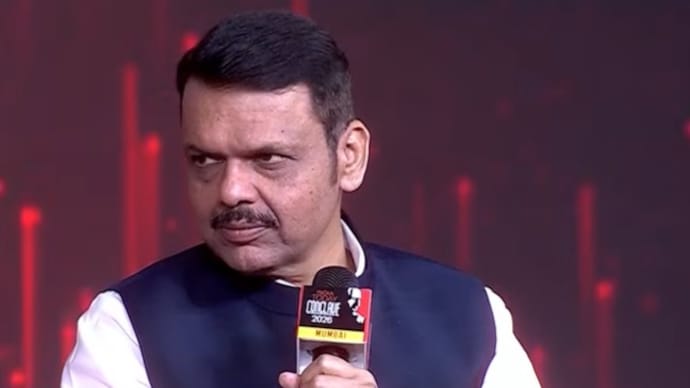
Maharashtra Chief Minister Devendra Fadnavis launched a scathing attack on the Cockroach Janta Party (CJP), accusing it of pursuing an “ultra-Leftist” agenda aimed at creating anarchy in India and gradually undermining constitutional institutions.
Speaking to India Today’s Managing Editor Sahil Joshi at the India Today Conclave 2026 Mumbai, he alleged that the group's protests were part of a political design to fill the vacuum created by a weak Opposition, as those who had lost the ideological battle were now using public grievances to challenge the government.
“They have lost the ideological battle, and now they have come to the issue-based battle. In any developing economy, the glass is never completely full. The government shows the glass as half full, while the Opposition can show it as half empty,” he said, describing this as the nature of the political contest,” he said.
During his session at the Conclave, Fadnavis also distinguished between demonstrations driven by genuine grievances and those he claimed were politically orchestrated. His comments came amid widespread protest in the state by several section of people
“There are two kinds of protests. Some protests are genuine, with people in genuine distress talking about their problems, while some protests are manufactured,”
He said protests over farmers' problems, tribal issues and student grievances could be genuine, but alleged that some groups were exploiting such concerns to advance a broader political agenda.
THEY INVOKE THE CONSTITUTION WHILE CONSPIRING AGAINST IT
Fadnavis alleged that the protests organised by the CJP and the Congress followed a common design of questioning the credibility of institutions established under the Constitution.
He said the groups invoked the Constitution during demonstrations while simultaneously portraying institutions such as the Reserve Bank of India (RBI), Election Commission of India (ECI), Supreme Court and Comptroller and Auditor General (CAG) as flawed.
According to Fadnavis, the objective was to gradually demonise these institutions and create the perception that they could not deliver justice to citizens. He alleged that this would eventually lead to the argument that the Constitution itself was incapable of delivering justice.
CONDUCT AT JANTAR MANTAR WAS ANARCHY, SAYS FADNAVIS
Fadnavis sought to distinguish between the right to protest and what he described as anarchic conduct during the demonstration at Delhi's Jantar Mantar over the NEET paper leak and other grievances.
He acknowledged that the paper leak was wrong and said nobody could defend it. However, he pointed out that the examination was subsequently conducted and the result was declared with transparency.
He said people had every right to assemble and place their demands, but alleged that the conduct of many protesters crossed the line as they hurled viral abuses at Prime Minister Narendra Modi.
Fadnavis also said that around 2,000 people present at the protest were history-sheeters, some facing accusations of serious crimes. He cited their presence and the behaviour witnessed at the demonstration to argue that the protest had gone beyond legitimate dissent.
GOVT MUST ENGAGE WITH PROTESTERS EVEN IF THEY SHARE DIFFERENT IDEOLOGIES
Responding to questions about why the government had engaged with protesters it described as anarchist forces, Fadnavis said dialogue was an essential part of democracy.
“If you believe in democracy, you have to engage with everyone,” he said, adding that the government had even held discussions with Naxalites despite their opposing ideology.
He said engaging with a group did not mean accepting its ideology or endorsing its actions, including violence. Governments, he argued, had to make efforts to persuade people and resolve differences through dialogue. If those efforts failed, they had to discharge their constitutional responsibilities.
However, he argued that force could become necessary when demonstrators refused to comply with the law or threatened constitutional institutions. Citing the possibility of protesters entering and vandalising Parliament, he said such incidents could damage India's reputation and project the country as a weak democracy.
However, he reiterated that the use of force should be the last resort.
NO INTERNAL COMPETITION WITH EKNATH SHINDE, SAYS FADNAVIS
Asked whether there was competition between him and Deputy Chief Minister Eknath Shinde over access to the Prime Minister and the Centre, Fadnavis said Shinde should not be viewed merely through his position in the Maharashtra government.
He pointed out that Shinde was also the national president of the Shiv Sena, a coalition partner of the BJP and an important constituent of the NDA.
Fadnavis said Shinde attended NDA meetings and met the Prime Minister in his capacity as a coalition partner. If he raised the issue of Maharashtra's drought with Modi, he would do so as the Shiv Sena president.
He added that Shinde discussed matters concerning Maharashtra with him before approaching the Prime Minister, rejecting the suggestion that the Deputy Chief Minister was meeting the Prime Minister behind his back.
Fadnavis said he had complete administrative control over the state government, while clarifying that he did not believe in controlling individuals.

