In first E20 protest, motorists claim drop in mileage, choked car fuel system
From stalled engines and falling mileage to costly repairs, allegations made on social media were heard on the streets of Delhi as people protested against the implementation of the ethanol-blending policy. Motorists at Delhi's Jantar Mantar claimed E20 petrol was damaging their cars, and that they had evidence of that.
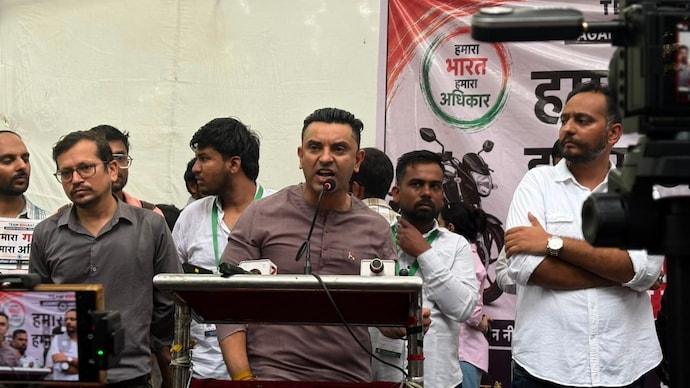

Claims that have been made on social media till now were heard at Jantar Mantar in New Delhi on Sunday as car owners gathered to protest against what they claim is a rushed implementation of the national Ethanol Blending Programme. This was the first on-ground protest held in India against the E20 mandate. Motorists shared with India Today Digital the issues with their cars that had forced them to turn into protesters.
"Hamaari Gaadi, Hamaara Adhikaar" — under this tagline, entrepreneur and TV personality Tehseen Poonawala, and his advocacy initiative Team Bharat, organised a protest at Delhi's Jantar Mantar against the government's aggressive push for E20 petrol (20% ethanol blended with 80% petrol).
The Centre has junked the claims of drop in mileage and wear and tear to vehicles because of E20 petrol. Ahead of Sunday's protest, a group of experts from the automobile and energy sectors defended the government's ethanol-blending programme. They claimed extensive testing had found no evidence that E20 poses concerns for vehicles.
While the participants claimed their cars were suffering due to the E20 petrol, a policy seen to be championed by Union Minister Nitin Gadkari, they made it very clear that it was a non-partisan protest. In fact, several of the protesters claimed they were BJP supporters but were against how the ethanol-blending policy was being implemented.
Social media has been flooded with complaints for months — videos of cars stalling, sudden mileage drops, fuel filter clogs, and expensive repairs. At the protest, these issues came alive through personal stories, even as the turnout remained lukewarm.
One of the organisers of the E20 protest at Jantar Mantar blamed the late approval from Delhi Police for a lesser-than-expected turnout. Despite Team Bharat approaching the police for approval days ahead, the permission was given on Saturday evening.
India rolled out Ethanol Blended Petrol (EBP) programme nationwide rapidly, achieving the target five years ahead of schedule. Critics argue this amounts to a massive, untested experiment on ordinary vehicle owners. According to available data, roughly 80% of cars sold in India over the past 15 years are not fully compatible with E20, as most were designed for E10 or lower blends.
REAL PROBLEMS DUE TO E20 ON THE GROUND, SAY PROTESTERS
Sarthak, a young software engineer from Gurgaon, said he drives a 2018 Baleno (E10 compliant) and has seen a big drop in mileage. "Since the last couple of months, my mileage has dropped from 18 km a litre to under 14 km," he told India Today Digital. That is around a 22% drop in mileage.
Another protester echoed the frustration, saying, "I don't want to buy blended petrol. Gaadi meri kharab honi hai [I It's my car that is going to get ruined.]"
Raj Singh from Delhi's Patel Nagar shared a more alarming account. He claimed that after using E20 fuel for the last seven months, a major fault developed in his car's fuel system.
"I have been filling E20 for the past seven months thinking it would save some money, but last month my car suddenly started losing power and the engine warning light came on. I had to get the entire fuel system cleaned and parts replaced. It cost me over Rs 35,000," he told India Today Digital at Jantar Mantar.
"This is not a small issue. My car was running perfectly before, and now I'm scared to fill the tank again," Singh added.
Meanwhile, Mudit Agarwal, who owns a Skoda Slavia in Delhi, recounted a frightening incident. "The car stopped suddenly and I asked the service guy — he said ethanol was the reason. I had to get my car towed." At the authorised service centre, Agarwal said that the staff told him that seven to eight cars were coming in daily with similar problems.
"E20, nobody is sure this is a scam — I have sent the video to Skoda service [centre]. They have not yet rejected that it could have been because of E20 fuel," he added. Though Agarwal is a Congress member and contested the 2025 Delhi Assembly election on the party's ticket, he came to Jantar Mantar as a troubled motorist.
Attorney General R Venkataramani told India Today TV earlier that the "20% mix of ethanol is a policy decision that is not likely to change."
WEAR AND TEAR IN CAR BECAUSE OF ETHANOL REAL, SAYS
Auto enthusiast and rally driver Ratan Dhillon from Team Bharat highlighted the mechanical concerns from ethanol-blended petrol in vehicles. When asked by India Today Digital if there was evidence that could link the wear and tear in cars to E20 petrol, Dhillon replied in the affirmative. "We have evidence," he said.
"Wear and tear is from ethanol — we will prove in the court — fuel filter and the entire pipeline gets choked. I was in Leh last week, and I had to leave the car there," he said, blaming ethanol-blended petrol for the vehicle's woes.
Asked what the cost of repairs could be, Dhillon said, "By the way, fuel filter costs anywhere between Rs 25,000 to Rs 80,000 for mid-range cars."
Dhillion pointed to challenges at high altitudes, like in Leh, where cold starts become difficult. "Car companies are also not mentioning the exact problem. They are hiding the issue... this is like playing video game. They are making policies without knowing the reality on ground," he said.
Shiv Bhatt, a resident of South Extension, was scathing in his criticism of the government. "Nitin Gadkari's experiment is turning our cars into scrap while his friends' sugar mills laugh all the way to the bank."
CHOICE AND COST CONCERNS OVER E20 FUEL
A practising doctor, who had come to Delhi's Jantar Mantar from UP's Moradabad, said he drives a 15-year-old sedan that is in "mint condition".
"Despite maintaining my car very well, I am noticing a big drop in mileage," said the doctor who was apprehensive about revealing his name. "I am a man of science. I don't make statements without verifying the facts," he added.
Himanshu Sharma, President of Dharmkalyan Foundation Education Programmes, questioned the lack of options. "Why don't I have the option to choose the fuel? I need pure petrol," said Sharma at Jantar Mantar.
Pure petrol is available but costs over Rs 160 per litre, while E20 is priced around Rs 102. "They said fuel bills will be less. Where has it happened?" he asked.
Sharma arrived at the protest in a car running on E20 despite compatibility issues. "E10 gaadi me E20 petrol daalke protest karne aaya hu." Sharma also asked why separate tanks or pumps for ethanol are not an option.
Protesters said that the tanks at fuel stations in India weren't capable of storing E20 petrol due to the hygroscopic nature of ethanol. What that means is that ethanol attracts moisture, and the water content in the fuel can increase due to contamination.
One protester summed up the broader sentiment, saying, "There is no accountability in this country, end of statement."
When asked about the modest turnout, another participant noted, "Middle class nahi aayega protest me. Already bohot kuch chal raha hai life me [The middle class have several problems to deal with, it won't show up at protests]."
PROTESTERS RAISE SUGAR-LOBBY ANGLE IN E20 ROW
The ethanol push benefits the sugar industry, as ethanol is primarily produced from sugarcane.
Uttar Pradesh has the highest number of registered sugar mills (over 155), while Maharashtra leads in operational crushing mills (over 195).
The two states often alternate as the top sugar producers.
Maharashtra's sugar industry, in particular, is deeply intertwined with the political class across parties. Politicians frequently own, operate, or have financial ties to cooperative and private mills, using them to build rural vote banks and access substantial government funds.
Protesters argue this creates a conflict of interest, with ordinary car owners bearing the cost through reduced mileage, higher maintenance, and potential long-term engine damage.
While the government highlights foreign exchange savings, farmer income, and lower emissions, vehicle owners at Jantar Mantar demanded transparency, choice, and accountability.
Countries like Brazil pioneered large-scale ethanol blending in the 1970s but did so gradually over decades, starting with lower blends and developing flex-fuel vehicles that can handle varying mixtures.
The United States expanded E10 slowly with regulatory support and testing, while other nations like Thailand and the Philippines also adopted phased approaches with research backing. India's swift mandate, protesters said, lacks similar caution or consumer choice.
Many said they support reducing oil imports but not at the expense of their vehicles without adequate preparation or alternatives.
The protest might have been small, but the grievances voiced point to real-world challenges that authorities cannot ignore.
Claims that have been made on social media till now were heard at Jantar Mantar in New Delhi on Sunday as car owners gathered to protest against what they claim is a rushed implementation of the national Ethanol Blending Programme. This was the first on-ground protest held in India against the E20 mandate. Motorists shared with India Today Digital the issues with their cars that had forced them to turn into protesters.
"Hamaari Gaadi, Hamaara Adhikaar" — under this tagline, entrepreneur and TV personality Tehseen Poonawala, and his advocacy initiative Team Bharat, organised a protest at Delhi's Jantar Mantar against the government's aggressive push for E20 petrol (20% ethanol blended with 80% petrol).
The Centre has junked the claims of drop in mileage and wear and tear to vehicles because of E20 petrol. Ahead of Sunday's protest, a group of experts from the automobile and energy sectors defended the government's ethanol-blending programme. They claimed extensive testing had found no evidence that E20 poses concerns for vehicles.
While the participants claimed their cars were suffering due to the E20 petrol, a policy seen to be championed by Union Minister Nitin Gadkari, they made it very clear that it was a non-partisan protest. In fact, several of the protesters claimed they were BJP supporters but were against how the ethanol-blending policy was being implemented.
Social media has been flooded with complaints for months — videos of cars stalling, sudden mileage drops, fuel filter clogs, and expensive repairs. At the protest, these issues came alive through personal stories, even as the turnout remained lukewarm.
One of the organisers of the E20 protest at Jantar Mantar blamed the late approval from Delhi Police for a lesser-than-expected turnout. Despite Team Bharat approaching the police for approval days ahead, the permission was given on Saturday evening.
India rolled out Ethanol Blended Petrol (EBP) programme nationwide rapidly, achieving the target five years ahead of schedule. Critics argue this amounts to a massive, untested experiment on ordinary vehicle owners. According to available data, roughly 80% of cars sold in India over the past 15 years are not fully compatible with E20, as most were designed for E10 or lower blends.
REAL PROBLEMS DUE TO E20 ON THE GROUND, SAY PROTESTERS
Sarthak, a young software engineer from Gurgaon, said he drives a 2018 Baleno (E10 compliant) and has seen a big drop in mileage. "Since the last couple of months, my mileage has dropped from 18 km a litre to under 14 km," he told India Today Digital. That is around a 22% drop in mileage.
Another protester echoed the frustration, saying, "I don't want to buy blended petrol. Gaadi meri kharab honi hai [I It's my car that is going to get ruined.]"
Raj Singh from Delhi's Patel Nagar shared a more alarming account. He claimed that after using E20 fuel for the last seven months, a major fault developed in his car's fuel system.
"I have been filling E20 for the past seven months thinking it would save some money, but last month my car suddenly started losing power and the engine warning light came on. I had to get the entire fuel system cleaned and parts replaced. It cost me over Rs 35,000," he told India Today Digital at Jantar Mantar.
"This is not a small issue. My car was running perfectly before, and now I'm scared to fill the tank again," Singh added.
Meanwhile, Mudit Agarwal, who owns a Skoda Slavia in Delhi, recounted a frightening incident. "The car stopped suddenly and I asked the service guy — he said ethanol was the reason. I had to get my car towed." At the authorised service centre, Agarwal said that the staff told him that seven to eight cars were coming in daily with similar problems.
"E20, nobody is sure this is a scam — I have sent the video to Skoda service [centre]. They have not yet rejected that it could have been because of E20 fuel," he added. Though Agarwal is a Congress member and contested the 2025 Delhi Assembly election on the party's ticket, he came to Jantar Mantar as a troubled motorist.
Attorney General R Venkataramani told India Today TV earlier that the "20% mix of ethanol is a policy decision that is not likely to change."
WEAR AND TEAR IN CAR BECAUSE OF ETHANOL REAL, SAYS
Auto enthusiast and rally driver Ratan Dhillon from Team Bharat highlighted the mechanical concerns from ethanol-blended petrol in vehicles. When asked by India Today Digital if there was evidence that could link the wear and tear in cars to E20 petrol, Dhillon replied in the affirmative. "We have evidence," he said.
"Wear and tear is from ethanol — we will prove in the court — fuel filter and the entire pipeline gets choked. I was in Leh last week, and I had to leave the car there," he said, blaming ethanol-blended petrol for the vehicle's woes.
Asked what the cost of repairs could be, Dhillon said, "By the way, fuel filter costs anywhere between Rs 25,000 to Rs 80,000 for mid-range cars."
Dhillion pointed to challenges at high altitudes, like in Leh, where cold starts become difficult. "Car companies are also not mentioning the exact problem. They are hiding the issue... this is like playing video game. They are making policies without knowing the reality on ground," he said.
Shiv Bhatt, a resident of South Extension, was scathing in his criticism of the government. "Nitin Gadkari's experiment is turning our cars into scrap while his friends' sugar mills laugh all the way to the bank."
CHOICE AND COST CONCERNS OVER E20 FUEL
A practising doctor, who had come to Delhi's Jantar Mantar from UP's Moradabad, said he drives a 15-year-old sedan that is in "mint condition".
"Despite maintaining my car very well, I am noticing a big drop in mileage," said the doctor who was apprehensive about revealing his name. "I am a man of science. I don't make statements without verifying the facts," he added.
Himanshu Sharma, President of Dharmkalyan Foundation Education Programmes, questioned the lack of options. "Why don't I have the option to choose the fuel? I need pure petrol," said Sharma at Jantar Mantar.
Pure petrol is available but costs over Rs 160 per litre, while E20 is priced around Rs 102. "They said fuel bills will be less. Where has it happened?" he asked.
Sharma arrived at the protest in a car running on E20 despite compatibility issues. "E10 gaadi me E20 petrol daalke protest karne aaya hu." Sharma also asked why separate tanks or pumps for ethanol are not an option.
Protesters said that the tanks at fuel stations in India weren't capable of storing E20 petrol due to the hygroscopic nature of ethanol. What that means is that ethanol attracts moisture, and the water content in the fuel can increase due to contamination.
One protester summed up the broader sentiment, saying, "There is no accountability in this country, end of statement."
When asked about the modest turnout, another participant noted, "Middle class nahi aayega protest me. Already bohot kuch chal raha hai life me [The middle class have several problems to deal with, it won't show up at protests]."
PROTESTERS RAISE SUGAR-LOBBY ANGLE IN E20 ROW
The ethanol push benefits the sugar industry, as ethanol is primarily produced from sugarcane.
Uttar Pradesh has the highest number of registered sugar mills (over 155), while Maharashtra leads in operational crushing mills (over 195).
The two states often alternate as the top sugar producers.
Maharashtra's sugar industry, in particular, is deeply intertwined with the political class across parties. Politicians frequently own, operate, or have financial ties to cooperative and private mills, using them to build rural vote banks and access substantial government funds.
Protesters argue this creates a conflict of interest, with ordinary car owners bearing the cost through reduced mileage, higher maintenance, and potential long-term engine damage.
While the government highlights foreign exchange savings, farmer income, and lower emissions, vehicle owners at Jantar Mantar demanded transparency, choice, and accountability.
Countries like Brazil pioneered large-scale ethanol blending in the 1970s but did so gradually over decades, starting with lower blends and developing flex-fuel vehicles that can handle varying mixtures.
The United States expanded E10 slowly with regulatory support and testing, while other nations like Thailand and the Philippines also adopted phased approaches with research backing. India's swift mandate, protesters said, lacks similar caution or consumer choice.
Many said they support reducing oil imports but not at the expense of their vehicles without adequate preparation or alternatives.
The protest might have been small, but the grievances voiced point to real-world challenges that authorities cannot ignore.

