No role for 3rd parties in border row: India after Nepal PM's 'encroached' remark
MEA spokesperson Randhir Jaiswal said boundary-related matters between India and Nepal are strictly bilateral and are being addressed through existing mechanisms established by the two countries.
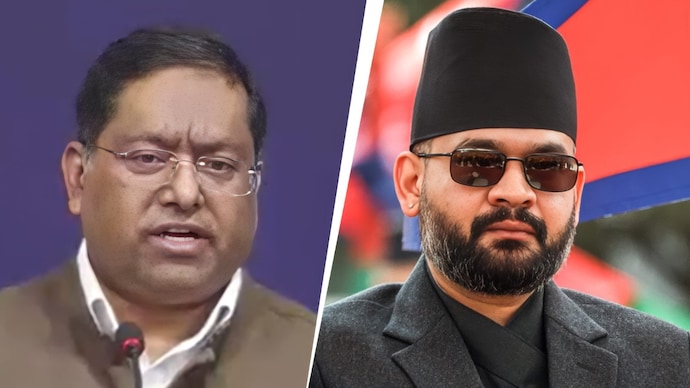
India firmly ruled out any third-party involvement in its border row with Nepal, responding to remarks by Nepal Prime Minister Balendra Shah that China and the United Kingdom should be brought into discussions over the decades-old issue.
The response from New Delhi came two days after Nepal PM told Parliament that Kathmandu was not only talking to India about the boundary dispute but was also in contact with Beijing and London. New Delhi has been reiterating that all unresolved boundary matters with Nepal must be handled through bilateral channels.
Speaking at a media briefing on Tuesday, External Affairs Ministry spokesperson Randhir Jaiswal said existing mechanisms between the two neighbours were sufficient to address all outstanding issues.
INDIA REJECTS THIRD-PARTY ROLE
"We have established bilateral mechanisms to deal with all aspects of boundary matters. It should be clear to all concerned that there is no role for any third parties in a bilateral matter between India and Nepal," Randhir Jaiswal said.
He added that India had taken note of both the Nepal PM's comments and the statement later issued by Nepal's Foreign Ministry on the matter. The remarks marked one of New Delhi's strongest responses to recent calls from Kathmandu for international involvement in the dispute.
During his address to Parliament on Sunday, Balendra Shah argued that Britain should have a role because the roots of the boundary issue date back to the colonial era.
"Since this problem dates from the time when British India left the region, it is our view that England should be involved in this matter," he said.
INDIA, NEPAL DIFFER ON TERRITORIAL CLAIMS
The dispute primarily concerns the Lipulekh, Limpiyadhura and Kalapani regions along the western sector of the India-Nepal border. Nepal claims the territories belong to it, while India maintains that all three areas are part of the state of Uttarakhand.
The MEA spokesperson noted that most of the boundary between India and Nepal has already been settled.
"While close to 98 per cent of the India-Nepal boundary has been demarcated, there are some unresolved segments. The shifting of the course of the Gandak river has resulted in this situation," he said.
Jaiswal also pointed to issues beyond the disputed territories, saying both sides were jointly examining cases involving occupation and encroachment along already demarcated sections of the border.
"In addition, there are cases of cross-border occupation and encroachment of No-Man's land in demarcated segments of the boundary which are currently being mapped jointly," he said.
One of the more notable aspects of Shah's parliamentary remarks was his acknowledgement that encroachment concerns were not one-sided. He admitted that Nepal had also "encroached" on Indian territory, which triggered a backlash inside Nepal.
India firmly ruled out any third-party involvement in its border row with Nepal, responding to remarks by Nepal Prime Minister Balendra Shah that China and the United Kingdom should be brought into discussions over the decades-old issue.
The response from New Delhi came two days after Nepal PM told Parliament that Kathmandu was not only talking to India about the boundary dispute but was also in contact with Beijing and London. New Delhi has been reiterating that all unresolved boundary matters with Nepal must be handled through bilateral channels.
Speaking at a media briefing on Tuesday, External Affairs Ministry spokesperson Randhir Jaiswal said existing mechanisms between the two neighbours were sufficient to address all outstanding issues.
INDIA REJECTS THIRD-PARTY ROLE
"We have established bilateral mechanisms to deal with all aspects of boundary matters. It should be clear to all concerned that there is no role for any third parties in a bilateral matter between India and Nepal," Randhir Jaiswal said.
He added that India had taken note of both the Nepal PM's comments and the statement later issued by Nepal's Foreign Ministry on the matter. The remarks marked one of New Delhi's strongest responses to recent calls from Kathmandu for international involvement in the dispute.
During his address to Parliament on Sunday, Balendra Shah argued that Britain should have a role because the roots of the boundary issue date back to the colonial era.
"Since this problem dates from the time when British India left the region, it is our view that England should be involved in this matter," he said.
INDIA, NEPAL DIFFER ON TERRITORIAL CLAIMS
The dispute primarily concerns the Lipulekh, Limpiyadhura and Kalapani regions along the western sector of the India-Nepal border. Nepal claims the territories belong to it, while India maintains that all three areas are part of the state of Uttarakhand.
The MEA spokesperson noted that most of the boundary between India and Nepal has already been settled.
"While close to 98 per cent of the India-Nepal boundary has been demarcated, there are some unresolved segments. The shifting of the course of the Gandak river has resulted in this situation," he said.
Jaiswal also pointed to issues beyond the disputed territories, saying both sides were jointly examining cases involving occupation and encroachment along already demarcated sections of the border.
"In addition, there are cases of cross-border occupation and encroachment of No-Man's land in demarcated segments of the boundary which are currently being mapped jointly," he said.
One of the more notable aspects of Shah's parliamentary remarks was his acknowledgement that encroachment concerns were not one-sided. He admitted that Nepal had also "encroached" on Indian territory, which triggered a backlash inside Nepal.

