Mohammad Irfan, not Dipke, is rare find from CJP protest: Unheard voice of young India
At the CJP protest at Jantar Mantar, hawker Mohammad Irfan stunned The Lallantop's Rajat Pandey with his remarks on democracy, dignity and labour rights. The focus then turned to his life in a Delhi slum and how the unlettered 35-year-old used Google voice command to inform himself on the Constitution, democracy and labour rights.
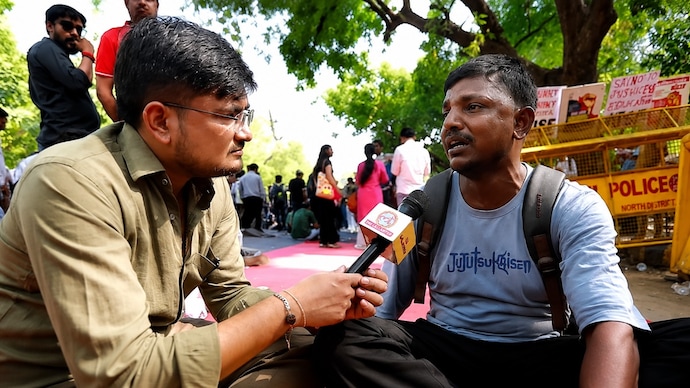
By the time Mohammad Irfan stopped speaking, Rajat Pandey had goosebumps. The journalist from The Lallantop was covering the Cockroach Janta Party's (CJP's) protest at New Delhi's Jantar Mantar expecting another day of slogans, speeches and political theatre. Instead, amid the distressed crowd after the crackdown by security forces on July 20, a youth in a blue T-shirt walked up to him and quietly changed the story.
"I literally had goosebumps while he was speaking," Pandey told India Today Digital. "People often make ideological arguments. But when Irfan spoke, there was no performance. He had lived every word he was saying. That's why he never fumbled while speaking," he added.
"This was the best interview of my career," said Pandey of The Lallantop, India Today Digital's sister media outlet.
The internet also agreed with Rajat Pandey's feelings. Everyone who watched Irfan's interview ended emotional and surprised.
What people found exceptional was that Mohammad Irfan never went to school. The unlettered, 35-year-old hawker from a slum in Delhi gathered all the knowledge from Google, interacting through its voice search. Not just clarity on matters of democracy and labour rights, Irfan recited verses from Bhagat Singh's poems too.
Within hours, clips of Mohammad Irfan speaking on democracy, dignity, labour rights and India's education system exploded across social media. The man who had never entered a classroom was suddenly explaining the Constitution with a clarity that left journalists, politicians and millions online stunned.
The CJP movement might have found its mascot in Abhijeet Dipke, the CJP that was formed as a satirical online phenomenon, but the movement's most enduring discovery might well be Mohammad Irfan, a daily wage hawker from Delhi's Sawda JJ Colony who unknowingly became the conscience of a protest that was never about him.
Such has been Mohammad Irfan's popularity that on Monday evening, Rahul Gandhi, the Leader of the Opposition in the Lok Sabha, visited him. Rahul Gandhi made him talk to his sister and fellow MP Priyanka Gandhi on the phone and invited him to Parliament, Irfan told The Lallantop on Monday evening.
LIFE OF MOHAMMAD IRFAN BEYOND JANTAR MANTAR PROTEST SITE
The Lallantop team, after Irfan's interview blew up on social media, travelled to Sawda JJ Colony as Pandey insisted that Irfan's story did not end at Jantar Mantar.
The house they found was little more than an unfinished structure. There was no proper ceiling. Parts of the building remained incomplete. Before the journalists arrived, Irfan sprayed perfume inside because, as he explained with embarrassment, the smell from the animals could otherwise overwhelm the guests.
The first thing that strikes most viewers about Irfan's home is not poverty. It is how poverty has been normalised.
This is where the internet's newest political philosopher returns every evening after selling ice to earn around "Rs 500 a day".
"I earn Rs 500 a day. If there's a medical emergency, who will be responsible? How can someone study? How can someone wear clean clothes while earning only Rs 500 a day?" Irfan questioned with slight tears in his eyes.
His question was never rhetorical. For Irfan, it is daily arithmetic he has been living in for years. He was just sharing his lived experiences in a way that magically entwined with the nation's hopes, aspirations and failures.
MOHAMMAD IRFAN'S FIGHT FOR LABOUR RIGHTS
Irfan repeatedly insisted that he never went to Jantar Mantar to become famous. He went because, in his view, nobody speaks for India's blue-collared labour force.
"Nobody talks about the labour force and their misery," he told The Lallantop. "Labourers don't hit the streets because if they miss one day's work, they lose one day's income."
Irfan also speaks about the labour laws and the exploitation of poor workers with surprising fluency. He said that Rs 18,000 was the minimum wage a labourer should be paid for an eight-hour shift.
"The labour laws are no longer strict. People are made to work for 12 to 14 hours and receive salaries of only Rs 12,000 or Rs 13,000. With this inflation, workers are not being paid according to their hard work," he said. "People can't even protest because there is always someone to replace them at that wage," he said, explaining the predicament.
Irfan also revealed that he had been taking part in several protests, including Rahul Gandhi's Bharat Jodo Yatra in 2024. "I travelled from Delhi to Kashmir in Rahul Gandhi's Padayatra," Irfan said. On being asked if he had participated in any other Rahul-led protest, he answered in the negative.
The internet was mighty impressed by a man with no formal education articulating questions about wages, inflation, labour rights and also talking about direct and indirect taxes.
IRFAN STUDIED ABOUT DEMOCRACY AND CONSTITUTION ON GOOGLE
The most extraordinary part of Irfan's story is not what he says but how he learned to say it. He has not even completed primary school. He cannot type on a smartphone. "I just went to an anganwadi centre in my slum and received very basic education. I can't read or write," he confessed.
Instead, he revealed that he uses voice command on Google for his research.
His university, he jokes, is Google, YouTube and the internet. It was through videos and online searches that he says he understood the Constitution, democracy and public policy.
His now-famous remarks reflected exactly that self-taught education.
"In a democracy there should not be arrogance," he told The Lallantop at Jantar Mantar. "There should be dialogue, and the doors to dialogue should remain open from both sides [the government and the protesters]," said Irfan. Just to remind our readers, the interview was conducted after the police crackdown on July 20.
Referring to activist Sonam Wangchuk's hunger strike, Irfan said, "If this government had simply come with coconut water... The UPA government had offered coconut water to Anna Hazare... The British offered it to Mahatma Gandhi. This government too could have chosen the path of dialogue."
Then Irfan invoked the Constitution.
"The Constitution speaks about safeguarding the dignity of every individual and ensuring the unity and integrity of the nation. A person's dignity should never be allowed to fall," he said.
Those words, spoken with conviction without notes or prepared remarks, travelled across millions of mobile screens.
THE LESSON OF GST BY IRFAN AT JANTAR MANTAR
In The Lallantop interview, Irfan also made a powerful statement: "Just having a full stomach is not life."
What he meant was that disposable income was needed for bettering lives. "Even if someone earns Rs 500 a day, you still collect GST. There are direct taxes and indirect taxes," he said.
His point was not about taxation alone. It was about dignity. Irfan believes poverty is measured not only by income but also by whether people can educate their children, dress with self-respect and survive emergencies.
JAB RAHUL GANDHI MET MOHAMMAD IRFAN
The viral clips of Irfan made sound in the power corridors. Rahul Gandhi visited Irfan's place and invited him and his family to Parliament for a further meeting.
A glimpse of Irfan's humility emerged when Rahul Gandhi's security personnel prevented The Lallantop's Rajat Pandey from entering his house. Irfan immediately intervened, requesting them, "Please allow Rajat bhai inside. I'm nothing without him."
During their interaction, Irfan said that Rahul Gandhi connected him with Priyanka Gandhi by phone. "I told Priyanka Gandhi about the problems faced by labourers," Irfan told The Lallantop later on Monday.
"I told Rahul Gandhi that I didn't want anything personally, and I requested him to just fight for the labourers and poor people of this country," Irfan added.
Political movements often produce new politicians. But very few produce authentic voices.
The CJP protest will likely be remembered for forcing the resignation of Union Education Minister Dharmendra Pradhan after weeks of demonstrations. Abhijeet Dipke became its organiser, Sonam Wangchuk its moral face and Gen Z its unmistakable energy.
But amid the chants, placards and political symbolism emerged someone who belonged to none of those categories. Mohammad Irfan is not a student leader. He is not an activist or a politician. He is a labourer who never went to school, cannot type on his phone and earns Rs 500 a day selling ice.
Yet, in a movement dominated by educated students and social media influencers, it was his words that cut through the noise. Perhaps that is because Irfan was never speaking about ideology. He was speaking about survival. And in doing so, he became the unexpected voice of a generation that works the hardest, earns least, and is never heard.
By the time Mohammad Irfan stopped speaking, Rajat Pandey had goosebumps. The journalist from The Lallantop was covering the Cockroach Janta Party's (CJP's) protest at New Delhi's Jantar Mantar expecting another day of slogans, speeches and political theatre. Instead, amid the distressed crowd after the crackdown by security forces on July 20, a youth in a blue T-shirt walked up to him and quietly changed the story.
"I literally had goosebumps while he was speaking," Pandey told India Today Digital. "People often make ideological arguments. But when Irfan spoke, there was no performance. He had lived every word he was saying. That's why he never fumbled while speaking," he added.
"This was the best interview of my career," said Pandey of The Lallantop, India Today Digital's sister media outlet.
The internet also agreed with Rajat Pandey's feelings. Everyone who watched Irfan's interview ended emotional and surprised.
What people found exceptional was that Mohammad Irfan never went to school. The unlettered, 35-year-old hawker from a slum in Delhi gathered all the knowledge from Google, interacting through its voice search. Not just clarity on matters of democracy and labour rights, Irfan recited verses from Bhagat Singh's poems too.
Within hours, clips of Mohammad Irfan speaking on democracy, dignity, labour rights and India's education system exploded across social media. The man who had never entered a classroom was suddenly explaining the Constitution with a clarity that left journalists, politicians and millions online stunned.
The CJP movement might have found its mascot in Abhijeet Dipke, the CJP that was formed as a satirical online phenomenon, but the movement's most enduring discovery might well be Mohammad Irfan, a daily wage hawker from Delhi's Sawda JJ Colony who unknowingly became the conscience of a protest that was never about him.
Such has been Mohammad Irfan's popularity that on Monday evening, Rahul Gandhi, the Leader of the Opposition in the Lok Sabha, visited him. Rahul Gandhi made him talk to his sister and fellow MP Priyanka Gandhi on the phone and invited him to Parliament, Irfan told The Lallantop on Monday evening.
LIFE OF MOHAMMAD IRFAN BEYOND JANTAR MANTAR PROTEST SITE
The Lallantop team, after Irfan's interview blew up on social media, travelled to Sawda JJ Colony as Pandey insisted that Irfan's story did not end at Jantar Mantar.
The house they found was little more than an unfinished structure. There was no proper ceiling. Parts of the building remained incomplete. Before the journalists arrived, Irfan sprayed perfume inside because, as he explained with embarrassment, the smell from the animals could otherwise overwhelm the guests.
The first thing that strikes most viewers about Irfan's home is not poverty. It is how poverty has been normalised.
This is where the internet's newest political philosopher returns every evening after selling ice to earn around "Rs 500 a day".
"I earn Rs 500 a day. If there's a medical emergency, who will be responsible? How can someone study? How can someone wear clean clothes while earning only Rs 500 a day?" Irfan questioned with slight tears in his eyes.
His question was never rhetorical. For Irfan, it is daily arithmetic he has been living in for years. He was just sharing his lived experiences in a way that magically entwined with the nation's hopes, aspirations and failures.
MOHAMMAD IRFAN'S FIGHT FOR LABOUR RIGHTS
Irfan repeatedly insisted that he never went to Jantar Mantar to become famous. He went because, in his view, nobody speaks for India's blue-collared labour force.
"Nobody talks about the labour force and their misery," he told The Lallantop. "Labourers don't hit the streets because if they miss one day's work, they lose one day's income."
Irfan also speaks about the labour laws and the exploitation of poor workers with surprising fluency. He said that Rs 18,000 was the minimum wage a labourer should be paid for an eight-hour shift.
"The labour laws are no longer strict. People are made to work for 12 to 14 hours and receive salaries of only Rs 12,000 or Rs 13,000. With this inflation, workers are not being paid according to their hard work," he said. "People can't even protest because there is always someone to replace them at that wage," he said, explaining the predicament.
Irfan also revealed that he had been taking part in several protests, including Rahul Gandhi's Bharat Jodo Yatra in 2024. "I travelled from Delhi to Kashmir in Rahul Gandhi's Padayatra," Irfan said. On being asked if he had participated in any other Rahul-led protest, he answered in the negative.
The internet was mighty impressed by a man with no formal education articulating questions about wages, inflation, labour rights and also talking about direct and indirect taxes.
IRFAN STUDIED ABOUT DEMOCRACY AND CONSTITUTION ON GOOGLE
The most extraordinary part of Irfan's story is not what he says but how he learned to say it. He has not even completed primary school. He cannot type on a smartphone. "I just went to an anganwadi centre in my slum and received very basic education. I can't read or write," he confessed.
Instead, he revealed that he uses voice command on Google for his research.
His university, he jokes, is Google, YouTube and the internet. It was through videos and online searches that he says he understood the Constitution, democracy and public policy.
His now-famous remarks reflected exactly that self-taught education.
"In a democracy there should not be arrogance," he told The Lallantop at Jantar Mantar. "There should be dialogue, and the doors to dialogue should remain open from both sides [the government and the protesters]," said Irfan. Just to remind our readers, the interview was conducted after the police crackdown on July 20.
Referring to activist Sonam Wangchuk's hunger strike, Irfan said, "If this government had simply come with coconut water... The UPA government had offered coconut water to Anna Hazare... The British offered it to Mahatma Gandhi. This government too could have chosen the path of dialogue."
Then Irfan invoked the Constitution.
"The Constitution speaks about safeguarding the dignity of every individual and ensuring the unity and integrity of the nation. A person's dignity should never be allowed to fall," he said.
Those words, spoken with conviction without notes or prepared remarks, travelled across millions of mobile screens.
THE LESSON OF GST BY IRFAN AT JANTAR MANTAR
In The Lallantop interview, Irfan also made a powerful statement: "Just having a full stomach is not life."
What he meant was that disposable income was needed for bettering lives. "Even if someone earns Rs 500 a day, you still collect GST. There are direct taxes and indirect taxes," he said.
His point was not about taxation alone. It was about dignity. Irfan believes poverty is measured not only by income but also by whether people can educate their children, dress with self-respect and survive emergencies.
JAB RAHUL GANDHI MET MOHAMMAD IRFAN
The viral clips of Irfan made sound in the power corridors. Rahul Gandhi visited Irfan's place and invited him and his family to Parliament for a further meeting.
A glimpse of Irfan's humility emerged when Rahul Gandhi's security personnel prevented The Lallantop's Rajat Pandey from entering his house. Irfan immediately intervened, requesting them, "Please allow Rajat bhai inside. I'm nothing without him."
During their interaction, Irfan said that Rahul Gandhi connected him with Priyanka Gandhi by phone. "I told Priyanka Gandhi about the problems faced by labourers," Irfan told The Lallantop later on Monday.
"I told Rahul Gandhi that I didn't want anything personally, and I requested him to just fight for the labourers and poor people of this country," Irfan added.
Political movements often produce new politicians. But very few produce authentic voices.
The CJP protest will likely be remembered for forcing the resignation of Union Education Minister Dharmendra Pradhan after weeks of demonstrations. Abhijeet Dipke became its organiser, Sonam Wangchuk its moral face and Gen Z its unmistakable energy.
But amid the chants, placards and political symbolism emerged someone who belonged to none of those categories. Mohammad Irfan is not a student leader. He is not an activist or a politician. He is a labourer who never went to school, cannot type on his phone and earns Rs 500 a day selling ice.
Yet, in a movement dominated by educated students and social media influencers, it was his words that cut through the noise. Perhaps that is because Irfan was never speaking about ideology. He was speaking about survival. And in doing so, he became the unexpected voice of a generation that works the hardest, earns least, and is never heard.
By the time Mohammad Irfan stopped speaking, Rajat Pandey had goosebumps. The journalist from The Lallantop was covering the Cockroach Janta Party's (CJP's) protest at New Delhi's Jantar Mantar expecting another day of slogans, speeches and political theatre. Instead, amid the distressed crowd after the crackdown by security forces on July 20, a youth in a blue T-shirt walked up to him and quietly changed the story.
"I literally had goosebumps while he was speaking," Pandey told India Today Digital. "People often make ideological arguments. But when Irfan spoke, there was no performance. He had lived every word he was saying. That's why he never fumbled while speaking," he added.
"This was the best interview of my career," said Pandey of The Lallantop, India Today Digital's sister media outlet.
The internet also agreed with Rajat Pandey's feelings. Everyone who watched Irfan's interview ended emotional and surprised.
What people found exceptional was that Mohammad Irfan never went to school. The unlettered, 35-year-old hawker from a slum in Delhi gathered all the knowledge from Google, interacting through its voice search. Not just clarity on matters of democracy and labour rights, Irfan recited verses from Bhagat Singh's poems too.
Within hours, clips of Mohammad Irfan speaking on democracy, dignity, labour rights and India's education system exploded across social media. The man who had never entered a classroom was suddenly explaining the Constitution with a clarity that left journalists, politicians and millions online stunned.
The CJP movement might have found its mascot in Abhijeet Dipke, the CJP that was formed as a satirical online phenomenon, but the movement's most enduring discovery might well be Mohammad Irfan, a daily wage hawker from Delhi's Sawda JJ Colony who unknowingly became the conscience of a protest that was never about him.
Such has been Mohammad Irfan's popularity that on Monday evening, Rahul Gandhi, the Leader of the Opposition in the Lok Sabha, visited him. Rahul Gandhi made him talk to his sister and fellow MP Priyanka Gandhi on the phone and invited him to Parliament, Irfan told The Lallantop on Monday evening.
LIFE OF MOHAMMAD IRFAN BEYOND JANTAR MANTAR PROTEST SITE
The Lallantop team, after Irfan's interview blew up on social media, travelled to Sawda JJ Colony as Pandey insisted that Irfan's story did not end at Jantar Mantar.
The house they found was little more than an unfinished structure. There was no proper ceiling. Parts of the building remained incomplete. Before the journalists arrived, Irfan sprayed perfume inside because, as he explained with embarrassment, the smell from the animals could otherwise overwhelm the guests.
The first thing that strikes most viewers about Irfan's home is not poverty. It is how poverty has been normalised.
This is where the internet's newest political philosopher returns every evening after selling ice to earn around "Rs 500 a day".
"I earn Rs 500 a day. If there's a medical emergency, who will be responsible? How can someone study? How can someone wear clean clothes while earning only Rs 500 a day?" Irfan questioned with slight tears in his eyes.
His question was never rhetorical. For Irfan, it is daily arithmetic he has been living in for years. He was just sharing his lived experiences in a way that magically entwined with the nation's hopes, aspirations and failures.
MOHAMMAD IRFAN'S FIGHT FOR LABOUR RIGHTS
Irfan repeatedly insisted that he never went to Jantar Mantar to become famous. He went because, in his view, nobody speaks for India's blue-collared labour force.
"Nobody talks about the labour force and their misery," he told The Lallantop. "Labourers don't hit the streets because if they miss one day's work, they lose one day's income."
Irfan also speaks about the labour laws and the exploitation of poor workers with surprising fluency. He said that Rs 18,000 was the minimum wage a labourer should be paid for an eight-hour shift.
"The labour laws are no longer strict. People are made to work for 12 to 14 hours and receive salaries of only Rs 12,000 or Rs 13,000. With this inflation, workers are not being paid according to their hard work," he said. "People can't even protest because there is always someone to replace them at that wage," he said, explaining the predicament.
Irfan also revealed that he had been taking part in several protests, including Rahul Gandhi's Bharat Jodo Yatra in 2024. "I travelled from Delhi to Kashmir in Rahul Gandhi's Padayatra," Irfan said. On being asked if he had participated in any other Rahul-led protest, he answered in the negative.
The internet was mighty impressed by a man with no formal education articulating questions about wages, inflation, labour rights and also talking about direct and indirect taxes.
IRFAN STUDIED ABOUT DEMOCRACY AND CONSTITUTION ON GOOGLE
The most extraordinary part of Irfan's story is not what he says but how he learned to say it. He has not even completed primary school. He cannot type on a smartphone. "I just went to an anganwadi centre in my slum and received very basic education. I can't read or write," he confessed.
Instead, he revealed that he uses voice command on Google for his research.
His university, he jokes, is Google, YouTube and the internet. It was through videos and online searches that he says he understood the Constitution, democracy and public policy.
His now-famous remarks reflected exactly that self-taught education.
"In a democracy there should not be arrogance," he told The Lallantop at Jantar Mantar. "There should be dialogue, and the doors to dialogue should remain open from both sides [the government and the protesters]," said Irfan. Just to remind our readers, the interview was conducted after the police crackdown on July 20.
Referring to activist Sonam Wangchuk's hunger strike, Irfan said, "If this government had simply come with coconut water... The UPA government had offered coconut water to Anna Hazare... The British offered it to Mahatma Gandhi. This government too could have chosen the path of dialogue."
Then Irfan invoked the Constitution.
"The Constitution speaks about safeguarding the dignity of every individual and ensuring the unity and integrity of the nation. A person's dignity should never be allowed to fall," he said.
Those words, spoken with conviction without notes or prepared remarks, travelled across millions of mobile screens.
THE LESSON OF GST BY IRFAN AT JANTAR MANTAR
In The Lallantop interview, Irfan also made a powerful statement: "Just having a full stomach is not life."
What he meant was that disposable income was needed for bettering lives. "Even if someone earns Rs 500 a day, you still collect GST. There are direct taxes and indirect taxes," he said.
His point was not about taxation alone. It was about dignity. Irfan believes poverty is measured not only by income but also by whether people can educate their children, dress with self-respect and survive emergencies.
JAB RAHUL GANDHI MET MOHAMMAD IRFAN
The viral clips of Irfan made sound in the power corridors. Rahul Gandhi visited Irfan's place and invited him and his family to Parliament for a further meeting.
A glimpse of Irfan's humility emerged when Rahul Gandhi's security personnel prevented The Lallantop's Rajat Pandey from entering his house. Irfan immediately intervened, requesting them, "Please allow Rajat bhai inside. I'm nothing without him."
During their interaction, Irfan said that Rahul Gandhi connected him with Priyanka Gandhi by phone. "I told Priyanka Gandhi about the problems faced by labourers," Irfan told The Lallantop later on Monday.
"I told Rahul Gandhi that I didn't want anything personally, and I requested him to just fight for the labourers and poor people of this country," Irfan added.
Political movements often produce new politicians. But very few produce authentic voices.
The CJP protest will likely be remembered for forcing the resignation of Union Education Minister Dharmendra Pradhan after weeks of demonstrations. Abhijeet Dipke became its organiser, Sonam Wangchuk its moral face and Gen Z its unmistakable energy.
But amid the chants, placards and political symbolism emerged someone who belonged to none of those categories. Mohammad Irfan is not a student leader. He is not an activist or a politician. He is a labourer who never went to school, cannot type on his phone and earns Rs 500 a day selling ice.
Yet, in a movement dominated by educated students and social media influencers, it was his words that cut through the noise. Perhaps that is because Irfan was never speaking about ideology. He was speaking about survival. And in doing so, he became the unexpected voice of a generation that works the hardest, earns least, and is never heard.

