How Mysore's Hyder Ali and Tipu Sultan helped America gain Independence
As the US marks 250 years since its Declaration of Independence, here's why Hyder Ali and Tipu Sultan, the rulers of India's Mysore, were admired in America during its war of independence against Britain. This is how the war in Mysore stretched British power, which played a decisive role in the American War of Independence.
"Come, all ye lads who know no fear... Embark in our Hyder-Ally!"
These words were not sung on the streets of Mysore in India. They echoed through Philadelphia during the American War of Independence. Ballads celebrated a warship named after Hyder Ali, public toasts hailed him as a hero, and for many Americans fighting the British Crown for Independence, the ruler of India's Mysore was a symbol of resistance against empire. Even a ship was named after the ruler of Mysore.
As George Washington battled British forces in North America, Hyder Ali and later his son Tipu Sultan were fighting on another front of the same Imperial power. It was thousands of kilometres away from northern America, in southern India. The two never exchanged letters, nor did the state of Mysore send troops to America. But the two theatres became intertwined in Britain's imperial ambitions and France's attempt to humble Britain after the latter's defeat in the Seven Years' War of 1756-1763.
The American Revolution, historians say, was not just an American story. It stretched from the Caribbean and Europe to the Indian peninsula. Britain's East India Company, the same corporation whose tea helped trigger the Boston Tea Party, was simultaneously locked in a costly war against Mysore. French fleets and finances supported both Washington's revolutionaries (or rebels) and Hyder Ali's armies, forcing Britain to fight on multiple fronts at once.
As the United States marks the 250th anniversary of its Declaration of Independence (1776) this weekend, the celebrations offer an opportunity to revisit a largely forgotten chapter from the late eighteenth century. The declaration came in 1776, but the American Revolutionary War (between Britain and its 13 North American colonies) had begun in 1775. Britain’s decisive defeat came in 1781, and American independence was formally recognised only by the Treaty of Paris in 1783. That was a time when the rulers of Mysore, Hyder Ali and Tipu Sultan, were admired across America as comrades in a struggle against British imperial power.
The admiration did not mean Mysore "won" America its independence. The Second Anglo-Mysore War (1780–1784) opened another major front against Britain just as the American Revolutionary War was entering its decisive phase. But historians agree that the simultaneous wars forced Britain to fight on multiple fronts, adding to the pressures that ultimately shaped the outcome of the American Revolution.
DID MYSORE BECOME BRITAIN'S BIGGEST PROBLEM?
By the late 1770s, Imperial Britain had started consolidating power in the Indian subcontinent after the battles at Palassey and Buxar, and taking on other European powers in the region. Imperial Britain was also fighting a few rebellious colonies in northern America. France, on the other hand, had entered the American War of Independence in 1778 against Britain, which transformed it into a global conflict. The war and hostilities spread across Europe, the Caribbean, Africa and Asia. In India, the flashpoint became Mysore.
According to the Museum of the American Revolution's "Revolution Around the World" series, Britain seized the French-controlled port of Mahe in 1779 after France allied with the American colonies. Mahe was then crucial to Hyder Ali, who relied on it for military supplies from France. The British attack prompted Ali to launch the Second Anglo-Mysore War (1780-1784) against the British East India Company.
The French, eager to weaken Britain everywhere it could, dispatched Admiral Pierre Andre de Suffren to support Mysore. Britain suddenly found itself defending an empire stretched across continents, including North America.
Chicago-based historian Blake Smith, in his 2016 piece in Australian news outlet Aeon, noted that George Washington and Hyder Ali "fought against a common enemy, and shared a common ally". France deliberately backed both the American rebels and Mysore as part of a broader strategy to avenge its defeat in the Seven Years' War by "stoking colonial rebellions against Britain".
WHEN MYSORE, AMERICANS FOUGHT COMMON ENEMY BRITAIN THOUSANDS OF MILES APART
While there was no military alliance between Washington and Mysore's Hyder Ali, there was a convergence of interests.
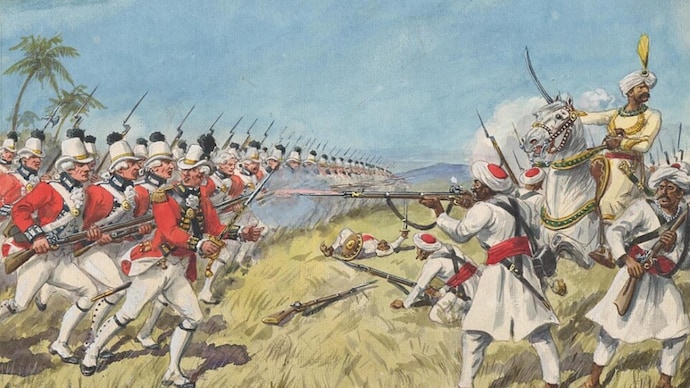
While Washington struggled through Valley Forge before eventually prevailing at Yorktown, Hyder Ali repeatedly challenged the East India Company's expansion in southern India. One of his greatest victories came at the Battle of Pollilur (near present-day Kanchipuram in Tamil Nadu) in 1780, where the forces of Mysore inflicted one of the East India Company's worst defeats. The battle was part of the Second Anglo-Mysore War.
The British suddenly had to divide soldiers, ships, money and political attention between America and India.
American scholar, Richard Sambasivam, in his 2016 piece in the Journal of the American Revolution (JAR), noted that British army commander, Cornwallis's surrender at Yorktown and Hyder Ali's victories in India were celebrated together in New Jersey's Trenton. On October 28, 1781, just days after Yorktown, townspeople raised 13 ceremonial toasts. The eleventh honoured "the great and heroic Hyder Ali... raised up by Providence... to check the insolence and reduce the power of Britain in the East Indies".
For revolutionary Americans, Hyder Ali had become an Indian ruler they hailed. That's because he was Britain's other enemy.
THE AMERICAN SHIP THAT BORE HYDER ALI'S NAME
Perhaps the clearest symbol of that admiration for Hyder Ali's contributions floated off the American coast. In 1781, Pennsylvania commissioned a warship named Hyder Ally, an Anglicised version of Hyder Ali.
American historian Blake Smith noted that the vessel demonstrated the "affinity American elites felt for Mysore's cause". American poet Philip Freneau celebrated it in verse that went...
"From an eastern prince she takes her name,
Who, smit with freedom's sacred flame,
Usurping Britons brought to shame."
The following year, the Hyder Ally defeated the larger British warship General Monk in one of the young American navy's most celebrated victories.
American scholar Sambasivam recounted that the triumph sparked celebrations across Philadelphia. Ballads praising Hyder Ally were echoed along with those of the ship's 23-year-old commander, Commodore Joshua Barney. Pennsylvania later presented Barney with a ceremonial gold-hilted sword depicting both the Hyder Ally and the captured British vessel.
WHY BRITAIN COULDN'T FOCUS ONLY ON AMERICA
Historians have argued that Britain's difficulties in America cannot be understood without looking at the imperial conflicts it was involved in across the globe.
The Museum of the American Revolution, on its website, notes that the war in India demonstrated how European rivalries produced global consequences of drawing Indian powers into conflicts that extended beyond the Atlantic.
In a 2021 analysis, Karnataka-based scholar Ameen Ahmed argued that Britain's struggle against Mysore forced it to rethink its priorities. Around one-fifth of the Royal Navy's ships of the line operated in the Indian theatre, where Admiral Suffern's French fleet challenged British dominance. This limited Britain's ability to concentrate resources elsewhere, including North America.
The argument is not that Mysore alone decided America's Independence. But it stretched Imperial Britain's war efforts and made them expensive and messy.
THE EAST INDIA COMPANY CONNECTED BOSTON TO BENGAL
However, the connection between American Independence and India had begun even before the shooting started in the wars in the present-day US.
The Boston Tea Party in December 1773, itself revolved around tea sold by the East India Company, the same corporation which was expanding the British footprint in India.
Writing in The Boston Globe in 2023, Johns Hopkins historian Sarah Pearsall argued that the story of the American Revolution "had its roots in Bengal, among other places". She noted that many American colonists viewed the East India Company as a symbol of imperial overreach after witnessing reports of its conduct in India.
"The American Revolution involved people far beyond our borders in all kinds of ways... It was international from the beginning," Pearsall wrote.
AFTER HYDER ALI, TIPU SULTAN ALSO CAPTURED AMERICAN IMAGINATION
Hyder Ali died in 1782, a year before the Treaty of Paris formally recognised American independence. His son, Tipu Sultan, inherited both the throne of Mysore and the war. American fascination with Mysore did not end with Hyder Ali.
Chicago-based historian Blake Smith noted that newspapers across the young United States frequently reported on Tipu's struggle against Britain. School textbooks included sections on Mysore. Racehorses were named after Hyder Ali. Even court records mention horses named "Hyder Ali", suggesting that the Mysore rulers had become familiar names in early elite American society.
When Tipu was killed defending Srirangapatnam in 1799, some Americans mourned his death.
Smith cited a Fourth of July sermon delivered in 1800 by Baptist minister John Russell. He described Tipu as a ruler who "defended his power with a spirit which showed he deserved it. His death was worthy of a king".
But that admiration proved short-lived. It was a casualty of shifting geopolitics and realpolitik. After its independence, American merchants sought access to Indian markets controlled by the very British East India Company that it and Mysore had fought. Washington's administration opened consulates in Company territory rather than establishing relations with independent Indian kingdoms, who were fighting against Imperialist Britain. America shifted to building an expanding republic of its own.
As Blake Smith wrote, "Within a generation, Americans lost their sense of solidarity with the Indian Subcontinent," as Mysore and its rulers were gradually "written out of the story of the American Revolution". So, to conclude, Washington did not win alone. Nor did Hyder Ali or Tipu Sultan fight for American independence. But they forced Britain into a war whose consequences shaped the journeys of the world's two democracies, India and the United States.
"Come, all ye lads who know no fear... Embark in our Hyder-Ally!"
These words were not sung on the streets of Mysore in India. They echoed through Philadelphia during the American War of Independence. Ballads celebrated a warship named after Hyder Ali, public toasts hailed him as a hero, and for many Americans fighting the British Crown for Independence, the ruler of India's Mysore was a symbol of resistance against empire. Even a ship was named after the ruler of Mysore.
As George Washington battled British forces in North America, Hyder Ali and later his son Tipu Sultan were fighting on another front of the same Imperial power. It was thousands of kilometres away from northern America, in southern India. The two never exchanged letters, nor did the state of Mysore send troops to America. But the two theatres became intertwined in Britain's imperial ambitions and France's attempt to humble Britain after the latter's defeat in the Seven Years' War of 1756-1763.
The American Revolution, historians say, was not just an American story. It stretched from the Caribbean and Europe to the Indian peninsula. Britain's East India Company, the same corporation whose tea helped trigger the Boston Tea Party, was simultaneously locked in a costly war against Mysore. French fleets and finances supported both Washington's revolutionaries (or rebels) and Hyder Ali's armies, forcing Britain to fight on multiple fronts at once.
As the United States marks the 250th anniversary of its Declaration of Independence (1776) this weekend, the celebrations offer an opportunity to revisit a largely forgotten chapter from the late eighteenth century. The declaration came in 1776, but the American Revolutionary War (between Britain and its 13 North American colonies) had begun in 1775. Britain’s decisive defeat came in 1781, and American independence was formally recognised only by the Treaty of Paris in 1783. That was a time when the rulers of Mysore, Hyder Ali and Tipu Sultan, were admired across America as comrades in a struggle against British imperial power.
The admiration did not mean Mysore "won" America its independence. The Second Anglo-Mysore War (1780–1784) opened another major front against Britain just as the American Revolutionary War was entering its decisive phase. But historians agree that the simultaneous wars forced Britain to fight on multiple fronts, adding to the pressures that ultimately shaped the outcome of the American Revolution.
DID MYSORE BECOME BRITAIN'S BIGGEST PROBLEM?
By the late 1770s, Imperial Britain had started consolidating power in the Indian subcontinent after the battles at Palassey and Buxar, and taking on other European powers in the region. Imperial Britain was also fighting a few rebellious colonies in northern America. France, on the other hand, had entered the American War of Independence in 1778 against Britain, which transformed it into a global conflict. The war and hostilities spread across Europe, the Caribbean, Africa and Asia. In India, the flashpoint became Mysore.
According to the Museum of the American Revolution's "Revolution Around the World" series, Britain seized the French-controlled port of Mahe in 1779 after France allied with the American colonies. Mahe was then crucial to Hyder Ali, who relied on it for military supplies from France. The British attack prompted Ali to launch the Second Anglo-Mysore War (1780-1784) against the British East India Company.
The French, eager to weaken Britain everywhere it could, dispatched Admiral Pierre Andre de Suffren to support Mysore. Britain suddenly found itself defending an empire stretched across continents, including North America.
Chicago-based historian Blake Smith, in his 2016 piece in Australian news outlet Aeon, noted that George Washington and Hyder Ali "fought against a common enemy, and shared a common ally". France deliberately backed both the American rebels and Mysore as part of a broader strategy to avenge its defeat in the Seven Years' War by "stoking colonial rebellions against Britain".
WHEN MYSORE, AMERICANS FOUGHT COMMON ENEMY BRITAIN THOUSANDS OF MILES APART
While there was no military alliance between Washington and Mysore's Hyder Ali, there was a convergence of interests.
While Washington struggled through Valley Forge before eventually prevailing at Yorktown, Hyder Ali repeatedly challenged the East India Company's expansion in southern India. One of his greatest victories came at the Battle of Pollilur (near present-day Kanchipuram in Tamil Nadu) in 1780, where the forces of Mysore inflicted one of the East India Company's worst defeats. The battle was part of the Second Anglo-Mysore War.
The British suddenly had to divide soldiers, ships, money and political attention between America and India.
American scholar, Richard Sambasivam, in his 2016 piece in the Journal of the American Revolution (JAR), noted that British army commander, Cornwallis's surrender at Yorktown and Hyder Ali's victories in India were celebrated together in New Jersey's Trenton. On October 28, 1781, just days after Yorktown, townspeople raised 13 ceremonial toasts. The eleventh honoured "the great and heroic Hyder Ali... raised up by Providence... to check the insolence and reduce the power of Britain in the East Indies".
For revolutionary Americans, Hyder Ali had become an Indian ruler they hailed. That's because he was Britain's other enemy.
THE AMERICAN SHIP THAT BORE HYDER ALI'S NAME
Perhaps the clearest symbol of that admiration for Hyder Ali's contributions floated off the American coast. In 1781, Pennsylvania commissioned a warship named Hyder Ally, an Anglicised version of Hyder Ali.
American historian Blake Smith noted that the vessel demonstrated the "affinity American elites felt for Mysore's cause". American poet Philip Freneau celebrated it in verse that went...
"From an eastern prince she takes her name,
Who, smit with freedom's sacred flame,
Usurping Britons brought to shame."
The following year, the Hyder Ally defeated the larger British warship General Monk in one of the young American navy's most celebrated victories.
American scholar Sambasivam recounted that the triumph sparked celebrations across Philadelphia. Ballads praising Hyder Ally were echoed along with those of the ship's 23-year-old commander, Commodore Joshua Barney. Pennsylvania later presented Barney with a ceremonial gold-hilted sword depicting both the Hyder Ally and the captured British vessel.
WHY BRITAIN COULDN'T FOCUS ONLY ON AMERICA
Historians have argued that Britain's difficulties in America cannot be understood without looking at the imperial conflicts it was involved in across the globe.
The Museum of the American Revolution, on its website, notes that the war in India demonstrated how European rivalries produced global consequences of drawing Indian powers into conflicts that extended beyond the Atlantic.
In a 2021 analysis, Karnataka-based scholar Ameen Ahmed argued that Britain's struggle against Mysore forced it to rethink its priorities. Around one-fifth of the Royal Navy's ships of the line operated in the Indian theatre, where Admiral Suffern's French fleet challenged British dominance. This limited Britain's ability to concentrate resources elsewhere, including North America.
The argument is not that Mysore alone decided America's Independence. But it stretched Imperial Britain's war efforts and made them expensive and messy.
THE EAST INDIA COMPANY CONNECTED BOSTON TO BENGAL
However, the connection between American Independence and India had begun even before the shooting started in the wars in the present-day US.
The Boston Tea Party in December 1773, itself revolved around tea sold by the East India Company, the same corporation which was expanding the British footprint in India.
Writing in The Boston Globe in 2023, Johns Hopkins historian Sarah Pearsall argued that the story of the American Revolution "had its roots in Bengal, among other places". She noted that many American colonists viewed the East India Company as a symbol of imperial overreach after witnessing reports of its conduct in India.
"The American Revolution involved people far beyond our borders in all kinds of ways... It was international from the beginning," Pearsall wrote.
AFTER HYDER ALI, TIPU SULTAN ALSO CAPTURED AMERICAN IMAGINATION
Hyder Ali died in 1782, a year before the Treaty of Paris formally recognised American independence. His son, Tipu Sultan, inherited both the throne of Mysore and the war. American fascination with Mysore did not end with Hyder Ali.
Chicago-based historian Blake Smith noted that newspapers across the young United States frequently reported on Tipu's struggle against Britain. School textbooks included sections on Mysore. Racehorses were named after Hyder Ali. Even court records mention horses named "Hyder Ali", suggesting that the Mysore rulers had become familiar names in early elite American society.
When Tipu was killed defending Srirangapatnam in 1799, some Americans mourned his death.
Smith cited a Fourth of July sermon delivered in 1800 by Baptist minister John Russell. He described Tipu as a ruler who "defended his power with a spirit which showed he deserved it. His death was worthy of a king".
But that admiration proved short-lived. It was a casualty of shifting geopolitics and realpolitik. After its independence, American merchants sought access to Indian markets controlled by the very British East India Company that it and Mysore had fought. Washington's administration opened consulates in Company territory rather than establishing relations with independent Indian kingdoms, who were fighting against Imperialist Britain. America shifted to building an expanding republic of its own.
As Blake Smith wrote, "Within a generation, Americans lost their sense of solidarity with the Indian Subcontinent," as Mysore and its rulers were gradually "written out of the story of the American Revolution". So, to conclude, Washington did not win alone. Nor did Hyder Ali or Tipu Sultan fight for American independence. But they forced Britain into a war whose consequences shaped the journeys of the world's two democracies, India and the United States.

