Rs 100 in 2000 vs 2026: How much could you buy at a general store?
A simple trip to the kirana store tells the story of inflation better than any economic report. Here's how much rice, wheat, milk and other essentials Rs 100 could buy in 2000 compared to 2026.
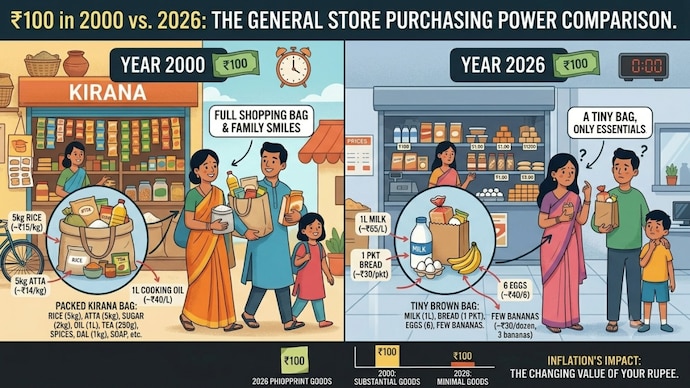
Ask anyone who shopped at a neighbourhood kirana store in the early 2000s and they will probably tell you the same thing, Rs 100 went a long way. It could buy several kilograms of rice, enough wheat for a family, litres of milk and a handful of other daily essentials.
Fast forward to 2026 and the picture looks very different. According to inflation calculations, India has recorded an average inflation rate of around 5.9 per cent annually between 2000 and 2026. Over that period, prices have risen by about 344 per cent.
In simple terms, something that cost Rs 100 in 2000 would require around Rs 444 today.
That explains why many households feel that money disappears much faster than it used to, even though incomes have increased over the years.
WHAT RS 100 BOUGHT AT A KIRANA STORE IN 2000
Back in 2000, a single Rs 100 note could buy substantial quantities of basic food items. Government data from the period paints a striking picture of how affordable everyday groceries were.
GENERAL STORE PRICES IN 2000
For many families, Rs 100 could cover a large share of their weekly grocery requirements. Essentials such as wheat, rice and vegetables were available at prices that seem almost unbelievable today.
WHAT RS 100 BUYS IN 2026
Today, the same Rs 100 note tells a very different story. Rising food prices mean shoppers take home far smaller quantities of the same products.
GENERAL STORE PRICES IN 2026
The difference is impossible to miss. The quantity of goods that Rs 100 can buy today is only a fraction of what shoppers could purchase in 2000.
WHICH ITEMS SAW THE BIGGEST PRICE JUMP?
Some products have become nearly four to five times more expensive over the last 26 years.
PRICE INCREASE COMPARISON
Sugar, wheat and milk are among the items that have seen some of the sharpest increases. While tea and onions have also become costlier, their rise has been relatively lower compared to staples such as wheat and sugar.
THE REAL IMPACT ON HOUSEHOLDS
Numbers alone do not always tell the full story. The easiest way to understand inflation is to look at what Rs 100 could actually buy.
In 2000, Rs 100 could buy around 8.3 kg of rice, 14.3 kg of wheat or more than seven litres of milk.
In 2026, the same amount buys only 2.3 kg of rice, 3.2 kg of wheat or about 1.65 litres of milk.
That means today's Rs 100 delivers only around 22.5 per cent of the purchasing power it had in 2000.
WHY EVERY SHOPPING TRIP FEELS MORE EXPENSIVE
Most people do not track inflation reports, but they notice the effect every time they visit a grocery store. Essentials that once formed the backbone of a modest household budget now consume a much larger share of monthly spending.
A family that spent Rs 500 on groceries in 2000 would need roughly Rs 2,220 or more today to buy a similar basket of goods. While salaries and incomes have grown over the years, so have expenses related to food, housing, healthcare, education and transport.
ALSO READ: Metro vs car vs cab: Which is cheapest for daily commute?
The story of Rs 100 is really the story of how India's cost of living has changed. A note that once filled a shopping bag now covers only a handful of essentials.
For younger shoppers, these figures offer a glimpse into how different everyday life looked in 2000. For older generations, they explain why so many people still talk about the days when Rs 100 felt like real money.
Ask anyone who shopped at a neighbourhood kirana store in the early 2000s and they will probably tell you the same thing, Rs 100 went a long way. It could buy several kilograms of rice, enough wheat for a family, litres of milk and a handful of other daily essentials.
Fast forward to 2026 and the picture looks very different. According to inflation calculations, India has recorded an average inflation rate of around 5.9 per cent annually between 2000 and 2026. Over that period, prices have risen by about 344 per cent.
In simple terms, something that cost Rs 100 in 2000 would require around Rs 444 today.
That explains why many households feel that money disappears much faster than it used to, even though incomes have increased over the years.
WHAT RS 100 BOUGHT AT A KIRANA STORE IN 2000
Back in 2000, a single Rs 100 note could buy substantial quantities of basic food items. Government data from the period paints a striking picture of how affordable everyday groceries were.
GENERAL STORE PRICES IN 2000
For many families, Rs 100 could cover a large share of their weekly grocery requirements. Essentials such as wheat, rice and vegetables were available at prices that seem almost unbelievable today.
WHAT RS 100 BUYS IN 2026
Today, the same Rs 100 note tells a very different story. Rising food prices mean shoppers take home far smaller quantities of the same products.
GENERAL STORE PRICES IN 2026
The difference is impossible to miss. The quantity of goods that Rs 100 can buy today is only a fraction of what shoppers could purchase in 2000.
WHICH ITEMS SAW THE BIGGEST PRICE JUMP?
Some products have become nearly four to five times more expensive over the last 26 years.
PRICE INCREASE COMPARISON
Sugar, wheat and milk are among the items that have seen some of the sharpest increases. While tea and onions have also become costlier, their rise has been relatively lower compared to staples such as wheat and sugar.
THE REAL IMPACT ON HOUSEHOLDS
Numbers alone do not always tell the full story. The easiest way to understand inflation is to look at what Rs 100 could actually buy.
In 2000, Rs 100 could buy around 8.3 kg of rice, 14.3 kg of wheat or more than seven litres of milk.
In 2026, the same amount buys only 2.3 kg of rice, 3.2 kg of wheat or about 1.65 litres of milk.
That means today's Rs 100 delivers only around 22.5 per cent of the purchasing power it had in 2000.
WHY EVERY SHOPPING TRIP FEELS MORE EXPENSIVE
Most people do not track inflation reports, but they notice the effect every time they visit a grocery store. Essentials that once formed the backbone of a modest household budget now consume a much larger share of monthly spending.
A family that spent Rs 500 on groceries in 2000 would need roughly Rs 2,220 or more today to buy a similar basket of goods. While salaries and incomes have grown over the years, so have expenses related to food, housing, healthcare, education and transport.
ALSO READ: Metro vs car vs cab: Which is cheapest for daily commute?
The story of Rs 100 is really the story of how India's cost of living has changed. A note that once filled a shopping bag now covers only a handful of essentials.
For younger shoppers, these figures offer a glimpse into how different everyday life looked in 2000. For older generations, they explain why so many people still talk about the days when Rs 100 felt like real money.

