IAS vs IIT: Why sarkari naukri still tops India's marriage market
In modern India, wealth may come from startups and global careers, but social prestige still often follows a different path. That's why the IAS officer remains the gold standard in the marriage market and the enduring symbol of the 'sarkari naukri' dream.
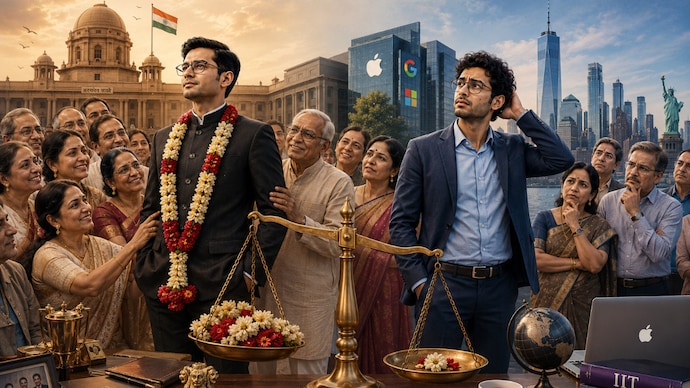
In India's marriage market, where status often matters as much as compatibility, one rivalry refuses to fade: IAS versus IIT.
"Boy kya karta hai?" (What does the boy do?)
"IIT se padha hai." (He graduated from IIT.)
"Achha hai... lekin sarkari naukri hai kya?" (That's good... but does he have a government job?)
The question is usually asked with a laugh.
The answer, however, is often taken very seriously.
For generations across Uttar Pradesh, Bihar and much of northern India, few achievements have carried more social weight than a sarkari naukri. The IT boom created millionaires. Startups created billionaires. Silicon Valley became a dream destination. Yet in many households, a government job remains the most coveted badge of success.
Ask any middle-class family what success looks like, and two dreams have traditionally stood above all others: crack the IITs or become a Collector.
One promises intellectual prestige, global mobility and wealth.
The other promises authority, influence and social standing.
Yet when marriage negotiations begin, the hierarchy often becomes clear.
The IIT graduate working in Manhattan, London or Silicon Valley may be admired.
The IAS officer is desired.
The humour struck a chord because it touched a cultural truth many Indians instinctively recognise.
WHAT MAKES THE IAS MORE THAN JUST A JOB?
An IAS officer is not merely seen as a salaried professional.
In many parts of India, the district magistrate or collector is the most visible face of the state. The position carries administrative authority, public recognition and decision-making power that few private-sector roles can match.
Parents do not just see a profession; they see status.
As executive search expert Ashish Dhawan, Managing Partner at NGS Global, says, "The Indian marriage market often works on a logic that would puzzle any economist."
Dhawan notes that once someone clears UPSC and becomes an IAS officer, he acquires something that no MBA, IIT degree or overseas salary can easily replicate: authority.
"He has a government residence, official staff, security, influence over public policy, and control over budgets running into hundreds or even thousands of crores. For many families, that combination of prestige, power and permanence is matrimonial gold," he adds.
That distinction matters.
An IIT graduate may build products used by millions.
An IAS officer may sign files that affect millions.
SCARCITY CREATES PRESTIGE
Part of the IAS aura comes from just how difficult it is to enter the service.
Every year, around 9–10 lakh candidates apply for the UPSC Civil Services Examination, but only a tiny fraction secure a place in the country's most coveted services.
Last year, 958 candidates were recommended for appointment to the IAS, IPS, IFS and other central services, while the 2026 examination was notified for about 1,000 vacancies, highlighting the intensely competitive and highly selective nature of the process.
The final success rate works out to roughly 0.1% to 0.2% of applicants, making it one of the world's most competitive examinations.
Compare that with IITs.
The IIT brand remains enormously respected, but the scale has changed. According to government data, more than 25,000 students graduated from India's IITs in 2022-23 alone, while the intake of IITs continues to expand.
In other words, there are thousands of IIT graduates every year.
There are only a few hundred new IAS officers.
Scarcity creates prestige.
And prestige drives demand.
DOES SOCIAL POWER MATTER MORE THAN SALARY?
On paper, the comparison seems unfair.
A software engineer in New York, Seattle or Bengaluru can earn compensation packages running into crores. Senior executives, founders and investors often earn many times more than civil servants.
Yet marriage markets rarely operate on salary alone. Families evaluate social capital alongside financial capital.
Dhawan captures the contrast neatly and says, "Mehra Ji's son may be building the AI platform that powers the future, while Sharma Ji's son is deciding where the new highway, hospital or industrial park will be built. One creates technology; the other exercises authority."
That authority is visible.
An IAS officer comes with official accommodation, staff support, government networks and a designation that commands instant recognition almost anywhere in India.
A corporate career, however successful, is often viewed as dependent on markets, employers and economic cycles. For many parents, certainty beats possibility.
HAS THE 'SARKARI NAUKRI' MINDSET REALLY CHANGED?
Urban India often likes to believe it has moved beyond its obsession with government jobs.
Reality is more nuanced.
The rise of technology, global migration and entrepreneurship has undoubtedly broadened definitions of success. Yet in many towns and semi-urban regions, government employment remains the gold standard.
The reasons are familiar: job security, social respect, predictability and institutional power.
A startup founder may become a billionaire.
An IAS officer may never become unemployed.
That difference carries weight in matrimonial calculations.
ARE FAMILIES CHOOSING THE PERSON OR THE DESIGNATION?
Marriage in India has traditionally been a union of families rather than merely individuals.
As a result, professions are often evaluated through the lens of family prestige.
An IAS officer enhances a family's social standing in ways that are immediately visible. Networks expand. Access increases. Influence grows.
The prestige is transferable. An IIT degree, meanwhile, is often viewed as a personal achievement.
The respect belongs primarily to the individual.
The IAS designation belongs to both the individual and, symbolically, the family. That distinction quietly shapes preferences.
WHY DOES LOCATION CHANGE EQUATION?
Ask families in Mumbai, Bengaluru, Hyderabad or Gurgaon and the rankings may look very different.
In India's corporate hubs, founders, investment bankers, doctors, private-equity professionals and global executives often compete closely with civil servants in the marriage market.
But in states where government institutions remain the most visible symbols of authority and upward mobility, the IAS continues to occupy a unique pedestal.
The marriage market reflects local aspirations.
And in large parts of India, power still speaks louder than wealth.
WHO REALLY WINS?
The answer depends on whom you ask.
Among globally mobile urban families, an IIT graduate with an international career may be every bit as attractive as a civil servant.
But across much of India's traditional matrimonial landscape, the IAS badge still carries a unique appeal.
As Dhawan puts it, "A Silicon Valley salary may buy a penthouse, but an IAS posting still comes with something many Indian families value even more: status, influence and the feeling that 'hamara damaad collector hai' (Our son-in-law is a District Collector)."
The software engineer in Manhattan may earn more.
The district collector may still command greater social prestige.
And perhaps that explains why, despite India's embrace of technology and global careers, one old belief refuses to fade:
Nothing beats a sarkari naukri!
In India's marriage market, where status often matters as much as compatibility, one rivalry refuses to fade: IAS versus IIT.
"Boy kya karta hai?" (What does the boy do?)
"IIT se padha hai." (He graduated from IIT.)
"Achha hai... lekin sarkari naukri hai kya?" (That's good... but does he have a government job?)
The question is usually asked with a laugh.
The answer, however, is often taken very seriously.
For generations across Uttar Pradesh, Bihar and much of northern India, few achievements have carried more social weight than a sarkari naukri. The IT boom created millionaires. Startups created billionaires. Silicon Valley became a dream destination. Yet in many households, a government job remains the most coveted badge of success.
Ask any middle-class family what success looks like, and two dreams have traditionally stood above all others: crack the IITs or become a Collector.
One promises intellectual prestige, global mobility and wealth.
The other promises authority, influence and social standing.
Yet when marriage negotiations begin, the hierarchy often becomes clear.
The IIT graduate working in Manhattan, London or Silicon Valley may be admired.
The IAS officer is desired.
The humour struck a chord because it touched a cultural truth many Indians instinctively recognise.
WHAT MAKES THE IAS MORE THAN JUST A JOB?
An IAS officer is not merely seen as a salaried professional.
In many parts of India, the district magistrate or collector is the most visible face of the state. The position carries administrative authority, public recognition and decision-making power that few private-sector roles can match.
Parents do not just see a profession; they see status.
As executive search expert Ashish Dhawan, Managing Partner at NGS Global, says, "The Indian marriage market often works on a logic that would puzzle any economist."
Dhawan notes that once someone clears UPSC and becomes an IAS officer, he acquires something that no MBA, IIT degree or overseas salary can easily replicate: authority.
"He has a government residence, official staff, security, influence over public policy, and control over budgets running into hundreds or even thousands of crores. For many families, that combination of prestige, power and permanence is matrimonial gold," he adds.
That distinction matters.
An IIT graduate may build products used by millions.
An IAS officer may sign files that affect millions.
SCARCITY CREATES PRESTIGE
Part of the IAS aura comes from just how difficult it is to enter the service.
Every year, around 9–10 lakh candidates apply for the UPSC Civil Services Examination, but only a tiny fraction secure a place in the country's most coveted services.
Last year, 958 candidates were recommended for appointment to the IAS, IPS, IFS and other central services, while the 2026 examination was notified for about 1,000 vacancies, highlighting the intensely competitive and highly selective nature of the process.
The final success rate works out to roughly 0.1% to 0.2% of applicants, making it one of the world's most competitive examinations.
Compare that with IITs.
The IIT brand remains enormously respected, but the scale has changed. According to government data, more than 25,000 students graduated from India's IITs in 2022-23 alone, while the intake of IITs continues to expand.
In other words, there are thousands of IIT graduates every year.
There are only a few hundred new IAS officers.
Scarcity creates prestige.
And prestige drives demand.
DOES SOCIAL POWER MATTER MORE THAN SALARY?
On paper, the comparison seems unfair.
A software engineer in New York, Seattle or Bengaluru can earn compensation packages running into crores. Senior executives, founders and investors often earn many times more than civil servants.
Yet marriage markets rarely operate on salary alone. Families evaluate social capital alongside financial capital.
Dhawan captures the contrast neatly and says, "Mehra Ji's son may be building the AI platform that powers the future, while Sharma Ji's son is deciding where the new highway, hospital or industrial park will be built. One creates technology; the other exercises authority."
That authority is visible.
An IAS officer comes with official accommodation, staff support, government networks and a designation that commands instant recognition almost anywhere in India.
A corporate career, however successful, is often viewed as dependent on markets, employers and economic cycles. For many parents, certainty beats possibility.
HAS THE 'SARKARI NAUKRI' MINDSET REALLY CHANGED?
Urban India often likes to believe it has moved beyond its obsession with government jobs.
Reality is more nuanced.
The rise of technology, global migration and entrepreneurship has undoubtedly broadened definitions of success. Yet in many towns and semi-urban regions, government employment remains the gold standard.
The reasons are familiar: job security, social respect, predictability and institutional power.
A startup founder may become a billionaire.
An IAS officer may never become unemployed.
That difference carries weight in matrimonial calculations.
ARE FAMILIES CHOOSING THE PERSON OR THE DESIGNATION?
Marriage in India has traditionally been a union of families rather than merely individuals.
As a result, professions are often evaluated through the lens of family prestige.
An IAS officer enhances a family's social standing in ways that are immediately visible. Networks expand. Access increases. Influence grows.
The prestige is transferable. An IIT degree, meanwhile, is often viewed as a personal achievement.
The respect belongs primarily to the individual.
The IAS designation belongs to both the individual and, symbolically, the family. That distinction quietly shapes preferences.
WHY DOES LOCATION CHANGE EQUATION?
Ask families in Mumbai, Bengaluru, Hyderabad or Gurgaon and the rankings may look very different.
In India's corporate hubs, founders, investment bankers, doctors, private-equity professionals and global executives often compete closely with civil servants in the marriage market.
But in states where government institutions remain the most visible symbols of authority and upward mobility, the IAS continues to occupy a unique pedestal.
The marriage market reflects local aspirations.
And in large parts of India, power still speaks louder than wealth.
WHO REALLY WINS?
The answer depends on whom you ask.
Among globally mobile urban families, an IIT graduate with an international career may be every bit as attractive as a civil servant.
But across much of India's traditional matrimonial landscape, the IAS badge still carries a unique appeal.
As Dhawan puts it, "A Silicon Valley salary may buy a penthouse, but an IAS posting still comes with something many Indian families value even more: status, influence and the feeling that 'hamara damaad collector hai' (Our son-in-law is a District Collector)."
The software engineer in Manhattan may earn more.
The district collector may still command greater social prestige.
And perhaps that explains why, despite India's embrace of technology and global careers, one old belief refuses to fade:
Nothing beats a sarkari naukri!

