AI needs human teachers and Indian homemakers are stepping up
Indian homemakers are earning up to Rs. 250 an hour by recording everyday chores such as cooking, cleaning, and washing dishes to help train AI-powered robots. As tech companies seek real-world human behaviour data, ordinary household routines are becoming valuable lessons for machines, creating new income opportunities across smaller Indian cities.
Who would pay 250 an hour for sweeping, mopping, cooking, or washing dishes in their own home? At first glance, the idea sounds absurd. Yet across India, particularly in smaller towns and cities, hundreds of homemakers are earning money doing exactly that. Their daily household routines are not just chores anymore; they are becoming lessons for some of the world's most advanced robots.
It may sound like the plot of a science-fiction film, but a recent ground report by Deutsche Welle (DW) has highlighted this surprising side of the global AI revolution. Ordinary Indian homemakers are emerging as unlikely contributors to cutting-edge technology, helping train robots by simply performing everyday tasks.
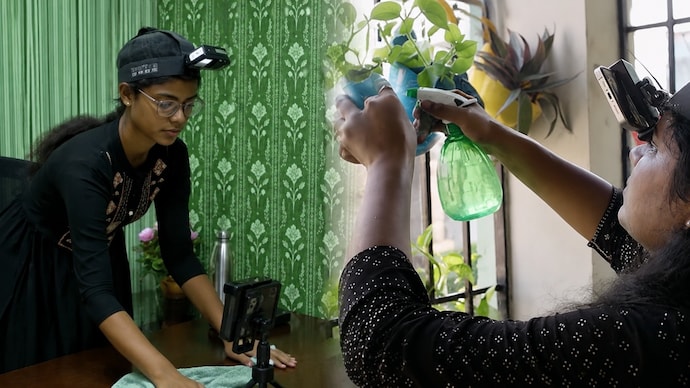
Armed with smartphones and cameras strapped to their heads, these women record themselves carrying out routine activities such as cooking meals, washing clothes, chopping vegetables, cleaning utensils, and tidying their homes. The footage is then used by technology companies to teach robots how humans interact with the physical world, enabling machines to replicate human actions more naturally and efficiently.
FROM HOUSEHOLD CHORES TO HIGH-TECH TRAINING
One of the homemakers featured in the DW report, Ramya Chandra, explains that the work requires far more patience than it appears. A kitchen task that would normally take 30 minutes can stretch to 35 or 40 minutes when recorded according to strict guidelines. Cameras must capture movements accurately, and every action needs to be performed carefully to ensure the data is useful for robot training.
The extra effort, however, comes with a financial reward. Participants can earn up to 250 per hour, an attractive source of income, particularly for women seeking flexible work opportunities from home.
Behind the scenes, the process is remarkably sophisticated. According to the report, each recording centre or studio produces more than 90 videos every day. To prevent robots from associating a task with only one environment, backgrounds are regularly changed. A participant might perform a task while seated one day, standing the next, and in a completely different location on another occasion. The goal is to expose robots to as many variations of human behaviour as possible.
WHY ROBOTS STILL NEED HUMANS
Every movement captured on camera, whether it involves handling utensils, folding clothes, or using household tools, helps build a vast library of examples that robots can learn from. In the technology industry, this process is often referred to as robotic learning through video demonstrations.
Perhaps the most fascinating aspect of this emerging industry is that robots cannot fully teach themselves. No matter how quickly artificial intelligence advances, machines still depend on humans for practical, real-world knowledge. Everyday actions that people perform without thinking become valuable lessons for AI systems trying to understand the physical world.
In a country where employment opportunities remain a constant concern, this growing demand for video data has created an unexpected source of income. For many women and young people in Tier-2 and Tier-3 cities, the AI boom is no longer a distant technological phenomenon.
It is arriving directly in their kitchens and living rooms, transforming ordinary household routines into an entirely new kind of work, and making them the hidden teachers behind the next generation of intelligent robots.
ANOTHER SIDE OF THE STORY
Yet the story is not entirely one of opportunity. The rise of this new form of work also raises important questions about the future relationship between humans and machines.
What appears to be routine documentation today could become valuable training data for tomorrow's automation systems. That is where much of the unease stems from. Many workers may not fully understand how the data being collected from them could be be used in the future.
The concern extends beyond the presence of cameras in homes and recording studios to the possibilities those recordings may unlock. If machines can learn household and manual tasks quickly enough, could they eventually perform the same work that humans do today?
The ethical questions are equally significant. Are participants being clearly informed about why they are being recorded and how the footage will be used? Do they have the right to opt out? If their labour is helping to develop technologies that could generate substantial future profits, should they receive a share of the benefits?
These concerns become even more pressing when the workers involved have limited bargaining power or little understanding of how AI systems are built.
For many observers, the debate ultimately comes down to fairness. The concern is that workers may unknowingly be helping create technologies that could one day reduce the demand for human labour in the very tasks they are teaching machines to perform. As AI continues to advance, the challenge will be ensuring that the people providing the knowledge behind these systems are not left behind by the technologies they helped create.
Who would pay 250 an hour for sweeping, mopping, cooking, or washing dishes in their own home? At first glance, the idea sounds absurd. Yet across India, particularly in smaller towns and cities, hundreds of homemakers are earning money doing exactly that. Their daily household routines are not just chores anymore; they are becoming lessons for some of the world's most advanced robots.
It may sound like the plot of a science-fiction film, but a recent ground report by Deutsche Welle (DW) has highlighted this surprising side of the global AI revolution. Ordinary Indian homemakers are emerging as unlikely contributors to cutting-edge technology, helping train robots by simply performing everyday tasks.
Armed with smartphones and cameras strapped to their heads, these women record themselves carrying out routine activities such as cooking meals, washing clothes, chopping vegetables, cleaning utensils, and tidying their homes. The footage is then used by technology companies to teach robots how humans interact with the physical world, enabling machines to replicate human actions more naturally and efficiently.
FROM HOUSEHOLD CHORES TO HIGH-TECH TRAINING
One of the homemakers featured in the DW report, Ramya Chandra, explains that the work requires far more patience than it appears. A kitchen task that would normally take 30 minutes can stretch to 35 or 40 minutes when recorded according to strict guidelines. Cameras must capture movements accurately, and every action needs to be performed carefully to ensure the data is useful for robot training.
The extra effort, however, comes with a financial reward. Participants can earn up to 250 per hour, an attractive source of income, particularly for women seeking flexible work opportunities from home.
Behind the scenes, the process is remarkably sophisticated. According to the report, each recording centre or studio produces more than 90 videos every day. To prevent robots from associating a task with only one environment, backgrounds are regularly changed. A participant might perform a task while seated one day, standing the next, and in a completely different location on another occasion. The goal is to expose robots to as many variations of human behaviour as possible.
WHY ROBOTS STILL NEED HUMANS
Every movement captured on camera, whether it involves handling utensils, folding clothes, or using household tools, helps build a vast library of examples that robots can learn from. In the technology industry, this process is often referred to as robotic learning through video demonstrations.
Perhaps the most fascinating aspect of this emerging industry is that robots cannot fully teach themselves. No matter how quickly artificial intelligence advances, machines still depend on humans for practical, real-world knowledge. Everyday actions that people perform without thinking become valuable lessons for AI systems trying to understand the physical world.
In a country where employment opportunities remain a constant concern, this growing demand for video data has created an unexpected source of income. For many women and young people in Tier-2 and Tier-3 cities, the AI boom is no longer a distant technological phenomenon.
It is arriving directly in their kitchens and living rooms, transforming ordinary household routines into an entirely new kind of work, and making them the hidden teachers behind the next generation of intelligent robots.
ANOTHER SIDE OF THE STORY
Yet the story is not entirely one of opportunity. The rise of this new form of work also raises important questions about the future relationship between humans and machines.
What appears to be routine documentation today could become valuable training data for tomorrow's automation systems. That is where much of the unease stems from. Many workers may not fully understand how the data being collected from them could be be used in the future.
The concern extends beyond the presence of cameras in homes and recording studios to the possibilities those recordings may unlock. If machines can learn household and manual tasks quickly enough, could they eventually perform the same work that humans do today?
The ethical questions are equally significant. Are participants being clearly informed about why they are being recorded and how the footage will be used? Do they have the right to opt out? If their labour is helping to develop technologies that could generate substantial future profits, should they receive a share of the benefits?
These concerns become even more pressing when the workers involved have limited bargaining power or little understanding of how AI systems are built.
For many observers, the debate ultimately comes down to fairness. The concern is that workers may unknowingly be helping create technologies that could one day reduce the demand for human labour in the very tasks they are teaching machines to perform. As AI continues to advance, the challenge will be ensuring that the people providing the knowledge behind these systems are not left behind by the technologies they helped create.

