Meet the botsitters, the employees cleaning up after AI
Welcome to the age of the botsitter. AI may be producing the first draft, but humans remain responsible for the final word. As long as machines can't fully be trusted to monitor themselves, every smart system will require someone behind the scenes checking the results.
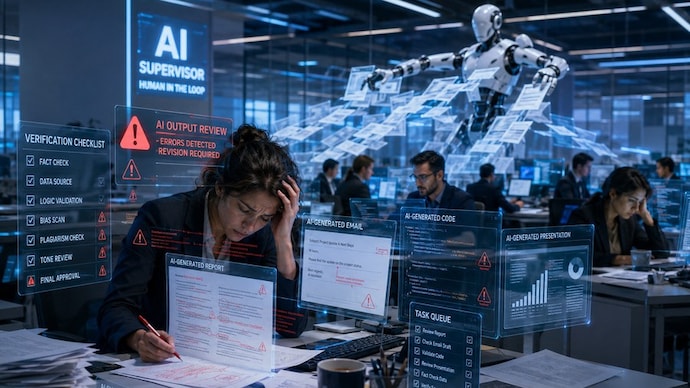
AI was supposed to eliminate busywork. Instead, it may have created a new kind of it. Every day, millions of employees spend time checking whether the AI got it right. They review chatbot responses, fix factual errors, rewrite awkward copy, and verify machine-generated reports before they can be sent to clients, colleagues, or customers.
The technology promised to save time and free workers for more meaningful tasks. Instead, many are finding themselves in an unexpected new role: supervising the machines.
The phenomenon has become so common that it now has a name -- "botsitting."
According to a new report by Glean's Work AI Institute, employees spend an average of 6.4 hours a week monitoring, reviewing, and correcting AI systems. The finding challenges one of the biggest assumptions of the AI boom: that automation automatically means less work. In many workplaces, the burden hasn't disappeared.
It has simply shifted from doing the work to checking the work.
Based on a survey of 6,000 digital workers across the US, UK and Australia, the report found that while 75% of employees believe AI makes them more productive, only 13 percent say it has significantly improved organisational performance. Researchers describe this disconnect as the "AI productivity paradox," where individual efficiency gains fail to translate into measurable business outcomes.
Behind every seemingly intelligent AI system is still a human making sure it doesn't make a costly mistake.
THE INVISIBLE WORK OF AI
The promise of AI was simple, automate routine tasks, so humans could focus on creativity, strategy, and decision-making. But reality has proven more complicated.
Today, professionals often find themselves acting as proofreaders, fact-checkers, and supervisors for AI-generated work. Reports, presentations, code, emails, and content may be produced faster than ever, but they still require human scrutiny before they can be trusted.
"AI does not eliminate work; it changes the nature of work," says Ravi Kaklasaria, Co-Founder and CEO of edForce. As enterprises move from experimentation to large-scale deployment, oversight, validation, and governance are becoming critical capabilities. According to Kaklasaria, organisations are increasingly investing not only in AI tools but also in training employees to manage them responsibly.
FROM CREATORS TO CURATORS?
For many workers, the shift is subtle but significant. Instead of creating from scratch, they are increasingly editing machine-generated drafts.
Jasvinder Bedi, Managing Partner at Biz Staffing Comrade Pvt Ltd, notes that while AI can generate content, code, and reports in minutes, professionals still spend considerable time reviewing and refining the output. The danger, he warns, is that employees may gradually become supervisors of machine-generated work rather than creators of original ideas.
That concern is echoed by Ashish Dhawan, who argues that AI's biggest limitation is not intelligence but accountability. Machines can generate answers, but they cannot make mistakes. As a result, the responsibility for accuracy ultimately falls back on humans.
"We haven't replaced human effort; we've redistributed it into quality control," he observes.
A NEW SKILL OR A NEW BURDEN?
Not everyone sees botsitting as a problem. Many industry leaders view it as the next stage of workforce evolution.
Sachin Alug, CEO of NLB Services, argues that AI supervision is becoming an essential workplace skill. Employees are increasingly validating outputs, monitoring system behaviour, refining prompts, and ensuring responsible usage, tasks that are critical for successful AI adoption.
Rather than unpaid digital labour, he sees AI oversight as an emerging skill category that organisations must formally recognise through training and governance frameworks.
The numbers appear to support that shift. At edForce, demand for Agentic AI training doubled during FY26, while leadership and AI governance programmes saw a sharp rise, signalling that companies are preparing employees not just to use AI, but to manage it.
THE HUMAN ADVANTAGE
The rise of botsitting reveals a paradox at the heart of the AI revolution. The more capable AI becomes, the more valuable human judgment appears to be.
Speed, automation, and efficiency remain AI's strengths. Context, accountability, critical thinking, and trust remain human responsibilities.
Far from disappearing, human work is being redefined. The office worker of the future may spend less time producing the first draft and more time ensuring the final output is accurate, ethical, and useful.
The age of AI has arrived. But for now, behind every "smart" system is still a human quietly making sure it doesn't fall apart.
AI was supposed to eliminate busywork. Instead, it may have created a new kind of it. Every day, millions of employees spend time checking whether the AI got it right. They review chatbot responses, fix factual errors, rewrite awkward copy, and verify machine-generated reports before they can be sent to clients, colleagues, or customers.
The technology promised to save time and free workers for more meaningful tasks. Instead, many are finding themselves in an unexpected new role: supervising the machines.
The phenomenon has become so common that it now has a name -- "botsitting."
According to a new report by Glean's Work AI Institute, employees spend an average of 6.4 hours a week monitoring, reviewing, and correcting AI systems. The finding challenges one of the biggest assumptions of the AI boom: that automation automatically means less work. In many workplaces, the burden hasn't disappeared.
It has simply shifted from doing the work to checking the work.
Based on a survey of 6,000 digital workers across the US, UK and Australia, the report found that while 75% of employees believe AI makes them more productive, only 13 percent say it has significantly improved organisational performance. Researchers describe this disconnect as the "AI productivity paradox," where individual efficiency gains fail to translate into measurable business outcomes.
Behind every seemingly intelligent AI system is still a human making sure it doesn't make a costly mistake.
THE INVISIBLE WORK OF AI
The promise of AI was simple, automate routine tasks, so humans could focus on creativity, strategy, and decision-making. But reality has proven more complicated.
Today, professionals often find themselves acting as proofreaders, fact-checkers, and supervisors for AI-generated work. Reports, presentations, code, emails, and content may be produced faster than ever, but they still require human scrutiny before they can be trusted.
"AI does not eliminate work; it changes the nature of work," says Ravi Kaklasaria, Co-Founder and CEO of edForce. As enterprises move from experimentation to large-scale deployment, oversight, validation, and governance are becoming critical capabilities. According to Kaklasaria, organisations are increasingly investing not only in AI tools but also in training employees to manage them responsibly.
FROM CREATORS TO CURATORS?
For many workers, the shift is subtle but significant. Instead of creating from scratch, they are increasingly editing machine-generated drafts.
Jasvinder Bedi, Managing Partner at Biz Staffing Comrade Pvt Ltd, notes that while AI can generate content, code, and reports in minutes, professionals still spend considerable time reviewing and refining the output. The danger, he warns, is that employees may gradually become supervisors of machine-generated work rather than creators of original ideas.
That concern is echoed by Ashish Dhawan, who argues that AI's biggest limitation is not intelligence but accountability. Machines can generate answers, but they cannot make mistakes. As a result, the responsibility for accuracy ultimately falls back on humans.
"We haven't replaced human effort; we've redistributed it into quality control," he observes.
A NEW SKILL OR A NEW BURDEN?
Not everyone sees botsitting as a problem. Many industry leaders view it as the next stage of workforce evolution.
Sachin Alug, CEO of NLB Services, argues that AI supervision is becoming an essential workplace skill. Employees are increasingly validating outputs, monitoring system behaviour, refining prompts, and ensuring responsible usage, tasks that are critical for successful AI adoption.
Rather than unpaid digital labour, he sees AI oversight as an emerging skill category that organisations must formally recognise through training and governance frameworks.
The numbers appear to support that shift. At edForce, demand for Agentic AI training doubled during FY26, while leadership and AI governance programmes saw a sharp rise, signalling that companies are preparing employees not just to use AI, but to manage it.
THE HUMAN ADVANTAGE
The rise of botsitting reveals a paradox at the heart of the AI revolution. The more capable AI becomes, the more valuable human judgment appears to be.
Speed, automation, and efficiency remain AI's strengths. Context, accountability, critical thinking, and trust remain human responsibilities.
Far from disappearing, human work is being redefined. The office worker of the future may spend less time producing the first draft and more time ensuring the final output is accurate, ethical, and useful.
The age of AI has arrived. But for now, behind every "smart" system is still a human quietly making sure it doesn't fall apart.

