In Panipat: How the world's textile trash gets a second life
Every day, tonnes of textile waste from India and around the world arrive in Panipat. We travelled there to see how the city weaves a new life from discarded textiles.
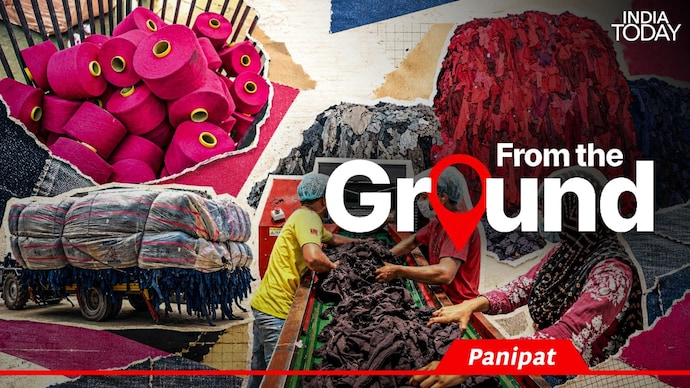
When you are in Panipat, giant trucks piled high with clothes are a common sight. Every few minutes, you see another one pass by. Some carry heaps of second-hand garments, others carry factory scraps. Different kinds of textile waste, but all in staggering quantities.
These trucks offer only a glimpse of Panipat's massive recycling industry. Every single day, nearly 3,000 tonnes of textile waste arrives in the city. Over a year, it processes around one million tonnes of discarded textiles from across the globe.
The numbers are hard to grasp until you step inside one of the warehouses where these trucks unload. Under the dimly lit godowns stand mountains of clothing stretching as far as the eye can see. Surrounded by these towering piles, you suddenly feel like a speck of dust. And this is just one warehouse. There are hundreds more across Panipat, each packed with discarded garments waiting to be given a new life.
This is also when the scale of the fast-fashion problem really hits you. You realise these aren't just heaps of fabric. They are a snapshot of how much clothing the world throws away. These heaps also remind you of what Panipat does every day. If this city wasn't recycling them, much of this waste would end up in landfills.
Maybe that pair of denim jeans you donated to an NGO months ago, or that distressed T-shirt you threw in the bin, could end up in Panipat too.
Every day, second-hand clothing, factory scraps and textile waste arrive here from across India and around the world. What happens next is what sets Panipat apart.
Through a vast network of warehouses, sorting units and recycling factories, discarded textiles are transformed into recycled fibres and yarn before finding their way back into international and domestic markets as blankets, carpets, clothing and home furnishings. Basically, it is circular fashion in action every single day.
International brands such as H&M, Zara and IKEA also rely on this ecosystem to recycle textile waste and meet their sustainability goals.
To understand how this works, we travelled to Panipat and followed the journey of discarded textiles through the city's recycling ecosystem, from the moment they arrive to the point they are transformed into new products.
The process begins with the arrival of textile waste. It broadly falls into two categories. The first is pre-consumer waste, which includes factory offcuts, fabric scraps and rejected materials that never reached the market. The second is post-consumer waste, which includes clothing and other textiles that have been used and discarded by consumers.
Both kinds of waste come from India as well as abroad.
Imported consignments arrive through ports such as Kandla and Mundra in Gujarat before making their way to the city. The bales contain everything from woollen winterwear and cotton T-shirts to denims and innerwear.
As for domestic textile waste, it mostly comes from some of India's largest textile manufacturing clusters, such as Tiruppur, Ludhiana and Surat. Domestic post-consumer waste is sourced through NGOs and local collection networks. Then there is also a growing number of donate-to-recycle programmes that encourage people to divert unwanted clothes away from landfills. Respun, a textile recycling company in Panipat, is one of them.
"People in India don't throw away their clothes easily. They wear them for years, then pass them on to someone else or use them as dusters. In richer countries, people may wear a garment just once or twice before donating it or throwing it away," said the caretaker of a sorting unit.
The massive sorting houses
Sorting houses are the first stop for clothes whose stories have ended but are about to begin a new life in Panipat.
The scale of these sorting warehouses is overwhelming. Many of them are tucked behind the famous Barsat Road - the market from where shopping hubs like Delhi's Sarojini Nagar buy second-hand clothing.
Inside these units, workers spend eight to nine hours a day sitting amid (and atop) the mountains of garments. Their job is to sort every piece by hand - by colour, fibre, quality and end use.
Garments that are still wearable are separated and sold in bulk to second-hand markets. The rest are packed onto trucks and sent to recycling mills.
This is what the clothes look like after sorting:
This colour-based sorting serves a larger purpose. It helps eliminate the need for dyeing and bleaching - one of the most polluting stages of textile manufacturing - which requires large amounts of chemicals and water. Wastewater from dyeing units, left untreated, is often discharged directly into drains, contaminating nearby water bodies.
To curb this pollution, the Haryana State Pollution Control Board (HSPCB) sealed 132 illegal bleach houses in Panipat over the last 10 years, according to a reply obtained under the Right to Information (RTI) Act. Despite this, many illegal bleaching units continue to operate on agricultural land in villages around Panipat.
Ironically, the process that helps reduce the need for dyeing and bleaching also begins in a much less organised part of the industry. Industry professionals describe sorting as a "Tier 4" activity, carried out mostly by small, unorganised units that depend almost entirely on manual labour.
The work is painstaking. Every garment has to be checked by hand. Buttons, zips and tags are manually removed before the fabric can move to the next stage of recycling.
The pay is meagre, and the working conditions are often harsh. During summer, the tin-roofed sorting units become unbearably hot. With little ventilation and limited use of electrical appliances, workers rely on a handful of pedestal fans for relief as they spend long hours amid towering piles of discarded clothing.
AI, by the way, could soon transform Panipat's sorting scene.
"We are developing AI-based automated sorting systems. Over the next six to seven months, we plan to introduce conveyor belt systems equipped with AI to sort textiles on a much larger scale," said Harshit Kakkar of HSN ECOTEX spinning mill, adding that the technology is intended to assist workers rather than replace them. Unlike the largely informal sorting units across Panipat, HSN ECOTEX has an organised, in-house sorting process.
Inside a spinning mill
Once sorted, the piles are loaded onto trucks and sent to spinning mills across the city.
On our way to the H.R, we passed truck after truck carrying neatly segregated loads. One was filled entirely with white garments. Another carried only black fabric scraps.
The mill we visited processes both pre-consumer factory scraps and post-consumer clothing. Spread across two acres, it employs around 150 people. It also runs on solar power, and almost every bit of textile that enters the facility finds a use, making the recycling process nearly zero waste.
"We have a specialised waste collection system that captures even the fine fibres and lint generated during the recycling process. Even this waste is collected and supplied to cardboard manufacturers," said Kakkar.
Once sorted, the fabric waste is fed into large shredding machines that cut it into small, rectangular pieces. The process is only partly mechanised. Workers manually feed the fabric into the machines and collect the shredded pieces at the other end.
The workers then use their hawk eyes to check the shredded pieces for contamination. In this case, contamination refers to anything that doesn't belong, such as stray fibres of a different colour, leftover pieces of another fabric or any other material that could affect the quality of the recycled fibre. Even a small amount of contamination can alter the colour and consistency of the final product, so workers inspect every batch and remove it by hand.
These fragments are then passed through massive recycling machines that carefully open up the fabric, separating it back into loose fibres. Within minutes, what started as discarded T-shirts, jeans or sweaters is transformed into soft recycled fibre that closely resembles raw cotton.
A few minutes inside a textile recycling unit is enough to leave your clothes covered in fine fibres. Workers wear masks and head coverings, particularly in the shredding and processing sections, where fine fibres and textile dust are generated. The mill also uses a centralised fibre collection system that continuously sucks up airborne lint and textile dust.
The recycled fibres are then compressed into bales before moving to the spinning section. Here, they pass through a series of cleaning and blending machines that remove impurities, align the fibres and convert them into long, continuous strands.
But not every recycling unit in Panipat looks like this.
In many smaller, informal facilities, worker safety often takes a back seat. Employees spend long hours sorting and processing textile waste for low wages, without adequate protective gear. A CNN investigation brought these working conditions into the spotlight, showing workers exposed to dust, fibre and hazardous conditions.
The government, however, rebutted the report. It acknowledged that some issues do exist - especially in smaller informal units - including worker safety, environmental compliance, and handling mixed-fibre textiles. However, it said these should be seen as challenges in a sector that is still evolving and improving, rather than as a reflection of the entire industry.
Industry leaders in Panipat agree with this argument. They insist that only a small fraction- around five to ten per cent - of recycling units operate without proper safety and environmental practices. Yet those few facilities, they say, have come to define the public perception of Panipat's recycling ecosystem.
"The concern relates to a very small, unorganised segment of the industry. More than 90 per cent of the organised recycling industry doesn't bleach fabrics at all. I would urge people to focus on what the organised recycling industry is actually achieving, rather than judging the entire sector by the actions of a small percentage of unorganised operators," said Pradeep Kakkar, Vice President of Northern India Rotor Spinners Association and owner of HSN ECOTEX.
At his facility, health checkups of all employees are conducted.
"Even when we hire a new employee, if someone has a lower-than-average fitness level, we assign them to a role where they can work while seated instead of standing for long hours. We also conduct regular health checkups, provide insurance, and monitor whether the work is affecting employees' health," he said, while showing us records of workers' periodic health checkups and consultations with a pulmonologist.
Anyway, back to the recycling process.
In the final stage, we stepped into the spinning section, where the constant hum of hundreds of rotor spinning machines filled the hall. The noise was so intense that workers wore earplugs as they moved between long rows of machines, each steadily twisting the cotton-like fibres into yarn.
Large white cans lined the floor, feeding soft slivers of recycled fibre into the machines, while overhead, freshly spun yarn wound itself onto bobbins in a continuous, almost hypnotic rhythm. Within minutes, the loose fibres had been transformed into neat cones of yarn, ready to be sent to weaving and knitting units, where they would eventually become everything from T-shirts and denim to blankets, rugs and bath mats.
From recycled yarn to Banjara Market and the USA
These yarn cones are then transported to clients ranging from manufacturing units in the vicinity to international fashion brands.
At Mohan International, the manufacturing unit we visited, recycled yarn is first woven into rolls of fabric on large looms. Karigars then cut the fabric into pieces based on the design and the buyer's requirements, stitch them together and finish the edges with piping.
The pieces then move to the tufting section, where more recycled yarn is used to create the soft texture of the bath mats. In the final packaging section, workers attach labels, brand tags and price tags before packing the products for dispatch.
Stacks of finished bath mats in different colours lined the warehouse, all made from recycled yarn that had once been discarded clothing or factory waste. These products don't just stay in India. They are exported to markets around the world, with the United States being the factory's biggest buyer.
The circular journey doesn't end there. Even the leftover pieces find a buyer. Excess production and rejected products are sold to scrape dealers, creating a market of their own.
"Even the carpets you get in Banjara Market go from here. They are all excess production," a factory representative told us. The textile waste generated during manufacturing is sent back for recycling and spun into yarn again, ensuring that almost nothing goes to waste.
Bath mats are just one of the many products made from recycled yarn. In Panipat, the same yarn is also transformed into stylish clothing.
At Aadi Sustainability Solutions Pvt Ltd, Parvinder Kadyan blends 30 per cent recycled yarn with virgin cotton to manufacture denim jeans for several leading brands like Wrogn and Ed-a-mamma.
According to Kadyan, textile recycling is becoming increasingly important as the fashion industry grapples with two major challenges: declining availability of raw materials and the growing volume of textile waste.
“Cotton production is declining globally, while polyester continues to depend on crude oil, a finite resource. At the same time, the world is generating enormous amounts of textile waste. Recycling is one solution that addresses both problems. If a garment contains 30 per cent recycled fibre, it replaces 30 per cent virgin material while also preventing that much textile waste from ending up in landfills or the environment," he explained.
The environmental benefits are significant. "When we compare a recycled denim garment with one made entirely from virgin materials, the environmental impact is around 40 to 45 per cent lower," he said.
Every year, the facility diverts around 24,000 tonnes of textile waste from landfills, giving discarded fabric a second life.
The next time you donate or throw away your clothes, there's a chance it could end up in Panipat. And if it does, its story may not be over after all. It may simply be waiting for a new beginning.
Our driver, Laddee Mehra, who spent two days taking us across the city's sorting units, spinning mills and factories, perhaps summed up Panipat best. "Panipat ki ye khaas baat hai ki kisi bhi cheez ko sona banaa dete hai," he said. The speciality of Panipat is that it can turn anything into gold. It may sound like an exaggeration. But after watching discarded clothes become fibre, yarn, fabric and finally new products, it's hard to disagree.
When you are in Panipat, giant trucks piled high with clothes are a common sight. Every few minutes, you see another one pass by. Some carry heaps of second-hand garments, others carry factory scraps. Different kinds of textile waste, but all in staggering quantities.
These trucks offer only a glimpse of Panipat's massive recycling industry. Every single day, nearly 3,000 tonnes of textile waste arrives in the city. Over a year, it processes around one million tonnes of discarded textiles from across the globe.
The numbers are hard to grasp until you step inside one of the warehouses where these trucks unload. Under the dimly lit godowns stand mountains of clothing stretching as far as the eye can see. Surrounded by these towering piles, you suddenly feel like a speck of dust. And this is just one warehouse. There are hundreds more across Panipat, each packed with discarded garments waiting to be given a new life.
This is also when the scale of the fast-fashion problem really hits you. You realise these aren't just heaps of fabric. They are a snapshot of how much clothing the world throws away. These heaps also remind you of what Panipat does every day. If this city wasn't recycling them, much of this waste would end up in landfills.
Maybe that pair of denim jeans you donated to an NGO months ago, or that distressed T-shirt you threw in the bin, could end up in Panipat too.
Every day, second-hand clothing, factory scraps and textile waste arrive here from across India and around the world. What happens next is what sets Panipat apart.
Through a vast network of warehouses, sorting units and recycling factories, discarded textiles are transformed into recycled fibres and yarn before finding their way back into international and domestic markets as blankets, carpets, clothing and home furnishings. Basically, it is circular fashion in action every single day.
International brands such as H&M, Zara and IKEA also rely on this ecosystem to recycle textile waste and meet their sustainability goals.
To understand how this works, we travelled to Panipat and followed the journey of discarded textiles through the city's recycling ecosystem, from the moment they arrive to the point they are transformed into new products.
The process begins with the arrival of textile waste. It broadly falls into two categories. The first is pre-consumer waste, which includes factory offcuts, fabric scraps and rejected materials that never reached the market. The second is post-consumer waste, which includes clothing and other textiles that have been used and discarded by consumers.
Both kinds of waste come from India as well as abroad.
Imported consignments arrive through ports such as Kandla and Mundra in Gujarat before making their way to the city. The bales contain everything from woollen winterwear and cotton T-shirts to denims and innerwear.
As for domestic textile waste, it mostly comes from some of India's largest textile manufacturing clusters, such as Tiruppur, Ludhiana and Surat. Domestic post-consumer waste is sourced through NGOs and local collection networks. Then there is also a growing number of donate-to-recycle programmes that encourage people to divert unwanted clothes away from landfills. Respun, a textile recycling company in Panipat, is one of them.
"People in India don't throw away their clothes easily. They wear them for years, then pass them on to someone else or use them as dusters. In richer countries, people may wear a garment just once or twice before donating it or throwing it away," said the caretaker of a sorting unit.
The massive sorting houses
Sorting houses are the first stop for clothes whose stories have ended but are about to begin a new life in Panipat.
The scale of these sorting warehouses is overwhelming. Many of them are tucked behind the famous Barsat Road - the market from where shopping hubs like Delhi's Sarojini Nagar buy second-hand clothing.
Inside these units, workers spend eight to nine hours a day sitting amid (and atop) the mountains of garments. Their job is to sort every piece by hand - by colour, fibre, quality and end use.
Garments that are still wearable are separated and sold in bulk to second-hand markets. The rest are packed onto trucks and sent to recycling mills.
This is what the clothes look like after sorting:
This colour-based sorting serves a larger purpose. It helps eliminate the need for dyeing and bleaching - one of the most polluting stages of textile manufacturing - which requires large amounts of chemicals and water. Wastewater from dyeing units, left untreated, is often discharged directly into drains, contaminating nearby water bodies.
To curb this pollution, the Haryana State Pollution Control Board (HSPCB) sealed 132 illegal bleach houses in Panipat over the last 10 years, according to a reply obtained under the Right to Information (RTI) Act. Despite this, many illegal bleaching units continue to operate on agricultural land in villages around Panipat.
Ironically, the process that helps reduce the need for dyeing and bleaching also begins in a much less organised part of the industry. Industry professionals describe sorting as a "Tier 4" activity, carried out mostly by small, unorganised units that depend almost entirely on manual labour.
The work is painstaking. Every garment has to be checked by hand. Buttons, zips and tags are manually removed before the fabric can move to the next stage of recycling.
The pay is meagre, and the working conditions are often harsh. During summer, the tin-roofed sorting units become unbearably hot. With little ventilation and limited use of electrical appliances, workers rely on a handful of pedestal fans for relief as they spend long hours amid towering piles of discarded clothing.
AI, by the way, could soon transform Panipat's sorting scene.
"We are developing AI-based automated sorting systems. Over the next six to seven months, we plan to introduce conveyor belt systems equipped with AI to sort textiles on a much larger scale," said Harshit Kakkar of HSN ECOTEX spinning mill, adding that the technology is intended to assist workers rather than replace them. Unlike the largely informal sorting units across Panipat, HSN ECOTEX has an organised, in-house sorting process.
Inside a spinning mill
Once sorted, the piles are loaded onto trucks and sent to spinning mills across the city.
On our way to the H.R, we passed truck after truck carrying neatly segregated loads. One was filled entirely with white garments. Another carried only black fabric scraps.
The mill we visited processes both pre-consumer factory scraps and post-consumer clothing. Spread across two acres, it employs around 150 people. It also runs on solar power, and almost every bit of textile that enters the facility finds a use, making the recycling process nearly zero waste.
"We have a specialised waste collection system that captures even the fine fibres and lint generated during the recycling process. Even this waste is collected and supplied to cardboard manufacturers," said Kakkar.
Once sorted, the fabric waste is fed into large shredding machines that cut it into small, rectangular pieces. The process is only partly mechanised. Workers manually feed the fabric into the machines and collect the shredded pieces at the other end.
The workers then use their hawk eyes to check the shredded pieces for contamination. In this case, contamination refers to anything that doesn't belong, such as stray fibres of a different colour, leftover pieces of another fabric or any other material that could affect the quality of the recycled fibre. Even a small amount of contamination can alter the colour and consistency of the final product, so workers inspect every batch and remove it by hand.
These fragments are then passed through massive recycling machines that carefully open up the fabric, separating it back into loose fibres. Within minutes, what started as discarded T-shirts, jeans or sweaters is transformed into soft recycled fibre that closely resembles raw cotton.
A few minutes inside a textile recycling unit is enough to leave your clothes covered in fine fibres. Workers wear masks and head coverings, particularly in the shredding and processing sections, where fine fibres and textile dust are generated. The mill also uses a centralised fibre collection system that continuously sucks up airborne lint and textile dust.
The recycled fibres are then compressed into bales before moving to the spinning section. Here, they pass through a series of cleaning and blending machines that remove impurities, align the fibres and convert them into long, continuous strands.
But not every recycling unit in Panipat looks like this.
In many smaller, informal facilities, worker safety often takes a back seat. Employees spend long hours sorting and processing textile waste for low wages, without adequate protective gear. A CNN investigation brought these working conditions into the spotlight, showing workers exposed to dust, fibre and hazardous conditions.
The government, however, rebutted the report. It acknowledged that some issues do exist - especially in smaller informal units - including worker safety, environmental compliance, and handling mixed-fibre textiles. However, it said these should be seen as challenges in a sector that is still evolving and improving, rather than as a reflection of the entire industry.
Industry leaders in Panipat agree with this argument. They insist that only a small fraction- around five to ten per cent - of recycling units operate without proper safety and environmental practices. Yet those few facilities, they say, have come to define the public perception of Panipat's recycling ecosystem.
"The concern relates to a very small, unorganised segment of the industry. More than 90 per cent of the organised recycling industry doesn't bleach fabrics at all. I would urge people to focus on what the organised recycling industry is actually achieving, rather than judging the entire sector by the actions of a small percentage of unorganised operators," said Pradeep Kakkar, Vice President of Northern India Rotor Spinners Association and owner of HSN ECOTEX.
At his facility, health checkups of all employees are conducted.
"Even when we hire a new employee, if someone has a lower-than-average fitness level, we assign them to a role where they can work while seated instead of standing for long hours. We also conduct regular health checkups, provide insurance, and monitor whether the work is affecting employees' health," he said, while showing us records of workers' periodic health checkups and consultations with a pulmonologist.
Anyway, back to the recycling process.
In the final stage, we stepped into the spinning section, where the constant hum of hundreds of rotor spinning machines filled the hall. The noise was so intense that workers wore earplugs as they moved between long rows of machines, each steadily twisting the cotton-like fibres into yarn.
Large white cans lined the floor, feeding soft slivers of recycled fibre into the machines, while overhead, freshly spun yarn wound itself onto bobbins in a continuous, almost hypnotic rhythm. Within minutes, the loose fibres had been transformed into neat cones of yarn, ready to be sent to weaving and knitting units, where they would eventually become everything from T-shirts and denim to blankets, rugs and bath mats.
From recycled yarn to Banjara Market and the USA
These yarn cones are then transported to clients ranging from manufacturing units in the vicinity to international fashion brands.
At Mohan International, the manufacturing unit we visited, recycled yarn is first woven into rolls of fabric on large looms. Karigars then cut the fabric into pieces based on the design and the buyer's requirements, stitch them together and finish the edges with piping.
The pieces then move to the tufting section, where more recycled yarn is used to create the soft texture of the bath mats. In the final packaging section, workers attach labels, brand tags and price tags before packing the products for dispatch.
Stacks of finished bath mats in different colours lined the warehouse, all made from recycled yarn that had once been discarded clothing or factory waste. These products don't just stay in India. They are exported to markets around the world, with the United States being the factory's biggest buyer.
The circular journey doesn't end there. Even the leftover pieces find a buyer. Excess production and rejected products are sold to scrape dealers, creating a market of their own.
"Even the carpets you get in Banjara Market go from here. They are all excess production," a factory representative told us. The textile waste generated during manufacturing is sent back for recycling and spun into yarn again, ensuring that almost nothing goes to waste.
Bath mats are just one of the many products made from recycled yarn. In Panipat, the same yarn is also transformed into stylish clothing.
At Aadi Sustainability Solutions Pvt Ltd, Parvinder Kadyan blends 30 per cent recycled yarn with virgin cotton to manufacture denim jeans for several leading brands like Wrogn and Ed-a-mamma.
According to Kadyan, textile recycling is becoming increasingly important as the fashion industry grapples with two major challenges: declining availability of raw materials and the growing volume of textile waste.
“Cotton production is declining globally, while polyester continues to depend on crude oil, a finite resource. At the same time, the world is generating enormous amounts of textile waste. Recycling is one solution that addresses both problems. If a garment contains 30 per cent recycled fibre, it replaces 30 per cent virgin material while also preventing that much textile waste from ending up in landfills or the environment," he explained.
The environmental benefits are significant. "When we compare a recycled denim garment with one made entirely from virgin materials, the environmental impact is around 40 to 45 per cent lower," he said.
Every year, the facility diverts around 24,000 tonnes of textile waste from landfills, giving discarded fabric a second life.
The next time you donate or throw away your clothes, there's a chance it could end up in Panipat. And if it does, its story may not be over after all. It may simply be waiting for a new beginning.
Our driver, Laddee Mehra, who spent two days taking us across the city's sorting units, spinning mills and factories, perhaps summed up Panipat best. "Panipat ki ye khaas baat hai ki kisi bhi cheez ko sona banaa dete hai," he said. The speciality of Panipat is that it can turn anything into gold. It may sound like an exaggeration. But after watching discarded clothes become fibre, yarn, fabric and finally new products, it's hard to disagree.

