Masaba's bridal couture is the kind you will actually want to wear
House of Masaba unveiled its first bridal couture collection - 'Chardi Kala' - at Hyundai India Couture Week 2026 in New Delhi. The showcase made a refreshing, fashionable case for accessible couture, offering plenty of inspiration for brides and bridesmaids alike.
How often do you look at pieces on the runway and wonder: "I think I can pull this off too. It looks perfectly wearable."
At the Hyundai India Couture Week 2026, Masaba's showcase sparked that feeling not once, not twice, but with almost every other piece. After six years, the House of Masaba returned to the runway with its first-ever bridal couture collection, titled Chardi Kala - a Punjabi phrase rooted in "optimism and resilience" – at Taj Palace, New Delhi.
The bridal collection was also a celebration of the true modern Indian woman, a "carrier of culture."
It introduced a refreshing idea of what couture can feel like: expressive without being inaccessible, celebratory without becoming costume.
Masaba Gupta's idea was simple: "I want the world to feel the India I grew up in—loud, lush, unapologetically itself. And the feeling of 'Still I Rise'." And that showed.
Why the showcase felt relatable was also because it had something for every modern bride.
The runway opened with soft tones of white, ivory and beige before gradually moving into light pink, orange and yellow, finally bursting into rich violet, elegant red with deep brown and vibrant pink. A transition in colour palette reflected on the celebration of optimism in itself.
Tropical motifs, Indian symbols, intricate embroidery, contemporary shirts with traditional skirts, tassels, cute little bags, embellished velvet dresses and statement jewellery tied the collection together.
The first look set the bold feminine energy right at the outset. The model wore a long white jacket with an embroidered train, layered over a black-and-gold anarkali, and carried a black briefcase featuring an embellished map of India. What really stood out was the pair of bajuband (armlets) over the jacket sleeves paired with bold bindi collar ornaments. Very Masaba core indeed.
A wedding wardrobe that looks fashionably accessible
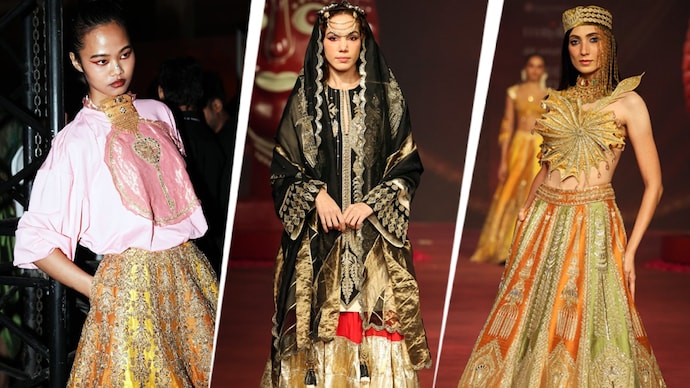
There were pieces that blended casual with couture making it feel relatable. The green and pink embellished tee paired with a heavily embroidered lehenga skirt blurred the line between occasion wear and everyday dressing. It felt just as relevant as a traditional blouse.
The yellow separates looked ready for a haldi ceremony, a destination celebration or even a festive brunch. Jackets layered over bralettes, flowing capes and relaxed silhouettes made couture feel lighter and easier to imagine in real wardrobes. Another element that made dressing feel easy was the tassel.
A few tassels here, an embellished jacket there, easy-to-style separates, and just like that, you've got yourself another wedding ensemble that's beyond usual.
The collection also ventured into resort bridalwear. From beaded velvet dresses and mini skirts with bralettes to flowing capes, dhotis and breezy tops, Masaba offered plenty of ideas for every event on the wedding calendar.
These are worth bookmarking!
Even the bridal looks resisted cliche.
Instead of an endless parade of predictable reds, Masaba embraced colour in all its exuberance. Rich crimson lehengas appeared alongside tropical greens and deep browns, there were violets and fuchsia pinks, making the collection vibrant and unique.
Another recurring motif was India itself. Several garments carried embroidered maps of the country.
Now, coming to the styling. It suggested a woman who honours tradition but isn't confined by it. That reflects resilience in a way, as it is not about clinging to culture, but carrying it forward on your own terms.
Speaking of adornments, the accessories made a statement too, not just dangling by the ears or dazzling on the neckline. Traditional jewellery was styled less as an obligation and more as a personal expression on the head, hair and more. In fact, the jewellery pieces by Indriya Jewels complemented and elevated the showcase's theme, reflecting the rich Indian spirit that exists at the intersection of culture and modernity.
Masaba interpreted Chardi Kala fashionably and how. Hope came through colours, resilience through women who wore tradition on their own terms, and India's spirit through motifs, maps and joyful maximalism.
From tissue sarees, sheer kurtis, flowy capes and dhotis to heavy lehengas (with pockets) and bold colours, Masaba clearly made a case for fashion that is couture and also very accessible. For all its couture embroidery, precious craftsmanship and bridal grandeur, these were still clothes that sparked a desire that felt affordable and that's House of Masaba for you.
How often do you look at pieces on the runway and wonder: "I think I can pull this off too. It looks perfectly wearable."
At the Hyundai India Couture Week 2026, Masaba's showcase sparked that feeling not once, not twice, but with almost every other piece. After six years, the House of Masaba returned to the runway with its first-ever bridal couture collection, titled Chardi Kala - a Punjabi phrase rooted in "optimism and resilience" – at Taj Palace, New Delhi.
The bridal collection was also a celebration of the true modern Indian woman, a "carrier of culture."
It introduced a refreshing idea of what couture can feel like: expressive without being inaccessible, celebratory without becoming costume.
Masaba Gupta's idea was simple: "I want the world to feel the India I grew up in—loud, lush, unapologetically itself. And the feeling of 'Still I Rise'." And that showed.
Why the showcase felt relatable was also because it had something for every modern bride.
The runway opened with soft tones of white, ivory and beige before gradually moving into light pink, orange and yellow, finally bursting into rich violet, elegant red with deep brown and vibrant pink. A transition in colour palette reflected on the celebration of optimism in itself.
Tropical motifs, Indian symbols, intricate embroidery, contemporary shirts with traditional skirts, tassels, cute little bags, embellished velvet dresses and statement jewellery tied the collection together.
The first look set the bold feminine energy right at the outset. The model wore a long white jacket with an embroidered train, layered over a black-and-gold anarkali, and carried a black briefcase featuring an embellished map of India. What really stood out was the pair of bajuband (armlets) over the jacket sleeves paired with bold bindi collar ornaments. Very Masaba core indeed.
A wedding wardrobe that looks fashionably accessible
There were pieces that blended casual with couture making it feel relatable. The green and pink embellished tee paired with a heavily embroidered lehenga skirt blurred the line between occasion wear and everyday dressing. It felt just as relevant as a traditional blouse.
The yellow separates looked ready for a haldi ceremony, a destination celebration or even a festive brunch. Jackets layered over bralettes, flowing capes and relaxed silhouettes made couture feel lighter and easier to imagine in real wardrobes. Another element that made dressing feel easy was the tassel.
A few tassels here, an embellished jacket there, easy-to-style separates, and just like that, you've got yourself another wedding ensemble that's beyond usual.
The collection also ventured into resort bridalwear. From beaded velvet dresses and mini skirts with bralettes to flowing capes, dhotis and breezy tops, Masaba offered plenty of ideas for every event on the wedding calendar.
These are worth bookmarking!
Even the bridal looks resisted cliche.
Instead of an endless parade of predictable reds, Masaba embraced colour in all its exuberance. Rich crimson lehengas appeared alongside tropical greens and deep browns, there were violets and fuchsia pinks, making the collection vibrant and unique.
Another recurring motif was India itself. Several garments carried embroidered maps of the country.
Now, coming to the styling. It suggested a woman who honours tradition but isn't confined by it. That reflects resilience in a way, as it is not about clinging to culture, but carrying it forward on your own terms.
Speaking of adornments, the accessories made a statement too, not just dangling by the ears or dazzling on the neckline. Traditional jewellery was styled less as an obligation and more as a personal expression on the head, hair and more. In fact, the jewellery pieces by Indriya Jewels complemented and elevated the showcase's theme, reflecting the rich Indian spirit that exists at the intersection of culture and modernity.
Masaba interpreted Chardi Kala fashionably and how. Hope came through colours, resilience through women who wore tradition on their own terms, and India's spirit through motifs, maps and joyful maximalism.
From tissue sarees, sheer kurtis, flowy capes and dhotis to heavy lehengas (with pockets) and bold colours, Masaba clearly made a case for fashion that is couture and also very accessible. For all its couture embroidery, precious craftsmanship and bridal grandeur, these were still clothes that sparked a desire that felt affordable and that's House of Masaba for you.
How often do you look at pieces on the runway and wonder: "I think I can pull this off too. It looks perfectly wearable."
At the Hyundai India Couture Week 2026, Masaba's showcase sparked that feeling not once, not twice, but with almost every other piece. After six years, the House of Masaba returned to the runway with its first-ever bridal couture collection, titled Chardi Kala - a Punjabi phrase rooted in "optimism and resilience" – at Taj Palace, New Delhi.
The bridal collection was also a celebration of the true modern Indian woman, a "carrier of culture."
It introduced a refreshing idea of what couture can feel like: expressive without being inaccessible, celebratory without becoming costume.
Masaba Gupta's idea was simple: "I want the world to feel the India I grew up in—loud, lush, unapologetically itself. And the feeling of 'Still I Rise'." And that showed.
Why the showcase felt relatable was also because it had something for every modern bride.
The runway opened with soft tones of white, ivory and beige before gradually moving into light pink, orange and yellow, finally bursting into rich violet, elegant red with deep brown and vibrant pink. A transition in colour palette reflected on the celebration of optimism in itself.
Tropical motifs, Indian symbols, intricate embroidery, contemporary shirts with traditional skirts, tassels, cute little bags, embellished velvet dresses and statement jewellery tied the collection together.
The first look set the bold feminine energy right at the outset. The model wore a long white jacket with an embroidered train, layered over a black-and-gold anarkali, and carried a black briefcase featuring an embellished map of India. What really stood out was the pair of bajuband (armlets) over the jacket sleeves paired with bold bindi collar ornaments. Very Masaba core indeed.
A wedding wardrobe that looks fashionably accessible
There were pieces that blended casual with couture making it feel relatable. The green and pink embellished tee paired with a heavily embroidered lehenga skirt blurred the line between occasion wear and everyday dressing. It felt just as relevant as a traditional blouse.
The yellow separates looked ready for a haldi ceremony, a destination celebration or even a festive brunch. Jackets layered over bralettes, flowing capes and relaxed silhouettes made couture feel lighter and easier to imagine in real wardrobes. Another element that made dressing feel easy was the tassel.
A few tassels here, an embellished jacket there, easy-to-style separates, and just like that, you've got yourself another wedding ensemble that's beyond usual.
The collection also ventured into resort bridalwear. From beaded velvet dresses and mini skirts with bralettes to flowing capes, dhotis and breezy tops, Masaba offered plenty of ideas for every event on the wedding calendar.
These are worth bookmarking!
Even the bridal looks resisted cliche.
Instead of an endless parade of predictable reds, Masaba embraced colour in all its exuberance. Rich crimson lehengas appeared alongside tropical greens and deep browns, there were violets and fuchsia pinks, making the collection vibrant and unique.
Another recurring motif was India itself. Several garments carried embroidered maps of the country.
Now, coming to the styling. It suggested a woman who honours tradition but isn't confined by it. That reflects resilience in a way, as it is not about clinging to culture, but carrying it forward on your own terms.
Speaking of adornments, the accessories made a statement too, not just dangling by the ears or dazzling on the neckline. Traditional jewellery was styled less as an obligation and more as a personal expression on the head, hair and more. In fact, the jewellery pieces by Indriya Jewels complemented and elevated the showcase's theme, reflecting the rich Indian spirit that exists at the intersection of culture and modernity.
Masaba interpreted Chardi Kala fashionably and how. Hope came through colours, resilience through women who wore tradition on their own terms, and India's spirit through motifs, maps and joyful maximalism.
From tissue sarees, sheer kurtis, flowy capes and dhotis to heavy lehengas (with pockets) and bold colours, Masaba clearly made a case for fashion that is couture and also very accessible. For all its couture embroidery, precious craftsmanship and bridal grandeur, these were still clothes that sparked a desire that felt affordable and that's House of Masaba for you.

