What an Indian paranormal investigator learnt after a decade of chasing 'ghosts'
Paranormal investigator Sarbajeet Mohanty explains how his team tests haunting claims through scientific methods. He says most cases have natural explanations, while folklore and fear often fill the gaps.
Everyone loves a good ghost story. Whether you're a believer or a sceptic is almost beside the point. The allure of the unknown remains powerful. How else do you explain the enduring popularity of horror franchises like The Conjuring, which have collectively grossed billions at the global box office?
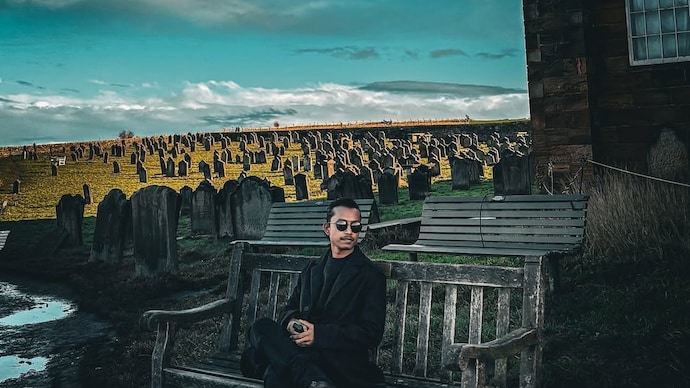
It is this fascination with the unexplained that brings us to Sarbajeet Mohanty, an Odisha-born paranormal investigator and demonologist who has spent over a decade examining claims of hauntings, supernatural encounters and allegedly cursed locations. Many may recognise him from MTV Dark Scroll or from his social media channels, where videos of investigations and discussions around paranormal folklore have earned him a dedicated following.
"Ghost hunting and paranormal investigation are completely different things," he says. "We investigate claims of the supernatural using every scientific method available to us."
Yes, scientific!
While ghost hunting is often associated with chasing thrills and spooky experiences, paranormal investigation, he says, is about asking questions, gathering evidence and trying to separate folklore from fact.
Science before spirits
Most non-believers have one thing in common, how can you scientifically prove the presence of unknown? For them, Sarbajeet has an answer. Contrary to popular perception, he says most of his work involves ruling things out rather than proving anything paranormal exists.
His team investigates two broad categories of cases: public locations with reputations for being haunted, and private properties where owners report unexplained incidents. The process begins with measurements, not conclusions.
Investigators carry equipment designed to monitor environmental conditions such as temperature, humidity, air pressure, sound frequencies and electromagnetic fields. The objective is to understand whether there are natural explanations behind the experiences being reported.
According to Sarbajeet, many cases stem from factors people rarely consider. Some properties, he says, sit on geomagnetic anomalies — areas where variations in the Earth's magnetic field may affect human perception. In other cases, houses located near mobile towers or sources of electromagnetic pollution may create conditions that contribute to headaches, disturbed sleep, feelings of unease or even sensory distortions.
"People report hearing voices, seeing shadows, having nightmares or feeling watched," he says. "A lot of these experiences can have natural explanations."
A sudden drop in temperature, for example, is not automatically treated as evidence of paranormal activity. Instead, investigators first look for structural or environmental causes. "If one room is significantly colder than the rest, we ask why. Is there a water tank above it? Is there an air shaft? Is there something in the construction causing it?" he explains.
Only after every obvious possibility has been examined does a phenomenon enter what he describes as the "paranormal" category — not as proof of ghosts, but as something that remains unexplained. Out of every ten cases his team receives, he estimates that around eight can be explained through existing scientific knowledge.
"The word haunted carries responsibility," he says. "You cannot casually label a place haunted because people trust what you say."
The child who was terrified of the dark
Ironically, Sarbajeet's journey into the paranormal began with fear. His father worked in a public sector undertaking, which meant the family moved frequently across eastern India. Many of the government quarters they occupied were old, and almost every house came with stories attached to it.
Growing up in Odisha, he heard endless folklore about spirits, witches and supernatural entities. One recurring figure was the "Dahani" — a witch-like character said to roam forests at night.
"I was intensely scared of darkness," he recalls.
He claims as a child when he would be unable to sleep at night, he would lie awake listening to creaks, knocks and unexplained sounds. Every new house seemed to come with fresh rumours and unsettling anecdotes from neighbours.
Then, as a teenager, he began asking himself a question that would eventually shape his career – “What exactly was he afraid of?”
The answer wasn't obvious. So he started reading. Long before paranormal content became a staple of YouTube and Instagram, Mohanty spent hours researching hauntings, folklore and supernatural beliefs, trying to understand the stories that had frightened him throughout childhood. The more he learnt, the less afraid he became. "The fear of the unknown is powerful," he says. "Knowledge helped me overcome that fear."
Bollywood's ghosts are stuck in another era
Ask Sarbajeet what popular culture gets wrong about hauntings, and his answer arrives almost immediately. "The biggest misconception is that every ghost wears white and every haunting has to involve some tragic emotional backstory."
For decades, Indian horror films have relied on familiar imagery: crumbling mansions, women in white sarees and vengeful spirits seeking revenge. Sarbajeet believes audiences have moved on. Modern viewers, he argues, are far more informed about the paranormal than filmmakers often assume. What scares people today is not necessarily spectacle, but relatability.
That, he says, is one reason why films like The Conjuring became cultural phenomena.
The premise itself is familiar — a family moves into a house and strange things begin to happen. Yet the fear works because viewers can imagine themselves in that situation. "The line between fiction and reality becomes blurred," he says. "You go home and wonder if something similar could happen to you."
He believes Indian horror often relies too heavily on cliches instead of creating emotionally grounded stories.
Interestingly, filmmakers regularly approach him and his team for advice. Some seek help with investigative procedures, terminology and equipment to make their stories more authentic. Others express interest in adapting stories from his team's case files.
Among those he speaks highly of are filmmaker Patrick Graham, known for Ghoul, Betaal, and Marathi director Vishal Furia, whose Lapachhapi was later adapted into Hindi as Chhorii, starring Nushrratt Bharuccha. According to him, they understand that effective horror isn't just about jump scares. It's about making audiences care.
The Warrens question
No conversation about paranormal investigations is complete without discussing Ed and Lorraine Warren, the American couple whose cases inspired The Conjuring universe. Mohanty's view is notably measured.
He acknowledges that many critics have questioned the Warrens' claims and pointed out discrepancies between historical accounts and cinematic portrayals. For instance, he notes that films significantly expanded the Warrens' role in cases such as the Enfield Poltergeist investigation.
At the same time, he is reluctant to pass judgment. "I never met them. I never saw them work," he says.
For him, the truth probably lies somewhere between hero worship and outright dismissal. He believes Hollywood transformed the Warrens into larger-than-life figures, making it difficult to separate the real people from the mythology built around them.
Why Bhangarh isn't India's most haunted place
Mention haunted locations in India and Bhangarh Fort inevitably enters the conversation. Sarbajeet thinks its reputation has grown far beyond reality. According to him, years of viral videos, television specials and social media content have turned Bhangarh into a shorthand for haunted India.
"It's misunderstood. It doesn’t even count among the top 10 haunted places of India," he says. While he doesn't dismiss the fort's eerie atmosphere, he believes several other locations deserve far more attention.
The place that still stays with him
Among all the places he has investigated, one continues to stand out.
Mukti Kothri in Nainital.
The British-era property is associated with stories of a doctor who allegedly conducted experiments related to the afterlife. He purportedly knew the exact time and date of when his patients are going to die. Nearby stands Abbott Mount Church, another location that features prominently in the area's folklore. For Sarbajeet, the site remains one of the most unsettling locations he has encountered.
What lingers most, however, is not the building itself but the emotional impact the investigation had on people around him.
He recalls that his partner and co-founder Pooja found the experience particularly overwhelming and stepped away from work for a period afterwards. "That place is India's answer to the Conjuring House," he says.
Fear, stories and unanswered questions
Despite spending years investigating claims of hauntings, Mohanty's philosophy remains surprisingly straightforward. People, he believes, are uncomfortable with uncertainty.
When something happens that cannot be immediately explained, the human mind instinctively looks for a story. That tendency, he says, also explains the speculation that followed the death of paranormal investigator Gaurav Tiwari, whose passing sparked years of rumours and theories.
Sarbajeet rejects attempts to automatically connect such events to supernatural causes. Instead, he argues that unanswered questions often create a vacuum that folklore quickly fills. For him, the goal has never been to convince people that ghosts are real. Nor is it to convince them that every paranormal claim is false.
The objective is simpler: investigate honestly, explain what can be explained and remain open about what cannot.
Everyone loves a good ghost story. Whether you're a believer or a sceptic is almost beside the point. The allure of the unknown remains powerful. How else do you explain the enduring popularity of horror franchises like The Conjuring, which have collectively grossed billions at the global box office?
It is this fascination with the unexplained that brings us to Sarbajeet Mohanty, an Odisha-born paranormal investigator and demonologist who has spent over a decade examining claims of hauntings, supernatural encounters and allegedly cursed locations. Many may recognise him from MTV Dark Scroll or from his social media channels, where videos of investigations and discussions around paranormal folklore have earned him a dedicated following.
"Ghost hunting and paranormal investigation are completely different things," he says. "We investigate claims of the supernatural using every scientific method available to us."
Yes, scientific!
While ghost hunting is often associated with chasing thrills and spooky experiences, paranormal investigation, he says, is about asking questions, gathering evidence and trying to separate folklore from fact.
Science before spirits
Most non-believers have one thing in common, how can you scientifically prove the presence of unknown? For them, Sarbajeet has an answer. Contrary to popular perception, he says most of his work involves ruling things out rather than proving anything paranormal exists.
His team investigates two broad categories of cases: public locations with reputations for being haunted, and private properties where owners report unexplained incidents. The process begins with measurements, not conclusions.
Investigators carry equipment designed to monitor environmental conditions such as temperature, humidity, air pressure, sound frequencies and electromagnetic fields. The objective is to understand whether there are natural explanations behind the experiences being reported.
According to Sarbajeet, many cases stem from factors people rarely consider. Some properties, he says, sit on geomagnetic anomalies — areas where variations in the Earth's magnetic field may affect human perception. In other cases, houses located near mobile towers or sources of electromagnetic pollution may create conditions that contribute to headaches, disturbed sleep, feelings of unease or even sensory distortions.
"People report hearing voices, seeing shadows, having nightmares or feeling watched," he says. "A lot of these experiences can have natural explanations."
A sudden drop in temperature, for example, is not automatically treated as evidence of paranormal activity. Instead, investigators first look for structural or environmental causes. "If one room is significantly colder than the rest, we ask why. Is there a water tank above it? Is there an air shaft? Is there something in the construction causing it?" he explains.
Only after every obvious possibility has been examined does a phenomenon enter what he describes as the "paranormal" category — not as proof of ghosts, but as something that remains unexplained. Out of every ten cases his team receives, he estimates that around eight can be explained through existing scientific knowledge.
"The word haunted carries responsibility," he says. "You cannot casually label a place haunted because people trust what you say."
The child who was terrified of the dark
Ironically, Sarbajeet's journey into the paranormal began with fear. His father worked in a public sector undertaking, which meant the family moved frequently across eastern India. Many of the government quarters they occupied were old, and almost every house came with stories attached to it.
Growing up in Odisha, he heard endless folklore about spirits, witches and supernatural entities. One recurring figure was the "Dahani" — a witch-like character said to roam forests at night.
"I was intensely scared of darkness," he recalls.
He claims as a child when he would be unable to sleep at night, he would lie awake listening to creaks, knocks and unexplained sounds. Every new house seemed to come with fresh rumours and unsettling anecdotes from neighbours.
Then, as a teenager, he began asking himself a question that would eventually shape his career – “What exactly was he afraid of?”
The answer wasn't obvious. So he started reading. Long before paranormal content became a staple of YouTube and Instagram, Mohanty spent hours researching hauntings, folklore and supernatural beliefs, trying to understand the stories that had frightened him throughout childhood. The more he learnt, the less afraid he became. "The fear of the unknown is powerful," he says. "Knowledge helped me overcome that fear."
Bollywood's ghosts are stuck in another era
Ask Sarbajeet what popular culture gets wrong about hauntings, and his answer arrives almost immediately. "The biggest misconception is that every ghost wears white and every haunting has to involve some tragic emotional backstory."
For decades, Indian horror films have relied on familiar imagery: crumbling mansions, women in white sarees and vengeful spirits seeking revenge. Sarbajeet believes audiences have moved on. Modern viewers, he argues, are far more informed about the paranormal than filmmakers often assume. What scares people today is not necessarily spectacle, but relatability.
That, he says, is one reason why films like The Conjuring became cultural phenomena.
The premise itself is familiar — a family moves into a house and strange things begin to happen. Yet the fear works because viewers can imagine themselves in that situation. "The line between fiction and reality becomes blurred," he says. "You go home and wonder if something similar could happen to you."
He believes Indian horror often relies too heavily on cliches instead of creating emotionally grounded stories.
Interestingly, filmmakers regularly approach him and his team for advice. Some seek help with investigative procedures, terminology and equipment to make their stories more authentic. Others express interest in adapting stories from his team's case files.
Among those he speaks highly of are filmmaker Patrick Graham, known for Ghoul, Betaal, and Marathi director Vishal Furia, whose Lapachhapi was later adapted into Hindi as Chhorii, starring Nushrratt Bharuccha. According to him, they understand that effective horror isn't just about jump scares. It's about making audiences care.
The Warrens question
No conversation about paranormal investigations is complete without discussing Ed and Lorraine Warren, the American couple whose cases inspired The Conjuring universe. Mohanty's view is notably measured.
He acknowledges that many critics have questioned the Warrens' claims and pointed out discrepancies between historical accounts and cinematic portrayals. For instance, he notes that films significantly expanded the Warrens' role in cases such as the Enfield Poltergeist investigation.
At the same time, he is reluctant to pass judgment. "I never met them. I never saw them work," he says.
For him, the truth probably lies somewhere between hero worship and outright dismissal. He believes Hollywood transformed the Warrens into larger-than-life figures, making it difficult to separate the real people from the mythology built around them.
Why Bhangarh isn't India's most haunted place
Mention haunted locations in India and Bhangarh Fort inevitably enters the conversation. Sarbajeet thinks its reputation has grown far beyond reality. According to him, years of viral videos, television specials and social media content have turned Bhangarh into a shorthand for haunted India.
"It's misunderstood. It doesn’t even count among the top 10 haunted places of India," he says. While he doesn't dismiss the fort's eerie atmosphere, he believes several other locations deserve far more attention.
The place that still stays with him
Among all the places he has investigated, one continues to stand out.
Mukti Kothri in Nainital.
The British-era property is associated with stories of a doctor who allegedly conducted experiments related to the afterlife. He purportedly knew the exact time and date of when his patients are going to die. Nearby stands Abbott Mount Church, another location that features prominently in the area's folklore. For Sarbajeet, the site remains one of the most unsettling locations he has encountered.
What lingers most, however, is not the building itself but the emotional impact the investigation had on people around him.
He recalls that his partner and co-founder Pooja found the experience particularly overwhelming and stepped away from work for a period afterwards. "That place is India's answer to the Conjuring House," he says.
Fear, stories and unanswered questions
Despite spending years investigating claims of hauntings, Mohanty's philosophy remains surprisingly straightforward. People, he believes, are uncomfortable with uncertainty.
When something happens that cannot be immediately explained, the human mind instinctively looks for a story. That tendency, he says, also explains the speculation that followed the death of paranormal investigator Gaurav Tiwari, whose passing sparked years of rumours and theories.
Sarbajeet rejects attempts to automatically connect such events to supernatural causes. Instead, he argues that unanswered questions often create a vacuum that folklore quickly fills. For him, the goal has never been to convince people that ghosts are real. Nor is it to convince them that every paranormal claim is false.
The objective is simpler: investigate honestly, explain what can be explained and remain open about what cannot.

