Can Rs 30,000 measure a homemaker's labour? Women weigh in on the Supreme Court ruling
The Supreme Court has set a minimum Rs 30,000 monthly value for homemakers' domestic care services in accident compensation cases. Homemakers say the amount may be inadequate, but the legal recognition of unpaid work is significant.
For years, homemakers have heard some version of the same sentence.
"Tum ghar pe pure din baith kar karti hi kya ho? (What do you even do staying at home whole day?)"
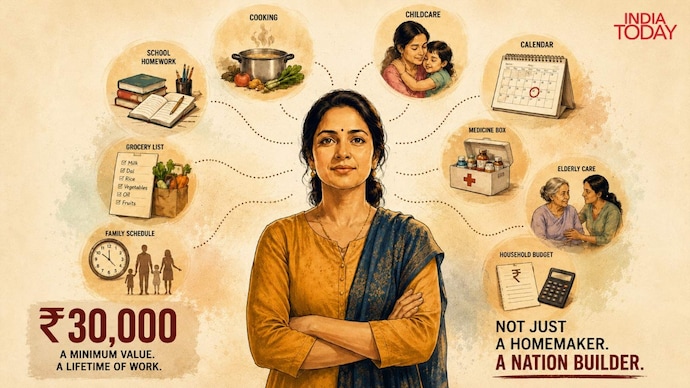
The Supreme Court's recent ruling may not end that mindset overnight, but it has done something many women say matters just as much as money: it has officially recognised that running a home is work. Calling homemakers "nation builders", the court held that Motor Accident Claims Tribunals should treat the loss of domestic care services as having a minimum value of Rs 30,000 a month while calculating compensation in accident death cases.
Predictably, the number sparked debate. Is Rs 30,000 enough for someone who cooks, cleans, manages the household, raises children, cares for ageing parents, remembers birthdays, doctor's appointments and school projects, often without a single day off?
Many homemakers India Today spoke to say the answer is no. But almost all of them also said the same thing: the acknowledgement itself feels bigger than the figure.
"I think the biggest achievement is the acknowledgement in itself," says Baishali, a 59-year-old homemaker from Siliguri. She says she was fortunate to grow up in a progressive family that never treated her as lesser because she wasn't earning. Yet she has seen many women being told by partners and relatives that their contribution is insignificant because "millions of women do the same thing".
"They fail to acknowledge that for a man to earn that bread, a woman often sacrifices a lot," she says.
The problem with putting a price on care
The conversation becomes even more complicated when working women enter the picture.
"These days it's a double whammy. Women are also homemakers and at the same time going to office and earning. How do you equate that?" she asks. And that sentiment echoes across generations.
"My generation and the one before that were mostly homemakers," says 49-year-old Delhi resident Bidisha Arora.
She paints a picture familiar to many Indian households. A husband leaves for work in the morning. The woman stays behind, manages the house, sends children to school, prepares meals, supervises homework, waits for everyone to return and then starts preparing dinner.
"That was what an average day looked like," she says.
Does Rs 30,000 adequately compensate for all that labour? "Not exactly. But since it had to start somewhere, the acknowledgement is good."
Others approach the question differently.
"Let's calculate it," says Kolkata-based homemaker Bonoshree Pal. She points to the rise of app-based home services where workers are paid to clean homes, wash utensils, chop vegetables and manage other household tasks." Now add the cost of tuition classes that many mothers provide themselves. Add childcare. Add cooking. Add household management. Then calculate the amount," she says.
Her conclusion is simple.
"What homemakers do is not easy to measure in numbers because it goes far beyond numbers. And yet we were told, 'Tum ghar pe baith kar kya hi karti ho?'"
Yet even among those who feel Rs 30,000 falls short, there is recognition that no single figure can capture the value of homemaking across vastly different social and economic realities.
Why Rs 30,000 isn't the same everywhere
Celebrity divorce lawyer Vandana Shah argues that the debate over the amount risks oversimplifying the judgement itself.
"The acknowledgement is the most important thing. For the first time, invisible labour has been accepted, acknowledged and endorsed by the Supreme Court of India," she says. Shah points out that the value of domestic labour will inevitably differ from one household to another.
According to her, compensation in such cases is never divorced from socioeconomic realities. Courts routinely consider financial circumstances and economic capacity while deciding matters involving compensation.
"Any matter related to money is always decided based on economic capacity and financial circumstances. It cannot be decided without taking those aspects into consideration," she says. That distinction matters because the judgement does not suggest that every homemaker's contribution is worth exactly Rs 30,000. Instead, it establishes a benchmark where none existed before.
When invisible labour becomes visible
Shah believes that is what makes the ruling historic.
For years, she says, homemakers have struggled to explain the economic value of work that keeps families functioning. Women have put careers on hold, stepped away from professional ambitions and sacrificed earning opportunities to support households and raise children.
"You give up your own satisfaction, your own self-esteem, your own career and nobody has been able to put a quantity to it," she says.
The Supreme Court's recognition changes that.
"It has given women a formula that says my contribution can now be economically quantified, so don't just write me off."
A ruling bigger than compensation
For Jasmeet Singh, 68, from Punjab, the ruling feels especially significant because of what she witnessed growing up. "The women in our families would cook for 20-25 people at a time. They made 60-70 rotis for dinner alone. Then there was farm work and looking after cattle. Yet they were never called breadwinners. It was simply expected of them."
The Supreme Court's observations, she says, deserve wider attention. "People should know about this. Both men and women."
Interestingly, some homemakers see another dimension in the judgement.
"I think it's a very gender-neutral decision because it says homemakers, not housewives," says 32-year-old Sushmita Chanda.
That distinction matters. The court's language recognises caregiving and domestic labour rather than attaching it exclusively to women.
Shah agrees.
Although the judgement emerged from a case involving a woman, she notes that the court repeatedly used the term "homemaker". "It is a gender-neutral judgement. Tomorrow, if a man is the homemaker, it applies to him too," she says.
Many homemakers believe Rs 30,000 falls short of the actual value of what they do. Some point out that hiring separate people to cook, clean, tutor children, care for elderly family members and manage a household would cost far more. But reducing the judgement to a debate over whether the number should be Rs 30,000, Rs 50,000 or Rs 1 lakh risks missing the larger shift.
For perhaps the first time, India's highest court has said something homemakers have long known but rarely heard acknowledged in law: the work done inside a home is work.
And for many women, that recognition carries a value that cannot be easily calculated.
For years, homemakers have heard some version of the same sentence.
"Tum ghar pe pure din baith kar karti hi kya ho? (What do you even do staying at home whole day?)"
The Supreme Court's recent ruling may not end that mindset overnight, but it has done something many women say matters just as much as money: it has officially recognised that running a home is work. Calling homemakers "nation builders", the court held that Motor Accident Claims Tribunals should treat the loss of domestic care services as having a minimum value of Rs 30,000 a month while calculating compensation in accident death cases.
Predictably, the number sparked debate. Is Rs 30,000 enough for someone who cooks, cleans, manages the household, raises children, cares for ageing parents, remembers birthdays, doctor's appointments and school projects, often without a single day off?
Many homemakers India Today spoke to say the answer is no. But almost all of them also said the same thing: the acknowledgement itself feels bigger than the figure.
"I think the biggest achievement is the acknowledgement in itself," says Baishali, a 59-year-old homemaker from Siliguri. She says she was fortunate to grow up in a progressive family that never treated her as lesser because she wasn't earning. Yet she has seen many women being told by partners and relatives that their contribution is insignificant because "millions of women do the same thing".
"They fail to acknowledge that for a man to earn that bread, a woman often sacrifices a lot," she says.
The problem with putting a price on care
The conversation becomes even more complicated when working women enter the picture.
"These days it's a double whammy. Women are also homemakers and at the same time going to office and earning. How do you equate that?" she asks. And that sentiment echoes across generations.
"My generation and the one before that were mostly homemakers," says 49-year-old Delhi resident Bidisha Arora.
She paints a picture familiar to many Indian households. A husband leaves for work in the morning. The woman stays behind, manages the house, sends children to school, prepares meals, supervises homework, waits for everyone to return and then starts preparing dinner.
"That was what an average day looked like," she says.
Does Rs 30,000 adequately compensate for all that labour? "Not exactly. But since it had to start somewhere, the acknowledgement is good."
Others approach the question differently.
"Let's calculate it," says Kolkata-based homemaker Bonoshree Pal. She points to the rise of app-based home services where workers are paid to clean homes, wash utensils, chop vegetables and manage other household tasks." Now add the cost of tuition classes that many mothers provide themselves. Add childcare. Add cooking. Add household management. Then calculate the amount," she says.
Her conclusion is simple.
"What homemakers do is not easy to measure in numbers because it goes far beyond numbers. And yet we were told, 'Tum ghar pe baith kar kya hi karti ho?'"
Yet even among those who feel Rs 30,000 falls short, there is recognition that no single figure can capture the value of homemaking across vastly different social and economic realities.
Why Rs 30,000 isn't the same everywhere
Celebrity divorce lawyer Vandana Shah argues that the debate over the amount risks oversimplifying the judgement itself.
"The acknowledgement is the most important thing. For the first time, invisible labour has been accepted, acknowledged and endorsed by the Supreme Court of India," she says. Shah points out that the value of domestic labour will inevitably differ from one household to another.
According to her, compensation in such cases is never divorced from socioeconomic realities. Courts routinely consider financial circumstances and economic capacity while deciding matters involving compensation.
"Any matter related to money is always decided based on economic capacity and financial circumstances. It cannot be decided without taking those aspects into consideration," she says. That distinction matters because the judgement does not suggest that every homemaker's contribution is worth exactly Rs 30,000. Instead, it establishes a benchmark where none existed before.
When invisible labour becomes visible
Shah believes that is what makes the ruling historic.
For years, she says, homemakers have struggled to explain the economic value of work that keeps families functioning. Women have put careers on hold, stepped away from professional ambitions and sacrificed earning opportunities to support households and raise children.
"You give up your own satisfaction, your own self-esteem, your own career and nobody has been able to put a quantity to it," she says.
The Supreme Court's recognition changes that.
"It has given women a formula that says my contribution can now be economically quantified, so don't just write me off."
A ruling bigger than compensation
For Jasmeet Singh, 68, from Punjab, the ruling feels especially significant because of what she witnessed growing up. "The women in our families would cook for 20-25 people at a time. They made 60-70 rotis for dinner alone. Then there was farm work and looking after cattle. Yet they were never called breadwinners. It was simply expected of them."
The Supreme Court's observations, she says, deserve wider attention. "People should know about this. Both men and women."
Interestingly, some homemakers see another dimension in the judgement.
"I think it's a very gender-neutral decision because it says homemakers, not housewives," says 32-year-old Sushmita Chanda.
That distinction matters. The court's language recognises caregiving and domestic labour rather than attaching it exclusively to women.
Shah agrees.
Although the judgement emerged from a case involving a woman, she notes that the court repeatedly used the term "homemaker". "It is a gender-neutral judgement. Tomorrow, if a man is the homemaker, it applies to him too," she says.
Many homemakers believe Rs 30,000 falls short of the actual value of what they do. Some point out that hiring separate people to cook, clean, tutor children, care for elderly family members and manage a household would cost far more. But reducing the judgement to a debate over whether the number should be Rs 30,000, Rs 50,000 or Rs 1 lakh risks missing the larger shift.
For perhaps the first time, India's highest court has said something homemakers have long known but rarely heard acknowledged in law: the work done inside a home is work.
And for many women, that recognition carries a value that cannot be easily calculated.

