We visited 10 Delhi neighbourhoods after SC's 'right to walk' ruling. Here's what we found
After the Supreme Court affirmed the right to walk, India Today Digital checked 10 Delhi locations. The result wasn't very surprising to be honest.
Last week, the Supreme Court declared something millions of Indians do every day but rarely think about as a fundamental right - the right to walk.
Calling safe, demarcated footpaths an essential part of Articles 19 and 21 of the Constitution, the Court said that if a road exists, authorities have a duty to provide and maintain footpaths. It went a step further, holding that a pedestrian's right to walk overrides the privilege of motorised vehicles.
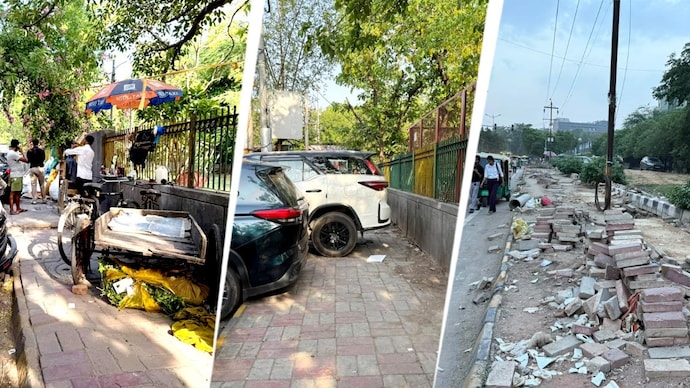
The judgment is ambitious. It is also deeply at odds with what a walk through Delhi looks like today. Over two days, India Today Digital visited ten locations across the capital from affluent markets and government districts to residential neighbourhoods and coaching hubs to see what exercising this newly affirmed constitutional right actually entails.
The answer, more often than not, involved stepping off the footpath and onto the road.
Where the footpath isn’t a footpath anymore
The first obstacle wasn't traffic. It was the footpath itself. In East Delhi’s Trilokpuri, heaps of sludge and garbage occupied almost an entire pavement. It appeared to be waste removed from a nearby drain during a cleaning exercise, only to be dumped where pedestrians were expected to walk. A cane furniture vendor had taken over another stretch of the pavement, forcing people onto the carriageway.
Mukherjee Nagar, better known as Delhi's coaching capital, presented a different version of the same problem. Makeshift stalls lined sections of the footpath. One shopkeeper agreed to speak to India Today Digital, but only off camera. "The MCD itself allowed us to set up here. If they demolish these shops now, we'll be ruined," he said.
His predicament highlighted a larger contradiction. The city has, in many places, normalised encroachments that leave pedestrians with nowhere to go. Even where shops weren't the problem, neglect was. Sections of the pavement reeked of urine, pools of stagnant muck made walking difficult, and low-hanging signboards repeatedly interrupted the path.
A constitutional right, in practice, had to negotiate garbage, commerce and neglect before it could negotiate traffic.
When the footpath exists, but only for name’s sake
In Vasundhara Enclave, the problem wasn't the absence of footpaths but their usability. Trees have grown through many stretches, with large cut-outs consuming much of the available space. Removing mature trees isn't the answer in a city choking on pollution. But the result is that pedestrians repeatedly have to climb down onto the road before getting back onto the pavement.
We watched an elderly man, walking with a stick, choose the road over the pavement because negotiating the constant obstacles was harder than walking beside moving traffic.
We saw another couple in their 60s who spoke about the situation in Vasundhara Enclave. “I don't know about all Delhi footpaths. I've been staying in Vasundhara Enclave since 2002, and since then I've never seen the Vasundhara Enclave footpaths in good condition. They are in a very bad shape, mostly broken. Hawkers have occupied the footpaths, and there is very little space for people to walk. As a result, people have to walk on the road and risk their lives,” he told India Today Digital.
“About the trees, I wouldn't say anything because I'm a tree lover. So I'm okay accommodating the trees, but I'm not okay accommodating animals, dog or human excreta, or hawkers on the footpaths,” he added.
On Outer Ring Road, a pavement next to a foot overbridge narrowed to the point where only one person could comfortably pass. Two-way pedestrian movement was practically impossible.
Elsewhere, footpaths simply ended without warning. We would take a few steps before the pavement abruptly disappeared, forcing us back onto the road until another stretch reappeared.
Privilege has an address
If Delhi proves anything, it is that functioning footpaths are not impossible. They are simply unevenly distributed.
In Connaught Place, Khan Market and Greater Kailash's M Block Market, walking almost felt effortless. The pavements were clean, unobstructed and well maintained. There were no piles of garbage, no overflowing drains and no visible encroachments. The roads were clean, the market areas smelled fresh, and for once, pedestrians did not have to constantly look over their shoulder for oncoming traffic. Walking here felt less like navigating an obstacle course and more like what a footpath is actually meant for.
The illusion, however, lasts only until you step outside the market.
Just beyond Khan Market, a lane lined with money exchange counters, xerox shops and fruit juice stalls had spilled onto the footpath, leaving little room for pedestrians. The contrast existed within a matter of metres. On one side was a pavement that served its purpose. On the other was one that had quietly surrendered it.
Encroachment isn't only a hawker problem
Not every obstruction came from hawkers or civic neglect.
In the residential colonies of Greater Kailash and Lajpat Nagar, some of the encroachment came from residents themselves. Cars were parked on footpaths, potted plants had been placed outside homes, landscaped patches spilled onto public walkways and boundary extensions further narrowed the space available for pedestrians.
Individually, these appeared like minor inconveniences. Collectively, they erased the very public space meant for walking, forcing pedestrians back onto the road.
Even premium roads aren't exempt
If premium neighbourhoods demonstrated that well-maintained footpaths are possible, premium roads showed that they are not immune to neglect.
Deen Dayal Upadhyay Marg, home to media organisations and political offices, was largely free of encroachments. But one sight stood out. Rows of clothes hung across sections of the pavement, left out to dry. People nearby pointed us towards a dhobi ghat in the vicinity, explaining that the clothes belonged there.
The footpath remained walkable, but the scene served as another reminder that even in some of Delhi's most prominent stretches, pavements are routinely treated as spaces available for any use other than walking.
Delhi mayor's response
Perhaps nowhere did the Supreme Court's words feel more immediate than Hauz Rani in Malviya Nagar.
Barely 600 to 700 metres from Max Hospital, near the site where a devastating fire claimed 23 lives last month, we found a stretch of footpath in a deplorable condition. Broken slabs, uneven surfaces and damaged sections made it difficult even for an able-bodied person to walk comfortably.
"It has been like this for over a year," a local bystander told India Today Digital.
When we shared these observations with Delhi Mayor Pravesh Wahi, he acknowledged that there may have been shortcomings.
"There may have been shortcomings on the part of the officials. I will hold a meeting with deputy commissioners and the concerned officials and ensure these issues are addressed," he said.
The Supreme Court has settled an important constitutional question. Walking is not a favour extended by the state but a fundamental right.
The harder question still remains unanswered: Who, exactly, will make that right walkable?
Last week, the Supreme Court declared something millions of Indians do every day but rarely think about as a fundamental right - the right to walk.
Calling safe, demarcated footpaths an essential part of Articles 19 and 21 of the Constitution, the Court said that if a road exists, authorities have a duty to provide and maintain footpaths. It went a step further, holding that a pedestrian's right to walk overrides the privilege of motorised vehicles.
The judgment is ambitious. It is also deeply at odds with what a walk through Delhi looks like today. Over two days, India Today Digital visited ten locations across the capital from affluent markets and government districts to residential neighbourhoods and coaching hubs to see what exercising this newly affirmed constitutional right actually entails.
The answer, more often than not, involved stepping off the footpath and onto the road.
Where the footpath isn’t a footpath anymore
The first obstacle wasn't traffic. It was the footpath itself. In East Delhi’s Trilokpuri, heaps of sludge and garbage occupied almost an entire pavement. It appeared to be waste removed from a nearby drain during a cleaning exercise, only to be dumped where pedestrians were expected to walk. A cane furniture vendor had taken over another stretch of the pavement, forcing people onto the carriageway.
Mukherjee Nagar, better known as Delhi's coaching capital, presented a different version of the same problem. Makeshift stalls lined sections of the footpath. One shopkeeper agreed to speak to India Today Digital, but only off camera. "The MCD itself allowed us to set up here. If they demolish these shops now, we'll be ruined," he said.
His predicament highlighted a larger contradiction. The city has, in many places, normalised encroachments that leave pedestrians with nowhere to go. Even where shops weren't the problem, neglect was. Sections of the pavement reeked of urine, pools of stagnant muck made walking difficult, and low-hanging signboards repeatedly interrupted the path.
A constitutional right, in practice, had to negotiate garbage, commerce and neglect before it could negotiate traffic.
When the footpath exists, but only for name’s sake
In Vasundhara Enclave, the problem wasn't the absence of footpaths but their usability. Trees have grown through many stretches, with large cut-outs consuming much of the available space. Removing mature trees isn't the answer in a city choking on pollution. But the result is that pedestrians repeatedly have to climb down onto the road before getting back onto the pavement.
We watched an elderly man, walking with a stick, choose the road over the pavement because negotiating the constant obstacles was harder than walking beside moving traffic.
We saw another couple in their 60s who spoke about the situation in Vasundhara Enclave. “I don't know about all Delhi footpaths. I've been staying in Vasundhara Enclave since 2002, and since then I've never seen the Vasundhara Enclave footpaths in good condition. They are in a very bad shape, mostly broken. Hawkers have occupied the footpaths, and there is very little space for people to walk. As a result, people have to walk on the road and risk their lives,” he told India Today Digital.
“About the trees, I wouldn't say anything because I'm a tree lover. So I'm okay accommodating the trees, but I'm not okay accommodating animals, dog or human excreta, or hawkers on the footpaths,” he added.
On Outer Ring Road, a pavement next to a foot overbridge narrowed to the point where only one person could comfortably pass. Two-way pedestrian movement was practically impossible.
Elsewhere, footpaths simply ended without warning. We would take a few steps before the pavement abruptly disappeared, forcing us back onto the road until another stretch reappeared.
Privilege has an address
If Delhi proves anything, it is that functioning footpaths are not impossible. They are simply unevenly distributed.
In Connaught Place, Khan Market and Greater Kailash's M Block Market, walking almost felt effortless. The pavements were clean, unobstructed and well maintained. There were no piles of garbage, no overflowing drains and no visible encroachments. The roads were clean, the market areas smelled fresh, and for once, pedestrians did not have to constantly look over their shoulder for oncoming traffic. Walking here felt less like navigating an obstacle course and more like what a footpath is actually meant for.
The illusion, however, lasts only until you step outside the market.
Just beyond Khan Market, a lane lined with money exchange counters, xerox shops and fruit juice stalls had spilled onto the footpath, leaving little room for pedestrians. The contrast existed within a matter of metres. On one side was a pavement that served its purpose. On the other was one that had quietly surrendered it.
Encroachment isn't only a hawker problem
Not every obstruction came from hawkers or civic neglect.
In the residential colonies of Greater Kailash and Lajpat Nagar, some of the encroachment came from residents themselves. Cars were parked on footpaths, potted plants had been placed outside homes, landscaped patches spilled onto public walkways and boundary extensions further narrowed the space available for pedestrians.
Individually, these appeared like minor inconveniences. Collectively, they erased the very public space meant for walking, forcing pedestrians back onto the road.
Even premium roads aren't exempt
If premium neighbourhoods demonstrated that well-maintained footpaths are possible, premium roads showed that they are not immune to neglect.
Deen Dayal Upadhyay Marg, home to media organisations and political offices, was largely free of encroachments. But one sight stood out. Rows of clothes hung across sections of the pavement, left out to dry. People nearby pointed us towards a dhobi ghat in the vicinity, explaining that the clothes belonged there.
The footpath remained walkable, but the scene served as another reminder that even in some of Delhi's most prominent stretches, pavements are routinely treated as spaces available for any use other than walking.
Delhi mayor's response
Perhaps nowhere did the Supreme Court's words feel more immediate than Hauz Rani in Malviya Nagar.
Barely 600 to 700 metres from Max Hospital, near the site where a devastating fire claimed 23 lives last month, we found a stretch of footpath in a deplorable condition. Broken slabs, uneven surfaces and damaged sections made it difficult even for an able-bodied person to walk comfortably.
"It has been like this for over a year," a local bystander told India Today Digital.
When we shared these observations with Delhi Mayor Pravesh Wahi, he acknowledged that there may have been shortcomings.
"There may have been shortcomings on the part of the officials. I will hold a meeting with deputy commissioners and the concerned officials and ensure these issues are addressed," he said.
The Supreme Court has settled an important constitutional question. Walking is not a favour extended by the state but a fundamental right.
The harder question still remains unanswered: Who, exactly, will make that right walkable?

