Are water bars the next big Indian luxury wedding trend?
Who knew water could do more than just hydrate. Today, it has the potential to become the next most talked about thing at luxury weddings.
"Excuse me, can I get a glass of water, please?"
It is one of the simplest requests you can make at a restaurant. At most, the server might ask whether you'd like it chilled or at room temperature. Maybe bottled, RO, or sparkling, if they're feeling particularly fancy.
Water, after all, was never meant to be complicated. You drink it because you're thirsty, and your body needs it. Nobody expects a discussion on flavour notes, mineral composition, source altitude, or whether a bottle is worth Rs 500.
And yet, here we are.
Water is no longer just something that quenches your thirst. The kind of water you drink increasingly says something about who you are—or at least who you want to be seen as. From luxury labels and designer bottles to curated mineral profiles, water is quietly transforming from a basic necessity into a lifestyle product, one that is marketed, experienced, and, in some circles, flaunted.
Recently, in a podcast, content creator Sakshi Shivdasani shared her experience of attending a wedding with a water bar. No lime soda or Blue Lagoon, but glacial water, spring water, mineral water and more. She mentioned that the groom's friends were observing 'Dry April' — a month-long break from alcohol – and that added on to the experience.
Water bars at weddings? It certainly doesn't sound impossible. After all, people are arranging everything from IV drips and hyper-personalised food and beverage stations to team games, bhajan clubbing, and all sorts of niche experiences at weddings these days. In comparison, a water bar seems fairly reasonable.
However, reasonable as it may sound, it did raise a lot of questions. Until then, the only 'fancy' water I had heard of was Evian — largely because of stories about Virat Kohli drinking it. That was pretty much my entire introduction to premium water.
The Reel opened the door to an entire world where water isn't just water, but a carefully marketed product complete with provenance, mineral composition, tasting notes, and a certain aspirational appeal.
Of course, when you come across something like this, you dig a little deeper. And that's where the intriguing stuff begins.
Not all water is the same
Much like wine tasting and wine sommeliers, water tasting and water sommeliers exist too, and the conversation around them is slowly gaining momentum. They're part of a growing movement within the water industry that aims to build awareness around the idea that water does more than simply hydrate.
Avanti Mehta, water sommelier, brand manager at Aava Natural Mineral Water, explains a basic difference first:
"There's natural mineral water, bottled straight from a single protected source with its minerals intact, and then there's packaged drinking water, which is RO-processed and stripped of minerals. It's kind of like the distinction between a real and a lab-grown diamond. One carries terroir, the geology of where it comes from, exactly like wine. The other is made by a machine and can be set up anywhere."
Apart from that, there's glacial water, alkaline water, natural alkaline water and more.
Why are minerals important? Some minerals, such as magnesium and calcium, can make water taste fuller or slightly sweet, while sodium and bicarbonates can affect its softness, saltiness or smoothness.
According to Reuters, Avni Biyani, co-founder of Foodstories, said sales of premium water at the retailer's three gourmet stores tripled in 2025. She noted that rising consumer demand led the chain to import Saratoga Spring Water from New York, marketed as having a "light and creamy" taste profile. Priced at Rs 799 for a 355-ml bottle, the product reportedly sold out within days of being stocked.
So, yes, people are ready to pay.
"Water menus have been established in European fine dining for years. Today, I already run tastings for our hospitality and retail partners, and I curate water-tasting dinners for HNIs and embassy events. I can see it extending naturally into hospitality, and even into concerts and weddings," Mehta says confidently.
New wedding trend: Water bars
"I think it has the potential to become a niche but meaningful part of premium weddings," says Archit Sahu, co-founder of Bas Paani. "Weddings have become increasingly experience-led, and hosts are constantly looking for thoughtful ways to surprise guests. A curated water experience feels less like a gimmick and more like a reflection of that broader shift towards conscious hospitality."
Can you imagine a station just for water? Damini Oberoi, founder of Pune-based Q Events and Weddings explains what it may look like.
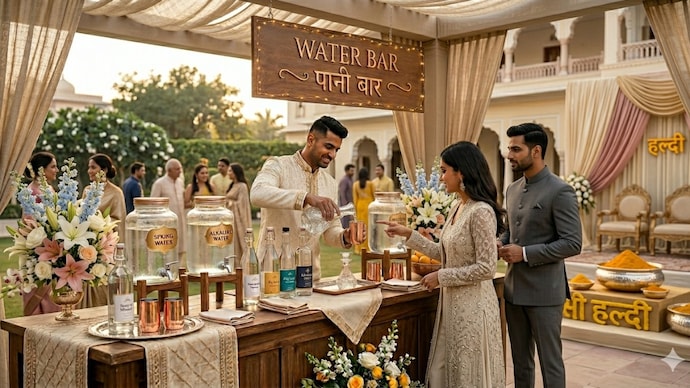
"A water bar can be a curated experience where guests are introduced to different types of premium waters sourced from various regions around the world, and then they can sample still, sparkling, mineral, glacier or artesian waters. The experience is designed to be interactive, educational and luxurious, adding a unique touch."
"As planners, we are always looking for meaningful ways to enhance guest experiences. I can see water bars working beautifully at wellness-inspired wedding weekends, luxury destination weddings, high-end brunches or intimate celebrations where guests have the time to engage with the experience. They could also be paired with gourmet dining experiences, tasting menus or health-conscious wedding concepts."
Even Mehta thinks it's genuinely poised to be the next big trend. "Offering water and water-based drinks to guests is the oldest gesture of welcome we have, and a water bar simply dignifies that gesture."
She adds, "Indian weddings have already elevated every other category. Water has been the one untouched constant, served as an afterthought. A water bar can be inclusive too. At a gathering where not everyone drinks alcohol, a water bar gives every guest something elevated to engage with."
Experts say beyond the growing awareness around water, there are several factors that could make water bars the next big wedding trend.
Luxury hospitality
Aaryandeep Singh, co-founder of Bas Paani, shares, "I think it is feasible in the Indian market, particularly at destination weddings, luxury celebrations and events where hospitality is a key focus. Like many experiential concepts, it will likely start at the premium end before becoming more familiar over time."
Oberoi shares a similar sentiment.
"In bespoke, highly personalised experiences, today's luxury wedding clientele is increasingly looking for unique elements. Water bars could naturally appeal to this segment, particularly for intimate luxury weddings and destination celebrations."
And as the trickle-down theory goes, trends that start with the elite eventually make their way to a broader section of society.
"The early adopters are likely to be consumers who already value wellness, sustainability, premium hospitality. They are typically the same audience that embraces specialty coffee, artisanal food products and conscious luxury," Singh adds.
The sober-curious movement
Remember how the Reel mentions 'Dry April.' Over the past few years, surveys have revealed that Gen Z is becoming increasingly sober-curious. They are adopting healthier lifestyles and reducing alcohol intake.
"Sober-curious hosting is no longer niche. I can absolutely see curating water bars for weddings — still and sparkling, with pairings as a proper experience for everyone not reaching for a cocktail," says Mehta.
Interestingly, this wellness trend towards mindful drinking has also given rise to zero-proof spirits. Non-alcoholic spirits aim to capture the flavour, aroma and ritual of drinking alcohol while keeping things completely booze-free. Hence, water tasting doesn't sound that unusual.
Beyond novelty and luxury, water bars are also tapping into two things modern consumers care deeply about: wellness and sustainability.
Wellness and sustainability
"People are far more conscious of what goes into their bodies, and minerals are the whole point. Rather than emptying sachets of electrolytes into whatever water you're handed at a wedding, consider that every litre of Aava carries an average of 21mg of calcium and 11mg of magnesium, still or sparkling, because these occur naturally. And you need them when you're dancing all night, because hydration actually comes from minerality, not just liquid H2O," says Mehta.
But how much does the type of water we drink actually affect our health?
Rohit Sharma, consultant internal medicine, Apollo Spectra Hospital, Jaipur, breaks down the nutrient profile of water.
"Mineral water contains naturally occurring minerals such as calcium, magnesium, sodium and bicarbonates. Natural mineral water usually comes from a protected underground source and has a stable mineral composition. Spring water also comes from an underground source and may or may not be rich in minerals. Alkaline water has a higher pH, usually above 7, either naturally or through added minerals. Alkaline mineral water combines both features. The key differences are the source, pH and dissolved minerals."
That said, experts caution against overcomplicating hydration.
"People should check safety first, along with transparency of source, mineral content and sodium levels," Dr Sharma emphasises.
"There is no single ideal mineral profile for everyone, but a well-balanced mineral water with moderate levels of calcium and magnesium and low sodium is generally a sensible choice for daily use. Very high-mineral or high-sodium water may not suit everyone. For regular drinking, choose water that is clean, tested, pleasant to drink and suitable for your health needs. The best water is the one you will drink consistently."
Health, however, is only one part of the appeal.
Sustainability is increasingly becoming part of the conversation too. Sahu believes that from matkas to copper bottles, Indians have always been particular about their water. Today, that curiosity is extending to its source, mineral content and even packaging.
Last sip
Water is no longer just a utility at weddings. People are paying attention to minerals, sustainability and even tasting notes. In many ways, water is having the same cultural moment that coffee and wine had years ago.
Of course, more awareness is needed. The idea may not go viral overnight, but it has the potential to move from luxury events and fine-dining tables to family gatherings and restaurant menus.
Which brings us back to the question many of us have probably asked at some point: "Rs 300 ki paani ki bottle kaun leta hai?"
Turns out, quite a few people do.
The premium water space is no longer limited to water sommeliers and industry insiders. Actor Bhumi Pednekar has entered the category with Backbay, a venture she co-founded with her sister, Samiksha Pednekar. The brand offers natural mineral water sourced from the Himalayas and places a strong emphasis on sustainable packaging. Hollywood actor Jason Momoa, best known for playing Aquaman, has also backed Mananalu, a sustainable water venture focused on reducing single-use plastic.
Paani. Jal. Neer. Water. Call it by any name, yet it remains one of the simplest beverages to exist.
Or at least, most of us thought so.
So, the next time you're at a wedding, don't be surprised if "one spring water, please" becomes the new cocktail-hour order, replacing the Cosmopolitans, Martinis or Gin and Tonics.
"Excuse me, can I get a glass of water, please?"
It is one of the simplest requests you can make at a restaurant. At most, the server might ask whether you'd like it chilled or at room temperature. Maybe bottled, RO, or sparkling, if they're feeling particularly fancy.
Water, after all, was never meant to be complicated. You drink it because you're thirsty, and your body needs it. Nobody expects a discussion on flavour notes, mineral composition, source altitude, or whether a bottle is worth Rs 500.
And yet, here we are.
Water is no longer just something that quenches your thirst. The kind of water you drink increasingly says something about who you are—or at least who you want to be seen as. From luxury labels and designer bottles to curated mineral profiles, water is quietly transforming from a basic necessity into a lifestyle product, one that is marketed, experienced, and, in some circles, flaunted.
Recently, in a podcast, content creator Sakshi Shivdasani shared her experience of attending a wedding with a water bar. No lime soda or Blue Lagoon, but glacial water, spring water, mineral water and more. She mentioned that the groom's friends were observing 'Dry April' — a month-long break from alcohol – and that added on to the experience.
Water bars at weddings? It certainly doesn't sound impossible. After all, people are arranging everything from IV drips and hyper-personalised food and beverage stations to team games, bhajan clubbing, and all sorts of niche experiences at weddings these days. In comparison, a water bar seems fairly reasonable.
However, reasonable as it may sound, it did raise a lot of questions. Until then, the only 'fancy' water I had heard of was Evian — largely because of stories about Virat Kohli drinking it. That was pretty much my entire introduction to premium water.
The Reel opened the door to an entire world where water isn't just water, but a carefully marketed product complete with provenance, mineral composition, tasting notes, and a certain aspirational appeal.
Of course, when you come across something like this, you dig a little deeper. And that's where the intriguing stuff begins.
Not all water is the same
Much like wine tasting and wine sommeliers, water tasting and water sommeliers exist too, and the conversation around them is slowly gaining momentum. They're part of a growing movement within the water industry that aims to build awareness around the idea that water does more than simply hydrate.
Avanti Mehta, water sommelier, brand manager at Aava Natural Mineral Water, explains a basic difference first:
"There's natural mineral water, bottled straight from a single protected source with its minerals intact, and then there's packaged drinking water, which is RO-processed and stripped of minerals. It's kind of like the distinction between a real and a lab-grown diamond. One carries terroir, the geology of where it comes from, exactly like wine. The other is made by a machine and can be set up anywhere."
Apart from that, there's glacial water, alkaline water, natural alkaline water and more.
Why are minerals important? Some minerals, such as magnesium and calcium, can make water taste fuller or slightly sweet, while sodium and bicarbonates can affect its softness, saltiness or smoothness.
According to Reuters, Avni Biyani, co-founder of Foodstories, said sales of premium water at the retailer's three gourmet stores tripled in 2025. She noted that rising consumer demand led the chain to import Saratoga Spring Water from New York, marketed as having a "light and creamy" taste profile. Priced at Rs 799 for a 355-ml bottle, the product reportedly sold out within days of being stocked.
So, yes, people are ready to pay.
"Water menus have been established in European fine dining for years. Today, I already run tastings for our hospitality and retail partners, and I curate water-tasting dinners for HNIs and embassy events. I can see it extending naturally into hospitality, and even into concerts and weddings," Mehta says confidently.
New wedding trend: Water bars
"I think it has the potential to become a niche but meaningful part of premium weddings," says Archit Sahu, co-founder of Bas Paani. "Weddings have become increasingly experience-led, and hosts are constantly looking for thoughtful ways to surprise guests. A curated water experience feels less like a gimmick and more like a reflection of that broader shift towards conscious hospitality."
Can you imagine a station just for water? Damini Oberoi, founder of Pune-based Q Events and Weddings explains what it may look like.
"A water bar can be a curated experience where guests are introduced to different types of premium waters sourced from various regions around the world, and then they can sample still, sparkling, mineral, glacier or artesian waters. The experience is designed to be interactive, educational and luxurious, adding a unique touch."
"As planners, we are always looking for meaningful ways to enhance guest experiences. I can see water bars working beautifully at wellness-inspired wedding weekends, luxury destination weddings, high-end brunches or intimate celebrations where guests have the time to engage with the experience. They could also be paired with gourmet dining experiences, tasting menus or health-conscious wedding concepts."
Even Mehta thinks it's genuinely poised to be the next big trend. "Offering water and water-based drinks to guests is the oldest gesture of welcome we have, and a water bar simply dignifies that gesture."
She adds, "Indian weddings have already elevated every other category. Water has been the one untouched constant, served as an afterthought. A water bar can be inclusive too. At a gathering where not everyone drinks alcohol, a water bar gives every guest something elevated to engage with."
Experts say beyond the growing awareness around water, there are several factors that could make water bars the next big wedding trend.
Luxury hospitality
Aaryandeep Singh, co-founder of Bas Paani, shares, "I think it is feasible in the Indian market, particularly at destination weddings, luxury celebrations and events where hospitality is a key focus. Like many experiential concepts, it will likely start at the premium end before becoming more familiar over time."
Oberoi shares a similar sentiment.
"In bespoke, highly personalised experiences, today's luxury wedding clientele is increasingly looking for unique elements. Water bars could naturally appeal to this segment, particularly for intimate luxury weddings and destination celebrations."
And as the trickle-down theory goes, trends that start with the elite eventually make their way to a broader section of society.
"The early adopters are likely to be consumers who already value wellness, sustainability, premium hospitality. They are typically the same audience that embraces specialty coffee, artisanal food products and conscious luxury," Singh adds.
The sober-curious movement
Remember how the Reel mentions 'Dry April.' Over the past few years, surveys have revealed that Gen Z is becoming increasingly sober-curious. They are adopting healthier lifestyles and reducing alcohol intake.
"Sober-curious hosting is no longer niche. I can absolutely see curating water bars for weddings — still and sparkling, with pairings as a proper experience for everyone not reaching for a cocktail," says Mehta.
Interestingly, this wellness trend towards mindful drinking has also given rise to zero-proof spirits. Non-alcoholic spirits aim to capture the flavour, aroma and ritual of drinking alcohol while keeping things completely booze-free. Hence, water tasting doesn't sound that unusual.
Beyond novelty and luxury, water bars are also tapping into two things modern consumers care deeply about: wellness and sustainability.
Wellness and sustainability
"People are far more conscious of what goes into their bodies, and minerals are the whole point. Rather than emptying sachets of electrolytes into whatever water you're handed at a wedding, consider that every litre of Aava carries an average of 21mg of calcium and 11mg of magnesium, still or sparkling, because these occur naturally. And you need them when you're dancing all night, because hydration actually comes from minerality, not just liquid H2O," says Mehta.
But how much does the type of water we drink actually affect our health?
Rohit Sharma, consultant internal medicine, Apollo Spectra Hospital, Jaipur, breaks down the nutrient profile of water.
"Mineral water contains naturally occurring minerals such as calcium, magnesium, sodium and bicarbonates. Natural mineral water usually comes from a protected underground source and has a stable mineral composition. Spring water also comes from an underground source and may or may not be rich in minerals. Alkaline water has a higher pH, usually above 7, either naturally or through added minerals. Alkaline mineral water combines both features. The key differences are the source, pH and dissolved minerals."
That said, experts caution against overcomplicating hydration.
"People should check safety first, along with transparency of source, mineral content and sodium levels," Dr Sharma emphasises.
"There is no single ideal mineral profile for everyone, but a well-balanced mineral water with moderate levels of calcium and magnesium and low sodium is generally a sensible choice for daily use. Very high-mineral or high-sodium water may not suit everyone. For regular drinking, choose water that is clean, tested, pleasant to drink and suitable for your health needs. The best water is the one you will drink consistently."
Health, however, is only one part of the appeal.
Sustainability is increasingly becoming part of the conversation too. Sahu believes that from matkas to copper bottles, Indians have always been particular about their water. Today, that curiosity is extending to its source, mineral content and even packaging.
Last sip
Water is no longer just a utility at weddings. People are paying attention to minerals, sustainability and even tasting notes. In many ways, water is having the same cultural moment that coffee and wine had years ago.
Of course, more awareness is needed. The idea may not go viral overnight, but it has the potential to move from luxury events and fine-dining tables to family gatherings and restaurant menus.
Which brings us back to the question many of us have probably asked at some point: "Rs 300 ki paani ki bottle kaun leta hai?"
Turns out, quite a few people do.
The premium water space is no longer limited to water sommeliers and industry insiders. Actor Bhumi Pednekar has entered the category with Backbay, a venture she co-founded with her sister, Samiksha Pednekar. The brand offers natural mineral water sourced from the Himalayas and places a strong emphasis on sustainable packaging. Hollywood actor Jason Momoa, best known for playing Aquaman, has also backed Mananalu, a sustainable water venture focused on reducing single-use plastic.
Paani. Jal. Neer. Water. Call it by any name, yet it remains one of the simplest beverages to exist.
Or at least, most of us thought so.
So, the next time you're at a wedding, don't be surprised if "one spring water, please" becomes the new cocktail-hour order, replacing the Cosmopolitans, Martinis or Gin and Tonics.

