Delhi's hottest new nightlife trend isn't a speakeasy. It's gallery hopping
Delhi's latest Friday-night crawl swaps cocktails for canvases, though, as it turns out, you might not have to give up the G&T after all.
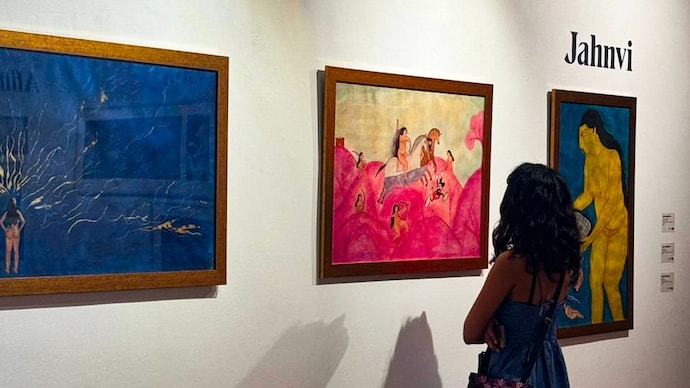
On most Friday evenings in Delhi, the script is familiar: a reservation at a restaurant, drinks at a bar, or maybe a speakeasy tucked behind an unmarked door. The city’s nightlife has long revolved around food, alcohol and music. But in one corner of South Delhi, a different kind of night out is quietly taking shape.
On select evenings, the streets of Defence Colony fill with people carrying neither shopping bags nor club wristbands. Instead, they move from one art gallery to another, drifting through exhibitions, conversations, performances and artist interactions. Some arrive as collectors. Many come as curious first-timers. Others simply stumble in after work, following the crowd.
Artsy nights in Delhi's Defence Colony
Welcome to Def Col Art Night, a monthly gallery crawl that may be Delhi's most unexpected new nightlife ritual.
There are over 10 art galleries in Defence Colony, and once a month, they come together for this special evening, turning the neighbourhood into a festival of sorts.
The galleries, which typically close by 6 pm, remain open until 9 pm. Entry is completely free. There are no registrations, tickets or exclusive guest lists. You simply show up and begin walking. And walking is central to the experience.
There is no fixed route or hopping schedule. Visitors are free to begin and end at any gallery, choosing which spaces to explore and which to skip. While many of the galleries are within comfortable walking distance of one another, a few may require a short drive.
Instagram is where the whole plan, list of participating galleries is shared.
Def Col Art Night unfolds within a compact, pedestrian-friendly pocket of Defence Colony. The galleries are clustered across the B and D blocks, allowing visitors to move seamlessly from one venue to the next. In many ways, it feels remarkably similar to a pub crawl - except here, paintings replace pints. (Though the pints aren't entirely missing either, as you'll discover later in this story.)
I began my evening at Vadehra Art Gallery, which was presenting works by 30 artists under the age of 30 across three floors. The gallery was packed with a mixed, striking crowd.
Some visitors were evidently from the art world - collectors, gallery owners, consultants and artists themselves. Others were students, fashion professionals, friends supporting exhibiting artists, or simply curious Delhiites (like me) looking for a different way to spend an evening. A handful of content creators moved through the halls, documenting every corner for social media.
Inside, the mix of audiences translated into an equally diverse set of interactions. Some visitors lingered over artworks, studying them intently, while others were content to soak in the atmosphere. A young artist explained her work to a group of students gathered around her, while nearby, two friends debated whether a painting spoke of hope or struggle.
That is perhaps the most surprising thing about the evening: conversations begin effortlessly. You ask someone what they think about a painting. Five minutes later, you're walking together to the next gallery. By the third gallery, you've forgotten you met only an hour ago.
More than just art
The idea behind Def Col Art Night emerged from a simple observation. Defence Colony already housed a remarkable concentration of galleries.
Arjun Butani, co-founder of Pristine Contemporary gallery and one of the conceptualisers behind Def Col Art Night, says the initiative was born from a desire to make art more spontaneous and accessible.
"The idea was to gather all the galleries in the neighbourhood because we're all friends anyway," he says.
The first edition took place in January 2026, shortly before the India Art Fair. Encouraged by strong support and publicity surrounding the fair, galleries joined forces to create a recurring evening dedicated to art, culture and community.
Unlike traditional monthly events, Def Col Art Night does not follow a fixed calendar. Instead, it is organised whenever multiple galleries are opening new exhibitions on the same evening. The next one will now take place on July 7, by the way.
The result is a programme that remains organic and constantly evolving. More importantly, it extends beyond the confines of visual art. One gallery may host an artist walkthrough, another a book launch or panel discussion, while a third might transform into a musical performance space.
"Once, we had a popular DJ open the evening and a lot of people came mainly for the music," recalls Butani. "Art was secondary. But that's the beauty of it - it becomes a melting point of culture."
There are precedents for this format in gallery districts such as Shoreditch and Bethnal Green in East London, and Mitte and Kreuzberg in Berlin, where audiences move between multiple cultural venues over the course of an evening.
Breaking gallery stereotypes
Private galleries have long battled perceptions of exclusivity. Many people assume they must possess specialist knowledge, buying power or industry connections before entering such spaces. Events like Def Col Art Night quietly dismantle those assumptions.
Bhavna Kakar, founder of Latitude 28, believes the initiative changes the conditions under which people encounter art.
"The audience extends beyond the regular gallery-going public," she says. "Alongside collectors, artists and students, we see visitors from architecture, design, publishing, fashion, music and entrepreneurship."
The social nature of the evening attracts people who may not ordinarily visit galleries. Some come because they are interested in a particular exhibition. Others simply arrive because a friend suggested it.
Divya Arora, a 33-year-old content professional, was drawn to Def Col Art Night after discovering it through a social media post two months ago. She finally attended the May edition, managing to cover five galleries in a single evening. So keen was she not to miss a moment that she wrapped up work early and arrived at the first gallery right at 6 pm.
Covering all 10–12 participating galleries in a three-hour window is ambitious, if not impossible. A more realistic goal is to visit five or six galleries, allowing enough time to engage with the exhibitions, attend a walkthrough or simply linger over conversations before moving on to the next stop.
One aspect of the experience particularly caught Arora off guard (and amazed). "I was surprised to see how many galleries were serving gin, mocktails and snacks to visitors. I wasn't expecting that at all," she says. "I'm someone who enjoys bar-hopping, so it was delightful to see G&Ts and champagne becoming part of my gallery-hopping experience too."
Arora isn't exaggerating. Several galleries had turned hospitality into a part of the experience. While Kalakaar Art Salon and Latitude 28 had mini bars serving wine, gin and other drinks, Method offered visitors glasses of classic lemonade - a welcome respite on a sweltering Delhi summer evening. And remember, this was a free entry event.
Delhi already has a large number of galleries, institutions, artist studios, and cultural organisations, but they are often experienced separately. This format encourages people to engage with multiple exhibitions and programmes in a single evening.
This sense of movement is the art night’s big USP. At Method, we encountered works that felt grotesque. Across the neighbourhood, another gallery might be presenting photography, while a third focuses on sculpture.
At the appointments-only Kalakaar Art Salon, visitors gathered around works by masters such as MF Husain and FN Souza - artists whose works many would otherwise encounter only in museums, auction catalogues or textbooks.
"Even those who arrive without a specific interest in contemporary art often leave having encountered a work, an artist or a conversation that stays with them," Kakar says.
This diversity of audience is also the most rewarding aspects for gallery directors like Roshini Vadehra of Vadehra Art Gallery.
“Such events create an opportunity for visitors extending beyond the immediate art community to experience art in a more dynamic and engaging way. This kind of engagement and awareness will go a long way in creating a gallery going culture with a much wider audience than what exists now,” she says.
For Butani, the art nights are as much about giving back to the neighbourhood as they are about supporting artists. By attracting a wider and more diverse audience, the initiative helps artists gain greater visibility and connect with people beyond the traditional art world. "It's more like a social responsibility," he says.
The final stop of my evening was Latitude 28. The exhibition explored textile-based practices and memory. One artist employed Bengal's kantha embroidery traditions to narrate inherited stories of Partition.
Another, Banaras-based textile practitioner Anshu Singh, transformed discarded copper wires from power looms into a luminous woven dupatta.
The work questioned an enduring contradiction: the women who produce luxury textiles are often unable to afford the products they help create. Using discarded industrial material, Singh transformed waste into something precious. The piece lingered long after we left.
As I stepped out of Latitude 28, Defence Colony felt different from the neighbourhood I had entered three hours earlier. Small groups lingered outside galleries, deciding where to go next. Some headed towards nearby cafes. Others debated squeezing in one final exhibition before closing time.
Delhi's art landscape
But Defence Colony is not the only district in the city where one can discover art this way. Visitors can also head to Lado Sarai or Hauz Khas, both home to several art galleries, or do the classic Mandi House crawl that covers museums and the NGMA independently.
Lately, there have been efforts to widen the reach of art in India. Large-scale events such as the India Art Fair are one example. Earlier this year, art collector Amit Kumar Jain and his team curated a special art exhibition inside an abandoned restaurant in Connaught Place, called Party is Elsewhere. Works by eminent artists, including Subodh Gupta, were on display at the free-entry exhibition, which was open to all. That event, too, drew a significant number of visitors who would not typically be considered part of the art world.
These events serve as an important gateway to the arts, introducing new and younger audiences to artistic practices and spaces. Unlike traditional art exhibitions, which were often formal and invitation-only, such initiatives democratise access to art, broaden public engagement, and create opportunities for emerging artists to connect with wider audiences.
Led by curiosity, these events satisfy a growing appetite among young people for experiences beyond the digital world - a reason to step out, explore the city on foot, meet strangers, and encounter the unexpected.
On most Friday evenings in Delhi, the script is familiar: a reservation at a restaurant, drinks at a bar, or maybe a speakeasy tucked behind an unmarked door. The city’s nightlife has long revolved around food, alcohol and music. But in one corner of South Delhi, a different kind of night out is quietly taking shape.
On select evenings, the streets of Defence Colony fill with people carrying neither shopping bags nor club wristbands. Instead, they move from one art gallery to another, drifting through exhibitions, conversations, performances and artist interactions. Some arrive as collectors. Many come as curious first-timers. Others simply stumble in after work, following the crowd.
Artsy nights in Delhi's Defence Colony
Welcome to Def Col Art Night, a monthly gallery crawl that may be Delhi's most unexpected new nightlife ritual.
There are over 10 art galleries in Defence Colony, and once a month, they come together for this special evening, turning the neighbourhood into a festival of sorts.
The galleries, which typically close by 6 pm, remain open until 9 pm. Entry is completely free. There are no registrations, tickets or exclusive guest lists. You simply show up and begin walking. And walking is central to the experience.
There is no fixed route or hopping schedule. Visitors are free to begin and end at any gallery, choosing which spaces to explore and which to skip. While many of the galleries are within comfortable walking distance of one another, a few may require a short drive.
Instagram is where the whole plan, list of participating galleries is shared.
Def Col Art Night unfolds within a compact, pedestrian-friendly pocket of Defence Colony. The galleries are clustered across the B and D blocks, allowing visitors to move seamlessly from one venue to the next. In many ways, it feels remarkably similar to a pub crawl - except here, paintings replace pints. (Though the pints aren't entirely missing either, as you'll discover later in this story.)
I began my evening at Vadehra Art Gallery, which was presenting works by 30 artists under the age of 30 across three floors. The gallery was packed with a mixed, striking crowd.
Some visitors were evidently from the art world - collectors, gallery owners, consultants and artists themselves. Others were students, fashion professionals, friends supporting exhibiting artists, or simply curious Delhiites (like me) looking for a different way to spend an evening. A handful of content creators moved through the halls, documenting every corner for social media.
Inside, the mix of audiences translated into an equally diverse set of interactions. Some visitors lingered over artworks, studying them intently, while others were content to soak in the atmosphere. A young artist explained her work to a group of students gathered around her, while nearby, two friends debated whether a painting spoke of hope or struggle.
That is perhaps the most surprising thing about the evening: conversations begin effortlessly. You ask someone what they think about a painting. Five minutes later, you're walking together to the next gallery. By the third gallery, you've forgotten you met only an hour ago.
More than just art
The idea behind Def Col Art Night emerged from a simple observation. Defence Colony already housed a remarkable concentration of galleries.
Arjun Butani, co-founder of Pristine Contemporary gallery and one of the conceptualisers behind Def Col Art Night, says the initiative was born from a desire to make art more spontaneous and accessible.
"The idea was to gather all the galleries in the neighbourhood because we're all friends anyway," he says.
The first edition took place in January 2026, shortly before the India Art Fair. Encouraged by strong support and publicity surrounding the fair, galleries joined forces to create a recurring evening dedicated to art, culture and community.
Unlike traditional monthly events, Def Col Art Night does not follow a fixed calendar. Instead, it is organised whenever multiple galleries are opening new exhibitions on the same evening. The next one will now take place on July 7, by the way.
The result is a programme that remains organic and constantly evolving. More importantly, it extends beyond the confines of visual art. One gallery may host an artist walkthrough, another a book launch or panel discussion, while a third might transform into a musical performance space.
"Once, we had a popular DJ open the evening and a lot of people came mainly for the music," recalls Butani. "Art was secondary. But that's the beauty of it - it becomes a melting point of culture."
There are precedents for this format in gallery districts such as Shoreditch and Bethnal Green in East London, and Mitte and Kreuzberg in Berlin, where audiences move between multiple cultural venues over the course of an evening.
Breaking gallery stereotypes
Private galleries have long battled perceptions of exclusivity. Many people assume they must possess specialist knowledge, buying power or industry connections before entering such spaces. Events like Def Col Art Night quietly dismantle those assumptions.
Bhavna Kakar, founder of Latitude 28, believes the initiative changes the conditions under which people encounter art.
"The audience extends beyond the regular gallery-going public," she says. "Alongside collectors, artists and students, we see visitors from architecture, design, publishing, fashion, music and entrepreneurship."
The social nature of the evening attracts people who may not ordinarily visit galleries. Some come because they are interested in a particular exhibition. Others simply arrive because a friend suggested it.
Divya Arora, a 33-year-old content professional, was drawn to Def Col Art Night after discovering it through a social media post two months ago. She finally attended the May edition, managing to cover five galleries in a single evening. So keen was she not to miss a moment that she wrapped up work early and arrived at the first gallery right at 6 pm.
Covering all 10–12 participating galleries in a three-hour window is ambitious, if not impossible. A more realistic goal is to visit five or six galleries, allowing enough time to engage with the exhibitions, attend a walkthrough or simply linger over conversations before moving on to the next stop.
One aspect of the experience particularly caught Arora off guard (and amazed). "I was surprised to see how many galleries were serving gin, mocktails and snacks to visitors. I wasn't expecting that at all," she says. "I'm someone who enjoys bar-hopping, so it was delightful to see G&Ts and champagne becoming part of my gallery-hopping experience too."
Arora isn't exaggerating. Several galleries had turned hospitality into a part of the experience. While Kalakaar Art Salon and Latitude 28 had mini bars serving wine, gin and other drinks, Method offered visitors glasses of classic lemonade - a welcome respite on a sweltering Delhi summer evening. And remember, this was a free entry event.
Delhi already has a large number of galleries, institutions, artist studios, and cultural organisations, but they are often experienced separately. This format encourages people to engage with multiple exhibitions and programmes in a single evening.
This sense of movement is the art night’s big USP. At Method, we encountered works that felt grotesque. Across the neighbourhood, another gallery might be presenting photography, while a third focuses on sculpture.
At the appointments-only Kalakaar Art Salon, visitors gathered around works by masters such as MF Husain and FN Souza - artists whose works many would otherwise encounter only in museums, auction catalogues or textbooks.
"Even those who arrive without a specific interest in contemporary art often leave having encountered a work, an artist or a conversation that stays with them," Kakar says.
This diversity of audience is also the most rewarding aspects for gallery directors like Roshini Vadehra of Vadehra Art Gallery.
“Such events create an opportunity for visitors extending beyond the immediate art community to experience art in a more dynamic and engaging way. This kind of engagement and awareness will go a long way in creating a gallery going culture with a much wider audience than what exists now,” she says.
For Butani, the art nights are as much about giving back to the neighbourhood as they are about supporting artists. By attracting a wider and more diverse audience, the initiative helps artists gain greater visibility and connect with people beyond the traditional art world. "It's more like a social responsibility," he says.
The final stop of my evening was Latitude 28. The exhibition explored textile-based practices and memory. One artist employed Bengal's kantha embroidery traditions to narrate inherited stories of Partition.
Another, Banaras-based textile practitioner Anshu Singh, transformed discarded copper wires from power looms into a luminous woven dupatta.
The work questioned an enduring contradiction: the women who produce luxury textiles are often unable to afford the products they help create. Using discarded industrial material, Singh transformed waste into something precious. The piece lingered long after we left.
As I stepped out of Latitude 28, Defence Colony felt different from the neighbourhood I had entered three hours earlier. Small groups lingered outside galleries, deciding where to go next. Some headed towards nearby cafes. Others debated squeezing in one final exhibition before closing time.
Delhi's art landscape
But Defence Colony is not the only district in the city where one can discover art this way. Visitors can also head to Lado Sarai or Hauz Khas, both home to several art galleries, or do the classic Mandi House crawl that covers museums and the NGMA independently.
Lately, there have been efforts to widen the reach of art in India. Large-scale events such as the India Art Fair are one example. Earlier this year, art collector Amit Kumar Jain and his team curated a special art exhibition inside an abandoned restaurant in Connaught Place, called Party is Elsewhere. Works by eminent artists, including Subodh Gupta, were on display at the free-entry exhibition, which was open to all. That event, too, drew a significant number of visitors who would not typically be considered part of the art world.
These events serve as an important gateway to the arts, introducing new and younger audiences to artistic practices and spaces. Unlike traditional art exhibitions, which were often formal and invitation-only, such initiatives democratise access to art, broaden public engagement, and create opportunities for emerging artists to connect with wider audiences.
Led by curiosity, these events satisfy a growing appetite among young people for experiences beyond the digital world - a reason to step out, explore the city on foot, meet strangers, and encounter the unexpected.

