West Bengal | BJP ups the ante
The booth committees are stronger, there is less factionalism, and belief in the party organisation is high. Will it be enough for the BJP to breach the TMC citadel of West Bengal?
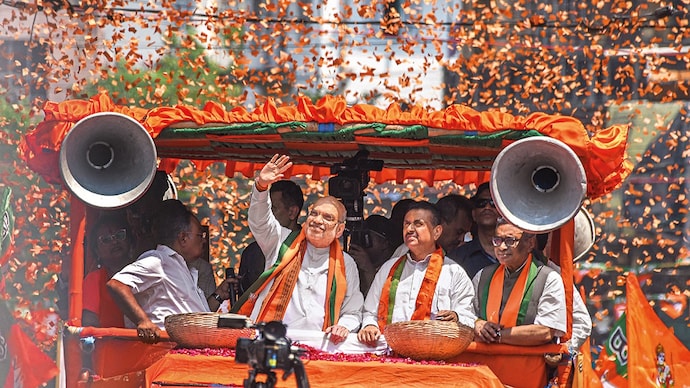
On April 2, Amit Shah was at a rally in Bhabanipur where he struck a markedly measured tone. Gone was the fire and brimstone of 2021, when the Union home minister and BJP No. 2 had predicted over 200 seats for the party (in the 294-member assembly). This time, seeking support for leader of the Opposition and party candidate here, Suvendu Adhikari, Shah scaled the target down to “at least 170 seats”.
On April 2, Amit Shah was at a rally in Bhabanipur where he struck a markedly measured tone. Gone was the fire and brimstone of 2021, when the Union home minister and BJP No. 2 had predicted over 200 seats for the party (in the 294-member assembly). This time, seeking support for leader of the Opposition and party candidate here, Suvendu Adhikari, Shah scaled the target down to “at least 170 seats”.
Still, even if the rhetoric appeared tempered, there was no doubting the confidence behind it. The BJP in Bengal, long criticised for its fragile organisation, believes it has rebuilt itself from booth up. Adhikari’s second nomination from Bhabanipur (he’s also contesting from Nandigram), where he’s taking on chief minister and Trinamool Congress (TMC) chairperson Mamata Banerjee in her backyard, was obviously meant to signal this aggressive political push.
For years, the BJP began with a disadvantage in Bengal. Roughly 30 per cent of the electorate comprises Muslims, a demographic that has consolidated behind the TMC. This effectively meant the BJP started many of the contests one step behind. But its deeper weaknesses lay elsewhere. Even in Hindu-dominated regions, the party often lacked booth-level strength. The 2021 assembly election aftermath, especially the post-poll violence, exposed this fragility. The leaders who had parachuted in from other states had left soon after the polls, and the local leadership was inaccessible. Many BJP grassroots workers felt abandoned; the psychological impact was severe. Morale dipped. Networks collapsed. Yet, paradoxically, the party’s vote base did not entirely erode. In the 2023 panchayat elections, despite widespread allegations of violence again, the BJP won over 9,700 gram panchayat seats (over 15 per cent of the total 63,000-plus seats). It signalled something important—a segment of the electorate continued to back the BJP.
THE BANSAL BLUEPRINT
The man tasked with the state unit overhaul was party general secretary Sunil Bansal, who had been appointed central observer for Bengal in August 2022. His predecessor, Madhya Pradesh leader Kailash Vijayvargiya, had been a controversial figure. The latter’s strategy of inducting TMC defectors and giving them tickets got much flak within the party, and he even took a hit for the organisational disarray and the 2021 loss.
Bansal’s approach was different. For months, he travelled across Bengal, holding meetings, understanding factional dynamics and mapping organisational gaps. The real push, however, came after the 2024 Lok Sabha election. In October that year, Shah launched an ambitious membership drive in Bengal—the ‘Sadasyata Abhiyan’ set a target of 10 million new members by January 15, 2026. They didn’t meet the target—party sources says the number hovers around 8 million currently—but the exercise yielded something more significant—a structured hierarchy of engagement.
Anyone who could enrol 100 primary members was designated an active member. Today, the party claims to have 60,000 such active members. This tiered structure ensured accountability and local ownership. The drive was executed in phases under different leaders. Rajya Sabha MP and current state president Samik Bhattacharya initially led the effort, followed by former Union minister of state Subhas Sarkar, and later state vice-president Prabal Raha.
The leadership consciously fostered competition. During the drive, those involved were required to report their numbers every night at 10 pm via video conference. Central leaders, including Bansal, monitored these sessions closely. His style, sources say, was “calibrated”. In one meeting, Bansal reportedly remarked that he was “kukhyat (notorious)” in his native Uttar Pradesh for cutting out non-performers. The message was clear. Performance would determine one’s chances within the organisation. Sarkar frames it a tad more diplomatically: “The leadership instilled a sense of competition among the workers. And it showed results.”
Simultaneously, key leaders like Adhikari, an ex-TMC strongman himself, were assigned responsibility over the ‘shakti kendras’, micro organisational units similar to a panchayat samiti. They travelled extensively, holding meetings and energising the cadre.
Factionalism was one area where the central leadership directly intervened, asking leaders to set aside differences and project a united front. The change is visible on the ground. Former state chief and Sangh veteran Dilip Ghosh, once at odds with Adhikari, was present at his nomination rally in Nandigram. Adhikari, in turn, attended Ghosh’s rally in his seat, Kharagpur Sadar.
The membership drive was followed by organisational elections across 1,326 mandals. Elections were only held in mandals where at least 50 per cent of booths had functioning committees. Each booth committee consists of 12 members, including a president. The party now claims to have such committees in around 68,000 of Bengal’s roughly 80,000 booths.
VERIFY AND PASS
In the past, claims about booth committees were difficult to audit, and numbers were often exaggerated. To address this issue, the party’s IT team developed a specialised feature within its internal web application, Saral. Party workers visited the residence of each prospective member, where a photograph was taken. To ensure that photo was not uploaded from a static source, the system required the individual to blink, ensuring the image was captured in real time. A one-time password was then sent to the individual’s mobile number. This step verified the authenticity of the contact details. The result: a “verified and dynamic” database, claims the party. Technology was also used to monitor performance. Daily reporting systems, digital tracking of enrolments, and centralised oversight ensured that the organisation functioned as a coordinated whole.
By April 2025, Bansal was setting a new target: strengthening the booths. A nine-month programme was rolled out in three phases. Booth Chalo Abhiyan focused on outreach; Booth Sashaktikaran Abhiyan looked to strengthen structures; and Booth Vijay Abhiyan was designed to convert organisational strength into electoral success. The programme extended even to Muslim-dominated booths, signalling an attempt to expand beyond traditional support bases. “The Bengal BJP organisation is in a confident position. Neither the CPI(M) nor the TMC had such an organisation when they were in the opposition,” says Raha.
UNRESOLVED ISSUES
Yet, beneath this confidence lie many unresolved challenges. Activity levels vary significantly across districts. Purba Medinipur, Adhikari’s home turf, is often cited as a model of organisational efficiency. In contrast, districts like Howrah and Hooghly lag behind. Many booth committee members, sources admit, are not as active as expected.
Candidate selection has also exposed fault lines. Despite assurances that loyal party workers would be prioritised, several candidates have been fielded without formal induction into the party, such as former IPS officer Rajesh Kumar in Jagaddal. Protests have erupted in multiple constituencies, forcing the party to change candidates in at least four seats.
These contradictions underline a broader reality. The BJP faces a formidable opponent in the TMC, whose organisational network is entrenched and supplemented by the strategic inputs of poll consultants IPAC. The battle, then, is not just about numbers, but execution too. The party is also still battling the “outsider, non-Bengali” tag, which the TMC has successfully attached to it.
Still, the BJP’s transformation in Bengal is difficult to ignore. Shah’s words at Adhikari’s rally, saying if we “win Bhabanipur, we’ll win Bengal”, reflect this shift—a matter-of-fact statement rooted in organisational belief. Come May 4, we’ll know if that belief has withstood the test of the ballot.

