A small step with big moves | Mercedes-Benz S-Class facelift
With a mid-life facelift, the Mercedes flagship bids to retain its status as the bestselling luxury sedan in the world. We went to Germany to drive it
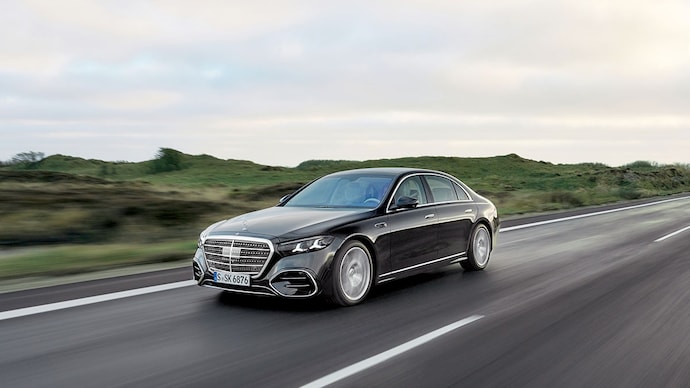
While mid-life facelifts usually go beyond just cosmetic changes, the claim by Mercedes that the car is 50 per cent new, with over 2,700 parts changed or new, goes to show how seriously the company has taken the makeover: It has changed as much of the car as possible without actually changing the bodyshell.
While mid-life facelifts usually go beyond just cosmetic changes, the claim by Mercedes that the car is 50 per cent new, with over 2,700 parts changed or new, goes to show how seriously the company has taken the makeover: It has changed as much of the car as possible without actually changing the bodyshell.
While striking cosmetic changes abound in the front of the car, with a bigger illuminated grille and new headlamps, the biggest change is the move to various takes on the three pointed star. The starry grille is taken from the new Battery Electric Vehicles, while the tail lamp signature is echoed in the headlamps and is a take from the E-Class tail lamps. On the exterior, wheel designs have changed and front fenders have a new camera for advanced assistance features.
The interiors are mostly all-new, as is most of the software. On the inside, the infotainment system’s screen makes its debut in the S-class, with three screens instead of the earlier two. The 12.3 inch passenger screen and the 14.4 inch central screen are behind the same glass panel, while the instrument panel is another 12.3 inch floating display. The biggest change is the software and hardware that drives these displays, powered by the Nvidia Drive Hyperion architecture that will have enough computing power for multiple upgrades to the car to enable autonomous driving in the future. The user interface now has the latest version of ChatGPT, Microsoft Bing and Google Gemini.
With 10 external cameras, five radars and 12 ultrasonic sensors, not only can the S-Class recognise parking spots before actually coming to them, it can also park by itself in non-conventional spaces, with or without differentiating lines, covered with grass or in between trees. It can also park itself at twice the speed it did earlier.
All the engines are upgraded and in the case of the top-of-the-line V8, this is perhaps the biggest work done on an internal combustion engine since the pandemic. The line-up starts with the EVO versions of the inline-six cylinder petrol and diesel engines. While all engines are mild hybrids, there are also two versions of plug-in hybrids, again powered by the inline-six, with 100 km of electric-only range.
Moreover, someone has finally gotten it right with regards to phone slots. Now, there are two charging pads accessible by the driver and passenger. The steering wheel is more tactile, too.
At the rear, instead of a single tablet for the rear seat passengers, each gets their own controller in the form of a removable smartphone-like device. The screens for rear passengers are also bigger and have an integrated webcam.
The entire climate control system has gone electronic, with the vents now opening and closing electrically and having numerous settings where the vents and the air flow get adjusted by themselves according to presets.
The AIRMATIC suspension system is now intelligent, and the rear wheel steering can turn up to an angle of 10 degrees, making short work of U-turns and cutting the turning circle. Driving the car feels more agile and nimble. It feels most different in its handling of really bad road surfaces and speed bumps.
All the engine variants, including the plug-in hybrids, get up to the top speed of 250 kmph with nonchalance. The 450e that will be launched in India features total output of 435 bhp and peak torque of 680 Nm. It will get up to 100 kmph in 5.7 seconds and now features a 27.8 kWh battery pack that can drive the car up to 108 km and a top speed of 140 kmph on electricity alone. The only drawback of the plug-in hybrids is that the boot space gets compromised as the floor of the boot is raised.
Overall, while the car is not revolutionary, it is better than before in every aspect. Mercedes has got the architecture right to build on for the future.

