New growth corridor | 3rd India Today Indo-Japan Conclave
The third India Today Indo-Japan Conclave highlighted the rising ambition on both sides to deepen strategic, economic and cultural engagement
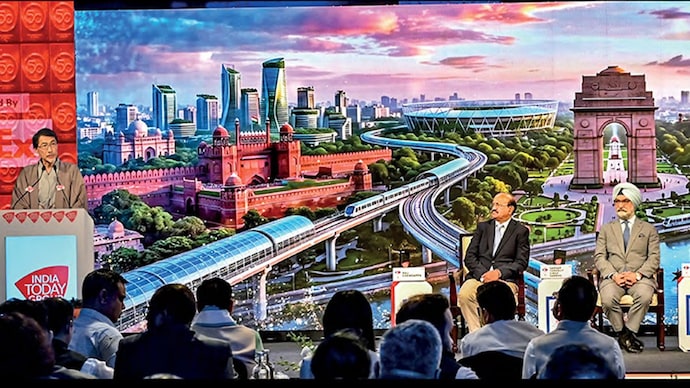
Amid global uncertainty, the third edition of the India Today Indo-Japan Conclave 2026, held on May 22 in Delhi, highlighted deepening strategic and economic ties between India and Japan. On the theme, ‘India-Japan: The New Growth Corridor’, it united policymakers, diplomats, business leaders and cultural ambassadors to explore new avenues of collaboration.
Delivering his special address, Japan’s ambassador to India, Ono Keiichi, pointed to a 10 trillion private investment pipeline and declared that the two countries had moved “from merely agreeing on beautiful words and principles to driving concrete collaboration”. He cited the Japan-India Economic Security Initiative and its five priority areas—semiconductors, critical minerals, information and communications technology, clean energy and pharmaceuticals—as evidence of that shift.
In his keynote address, Delhi Lieutenant Governor Sardar Taranjit Singh Sandhu underlined the city’s lived experience of Japanese partnership. “The Delhi Metro is not just a transport system; it is a model of efficiency, punctuality, safety and sustainability,” he said. Along similar lines, Union minister of parliamentary affairs, Kiren Rijiju, batted for positioning the Northeast as the centrepiece of India’s ties with East and Southeast Asia, urging Japanese investment, cultural collaboration and strategic integration with the region.
Haryana chief minister Nayab Singh Saini said the state is attempting to brand itself as India’s most mature Japan-ready manufacturing ecosystem, while Union minister of state for commerce and industry, Jitin Prasada, positioned India-Japan ties at the intersection of two defining themes shaping the world economy: technology and trade.
On the strategic front, Sujan R. Chinoy, director general of the Manohar Parrikar Institute for Defence Studies and Analyses (MP-IDSA) and a former ambassador of India to Japan, called for stronger India-Japan ties, suggesting that the relationship was boosted by India’s emergence as an economic power and China’s rising economic-military might and geopolitical assertion.
For the past three years, India has ranked among the most promising investment destinations for Japanese businesses, noted Takeshi Seo, India chairman of the Japan Chamber of Commerce and Industry, in the session on manufacturing. Echoing that optimism, Himanshu Srivastava, head, Japan Practice, Baker Tills ASA India LLP, said India is a hungry tiger and Japan a very experienced one. “What we need to do is walk together,” he said. On the same theme, Hemant Pimplikar, MD, sales, FedEx, said what was critical is how we moved trade across the globe.
Shifting the focus to human capital, Debashree Mukherjee, secretary, Union ministry of skill development and entrepreneurship, made a case for reimagining the bilateral relationship not just through trade deals and technology partnerships, but through people.
On boosting investment, Fumio Yamazaki, minister of economy and development, Embassy of Japan in India, outlined two priorities. “One, to make the manufacturing industry successful in India. Another, the economic security where, given the world situation, the strengthening of the supply chain is primordial.”
The discussions reflected a partnership widening in business, technology, infrastructure and culture. n
Amid global uncertainty, the third edition of the India Today Indo-Japan Conclave 2026, held on May 22 in Delhi, highlighted deepening strategic and economic ties between India and Japan. On the theme, ‘India-Japan: The New Growth Corridor’, it united policymakers, diplomats, business leaders and cultural ambassadors to explore new avenues of collaboration.
Delivering his special address, Japan’s ambassador to India, Ono Keiichi, pointed to a 10 trillion private investment pipeline and declared that the two countries had moved “from merely agreeing on beautiful words and principles to driving concrete collaboration”. He cited the Japan-India Economic Security Initiative and its five priority areas—semiconductors, critical minerals, information and communications technology, clean energy and pharmaceuticals—as evidence of that shift.
In his keynote address, Delhi Lieutenant Governor Sardar Taranjit Singh Sandhu underlined the city’s lived experience of Japanese partnership. “The Delhi Metro is not just a transport system; it is a model of efficiency, punctuality, safety and sustainability,” he said. Along similar lines, Union minister of parliamentary affairs, Kiren Rijiju, batted for positioning the Northeast as the centrepiece of India’s ties with East and Southeast Asia, urging Japanese investment, cultural collaboration and strategic integration with the region.
Haryana chief minister Nayab Singh Saini said the state is attempting to brand itself as India’s most mature Japan-ready manufacturing ecosystem, while Union minister of state for commerce and industry, Jitin Prasada, positioned India-Japan ties at the intersection of two defining themes shaping the world economy: technology and trade.
On the strategic front, Sujan R. Chinoy, director general of the Manohar Parrikar Institute for Defence Studies and Analyses (MP-IDSA) and a former ambassador of India to Japan, called for stronger India-Japan ties, suggesting that the relationship was boosted by India’s emergence as an economic power and China’s rising economic-military might and geopolitical assertion.
For the past three years, India has ranked among the most promising investment destinations for Japanese businesses, noted Takeshi Seo, India chairman of the Japan Chamber of Commerce and Industry, in the session on manufacturing. Echoing that optimism, Himanshu Srivastava, head, Japan Practice, Baker Tills ASA India LLP, said India is a hungry tiger and Japan a very experienced one. “What we need to do is walk together,” he said. On the same theme, Hemant Pimplikar, MD, sales, FedEx, said what was critical is how we moved trade across the globe.
Shifting the focus to human capital, Debashree Mukherjee, secretary, Union ministry of skill development and entrepreneurship, made a case for reimagining the bilateral relationship not just through trade deals and technology partnerships, but through people.
On boosting investment, Fumio Yamazaki, minister of economy and development, Embassy of Japan in India, outlined two priorities. “One, to make the manufacturing industry successful in India. Another, the economic security where, given the world situation, the strengthening of the supply chain is primordial.”
The discussions reflected a partnership widening in business, technology, infrastructure and culture. n

