India Today Tourism Survey & Awards 2026 | Trail blazers
At the India Today Tourism Survey & Awards 2026, states revealed plans to diversify attractions and unlock new destinations
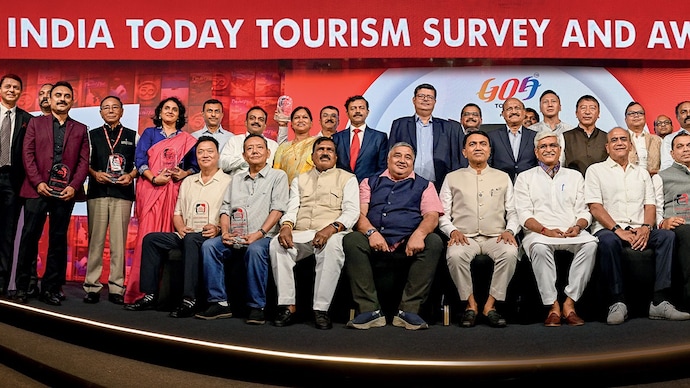
As domestic travel surges and states compete to attract visitors, India’s tourism sector is entering a new phase—one that seeks to balance growth with sustainability, diversify destinations and move beyond traditional tourism circuits. These themes dominated discussions at the India Today Tourism Survey & Awards 2026, held on June 14 and 15 in Goa, where policymakers, administrators and industry stakeholders outlined their vision for the future of Indian tourism.
In his keynote address, Union minister of culture and tourism Gajendra Singh Shekhawat said states have been asked to develop 50 new iconic tourist destinations that meet global standards. This will help decongest India’s most-visited destinations. “We have started working proactively with state governments to establish destination management authorities to holistically address issues and challenges,” he said.
Currently, India hosts 20 million international travellers annually, and the tourism sector’s contribution to GDP stands at 6 per cent. The long-term goal, envisioned by Prime Minister Narendra Modi, is to cater to 100 million tourists annually and raise the GDP share to 10 per cent by 2047. When that goal is met, tourism will become the country’s second-largest employment generator after agriculture, noted Shekhawat, who also presented the India Today Tourism Awards to representatives of 23 states across 11 categories in the presence of Goa chief minister Dr Pramod Sawant.
In his inaugural keynote address as chief guest, Pusapati Ashok Gajapathi Raju, Governor of Goa, noted that the state has in recent years transformed from a destination known primarily for its beaches into one defined by experiences. “People are no longer looking merely for places to visit. They are looking for experiences that are authentic, meaningful and memorable. They seek culture, nature, wellness, learning and adventure. And Goa is uniquely positioned to offer all of these.”
The summit saw states such as Goa and Rajasthan express their intent to move beyond their stereotypical images. In a fireside chat, Rohan Khaunte, Goa’s minister of tourism, said the state was looking beyond its beaches to showcase its verdant villages, temples, churches, sports and vibrant culture to domestic and international tourists. Shuchi Tyagi, secretary, department of tourism, arts and culture, Rajasthan, revealed that the state was diversifying beyond the perception of being a land of forts and palaces. It is promoting wildlife, desert safaris, astro, religious and rural tourism.
States are also keen to break the mould, transitioning from simply encouraging visits to creating immersive experiences. While Maharashtra seeks to highlight its hidden gems—from ancient geoglyphs to beaches, forts and World Heritage Sites—Madhya Pradesh is working towards achieving a synergy between tourism and wildlife, while neighbouring Chhattisgarh is promoting a unique tourism model centred on tribal and non-tribal festivals.
The pages ahead capture the key insights, strategies and success stories redefining tourism in India.
As domestic travel surges and states compete to attract visitors, India’s tourism sector is entering a new phase—one that seeks to balance growth with sustainability, diversify destinations and move beyond traditional tourism circuits. These themes dominated discussions at the India Today Tourism Survey & Awards 2026, held on June 14 and 15 in Goa, where policymakers, administrators and industry stakeholders outlined their vision for the future of Indian tourism.
In his keynote address, Union minister of culture and tourism Gajendra Singh Shekhawat said states have been asked to develop 50 new iconic tourist destinations that meet global standards. This will help decongest India’s most-visited destinations. “We have started working proactively with state governments to establish destination management authorities to holistically address issues and challenges,” he said.
Currently, India hosts 20 million international travellers annually, and the tourism sector’s contribution to GDP stands at 6 per cent. The long-term goal, envisioned by Prime Minister Narendra Modi, is to cater to 100 million tourists annually and raise the GDP share to 10 per cent by 2047. When that goal is met, tourism will become the country’s second-largest employment generator after agriculture, noted Shekhawat, who also presented the India Today Tourism Awards to representatives of 23 states across 11 categories in the presence of Goa chief minister Dr Pramod Sawant.
In his inaugural keynote address as chief guest, Pusapati Ashok Gajapathi Raju, Governor of Goa, noted that the state has in recent years transformed from a destination known primarily for its beaches into one defined by experiences. “People are no longer looking merely for places to visit. They are looking for experiences that are authentic, meaningful and memorable. They seek culture, nature, wellness, learning and adventure. And Goa is uniquely positioned to offer all of these.”
The summit saw states such as Goa and Rajasthan express their intent to move beyond their stereotypical images. In a fireside chat, Rohan Khaunte, Goa’s minister of tourism, said the state was looking beyond its beaches to showcase its verdant villages, temples, churches, sports and vibrant culture to domestic and international tourists. Shuchi Tyagi, secretary, department of tourism, arts and culture, Rajasthan, revealed that the state was diversifying beyond the perception of being a land of forts and palaces. It is promoting wildlife, desert safaris, astro, religious and rural tourism.
States are also keen to break the mould, transitioning from simply encouraging visits to creating immersive experiences. While Maharashtra seeks to highlight its hidden gems—from ancient geoglyphs to beaches, forts and World Heritage Sites—Madhya Pradesh is working towards achieving a synergy between tourism and wildlife, while neighbouring Chhattisgarh is promoting a unique tourism model centred on tribal and non-tribal festivals.
The pages ahead capture the key insights, strategies and success stories redefining tourism in India.

