NEET | A repeated failure
The race for medical seats fed an ecosystem of paper leaks, corruption and reform apathy, ending in NEET's cancellation and leaving 2.3 million students in the lurch. What needs to be done
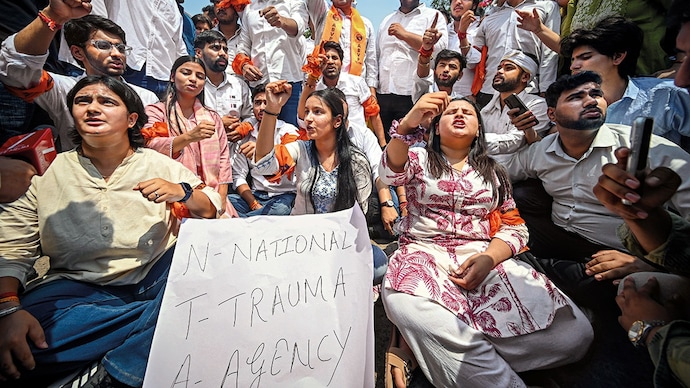
In Rajasthan’s Sikar town, 22-year-old Pradeep Meghwal had spent three years preparing for NEET-UG (National Eligibility cum Entrance Test-Undergraduate) for admissions to medical colleges. He was confident he would make it to a top institute this year. Instead, he died by suicide at his home on May 15, three days after the exam, conducted earlier on May 3, was cancelled following a paper leak. Twenty-one-year-old Ritik Mishra took the same route in Uttar Pradesh’s Lakhimpur Kheri, as the cancelled exam put an end to what was his third attempt too. Twenty-year-old Anshika Pandey, who had missed a seat by four marks last time, could not bear the collapse of her third attempt either and ended her life in Delhi’s Azadpur. In Goa, a 17-year-old boy could not handle the pressure of preparing for competitive exams while holding on to his love for hockey. He, too, chose death over uncertainty.
In Rajasthan’s Sikar town, 22-year-old Pradeep Meghwal had spent three years preparing for NEET-UG (National Eligibility cum Entrance Test-Undergraduate) for admissions to medical colleges. He was confident he would make it to a top institute this year. Instead, he died by suicide at his home on May 15, three days after the exam, conducted earlier on May 3, was cancelled following a paper leak. Twenty-one-year-old Ritik Mishra took the same route in Uttar Pradesh’s Lakhimpur Kheri, as the cancelled exam put an end to what was his third attempt too. Twenty-year-old Anshika Pandey, who had missed a seat by four marks last time, could not bear the collapse of her third attempt either and ended her life in Delhi’s Azadpur. In Goa, a 17-year-old boy could not handle the pressure of preparing for competitive exams while holding on to his love for hockey. He, too, chose death over uncertainty.
Four young lives, each representing the human cost of a broken examination system, conducted by the National Testing Agency (NTA), India’s premier testing body, which was twice told to mend its ways but did not. NEET-UG 2026 was a single-day, pen-and-paper examination for nearly 2.28 million aspirants across more than 5,400 centres in 565 cities. At stake were 129,805 MBBS seats in 824 medical colleges and 27,695 BDS seats in 330 dental colleges.
Within days of the test, a handwritten “guess paper” of about 410 questions started doing the rounds. It had been circulating on WhatsApp and Telegram before the exam. Some students reportedly received it 42 hours in advance, others nearly a month earlier. A whistleblower in Sikar compared it with the official booklet and found a near-perfect overlap, accounting for 600 of the total 720 marks.
The NTA’s own internal review found the leaked material to be identical in the case of the Chemistry paper and matching substantial portions of the Biology questionnaire too. Around 120 questions from the “guess paper” had appeared in the actual test. On May 12, the NTA cancelled the exam across the country, for the first time in its history. The re-examination will now be held on June 21.
The case, first investigated by the Rajasthan Special Operations Group (SOG), was later handed over to the Central Bureau of Investigation, which registered an FIR under the Public Examinations (Prevention of Unfair Means) Act, 2024, along with charges of cheating and corruption. The early findings make the current disruption seem graver than past breaches. This was not just an external criminal racket gaming the system. It bore the markings of an insider operation.
LEAK FROM THE TOP
Unlike in the past, the NEET paper this time did not get compromised at a printing press, courier van or exam-hall gate, but at the point where the questions were written and translated, before they ever entered the logistics chain. NEET-UG is set in 13 languages—English, plus 12 regional ones. Once the master paper is finalised in English, it is translated into each language, with a separate back-translation into English to verify accuracy, so that the questions pass through many hands before the paper is sealed. To limit exposure, the NTA sometimes uses the same expert to set the questions as well as translate them. In 2026, that shortcut concentrated access in a few hands.
Two of those experts were Chemistry lecturer P.V. Kulkarni and Biology expert Manisha Gurunath Mandhare. They were both from Pune and had known each other for years. And they had both served as paper-setters and Marathi translators. In the latter capacity, Kulkarni handled the 45 Chemistry questions and Mandhare the 90 Biology ones. Between them, they had access to all 135 Biology and Chemistry questions.
Late in April, the CBI alleges, Kulkarni put that access to use, running special coaching classes at his Pune home where he dictated the actual questions, their options and the correct answers. The handwritten notes from those sessions later tallied exactly with the May 3 paper. Mandhare and Kulkarni are suspected to have sold question papers to over 75 students for Rs 2.5-3 lakh each. From there, the material travelled first as handwritten notes, then as PDFs, later circulated on WhatsApp and Telegram and reaching coaching hubs in Rajasthan and Maharashtra. As the probe widened, subject by subject, another Pune-based NTA expert, Manisha Sanjay Havaldar, was identified as the source for the leaked Physics questions.
Below the experts ran a broker-beneficiary layer—middlemen who mobilised students, each paying Rs 10-15 lakh for the leaked question paper. More than 60 possible scammers, many tied to Sikar’s coaching ecosystem, are now under the scanner. By May 28, the CBI had arrested 13 people across Delhi, Jaipur, Gurugram, Nashik, Pune, Latur and Ahilyanagar. The NTA has roughly 24-27 setters and translators “on its radar”, has questioned its entire paper-setting committee, and begun replacing its pool of experts before the retest.
Dharmendra Pradhan, the Union minister of education, conceded “there was a breach somewhere in the chain of command”. NTA director-general Abhishek Singh, who took charge a month before the NEET-UG exam, attributes the failure to a trust that had turned into a blind spot. “Many of the translators had been there for six or seven years,” he says. “The organisation had developed trust in them. But, in such examinations, you must follow a zero-trust architecture.” Other NTA sources say the translation was done by hand, and the accused probably made multiple copies and smuggled out the papers, though the CBI has yet to establish exactly how.
As student groups, including Sangh affiliate Akhil Bharatiya Vidyarthi Parishad, erupted in protest, Opposition parties sharpened their attack on the government. Leader of Opposition in the Lok Sabha Rahul Gandhi called NEET an “auction”, alleging that questions were sold on WhatsApp, and said the Congress would not rest till Pradhan resigned and a foolproof system put in place.
LESSONS NOT LEARNT
Since the NTA took over NEET-UG in 2019, there have been several attempts to compromise the exam’s integrity. In 2021, the agency cancelled the results of 15 candidates for unfair practices. In 2022, the CBI busted an impersonation racket of “solvers” allegedly appearing for candidates. In 2025, it booked a person accused of impersonating a candidate in NEET-UG 2023. In 2024, a scandal erupted on three fronts. In Hazaribagh, the CBI found that one person had accessed the paper with the help of the principal and vice-principal of a school that was designated exam centre, and brokers later charged 144 aspirants Rs 30–50 lakh each. In Godhra, 27 candidates were allegedly asked to leave OMR (optical mark recognition) sheets blank so that insiders could fill them later. The price? Rs 10 lakh per candidate. The results triggered national outrage after 67 candidates, several from the same centre, scored a perfect 720, following the NTA’s award of “grace marks” to 1,563 students. The grace marks were later withdrawn, but a Supreme Court bench led by then Chief Justice D.Y. Chandrachud refused to cancel the exam, holding that the leak was localised and that there was no evidence of a “systemic” nationwide breach. A limited re-test was ordered instead, and a correction to a disputed Physics question brought the number of perfect scorers down from 67 to 17.
But the malaise persists. On May 25, hearing two petitions, the apex court said the NTA had failed to learn from the 2024 crisis. That breach had triggered two reform processes: the first a seven-member high-level committee of experts chaired by former ISRO chairman K. Radhakrishnan, set up by the education ministry in June 2024 to overhaul the end-to-end exam process and the NTA itself. The second was the Parliamentary Standing Committee on Education, chaired by Digvijaya Singh, whose Report 371, tabled in December 2025, said the NTA’s conduct of exams in 2024 “has not inspired much confidence”. Now, the Federation of All India Medical Association has sought the agency’s “replacement or fundamental restructuring”. Unlike the constitutional UPSC (Union Public Service Commission) or the statutory Staff Selection Commission, the NTA was founded under the Societies Registration Act, 1860. The United Doctors Front has asked that it be dissolved in its present form and rebuilt as a statutory body created by Parliament, answerable to it and subject to CAG (Comptroller and Auditor General) audits and committee scrutiny. These doctors describe the 2026 leak as part of a “recurring, systemic and catastrophic failure”, arguing that “cosmetic administrative tweaks” and committees such as the Radhakrishnan panel cannot fix it without a legislative overhaul. They have also sought digital locking of question papers and a complete shift to computer-based testing (CBT) to eliminate the risks of physical custody. Pradhan has already announced that NEET will move to CBT mode from next year.
The court issued a notice to the Union government, the education ministry, the NTA and the CBI, and gave the agency three days to file an affidavit detailing what it had actually done to implement those recommendations. Radhakrishnan himself was directed to file a separate affidavit on whether his panel’s recommendations had been followed.
THE UNTIDINESS OF NEET
NEET is not the only NTA exam to run into trouble. But it is the only one that has been discredited repeatedly. Other high-stakes tests—Joint Entrance Examination for IITs (IIT-JEE), Common University Entrance Test (CUET), the UPSC civil services—do not see this frequency of full-blown leaks. Of course, they also draw far fewer candidates: JEE Main recorded fewer than 1.5 million appearances, CUET about 1.07 million, and the UPSC prelims around 58,000. But scale alone cannot explain the breach. China’s national university entrance examination, Gaokao, had 13.3 million candidates in 2025, roughly six times NEET applicants, and is conducted under what is effectively military-grade security, with AI surveillance, signal jammers and swift, severe punishment for cheating.
The flaw in NEET is structural (see NEET Versus...). It is a one-shot test. A single exam, a single paper, decides everything. JEE, by contrast, has multiple layers—JEE Main, JEE Advanced and an eligibility filter of Class 12 marks. So, anyone trying to game it must breach the system at several points. It also runs as a computer-based test across multiple sessions with multiple sets of papers. The UPSC has its own filters of prelims, mains and an interview. Its scale then multiplies the danger for NEET. Because everyone sits the identical pen-and-paper test at the same hour, a breach in a single chain of custody taints the entire exam. Printing, storing and moving lakhs of sealed booklets to more than 5,400 centres—material that stays in motion for close to two weeks—creates handling point after handling point, each a fresh opportunity for leaks.
That is why most experts have pushed for shifting NEET to CBT. Former Union education secretary R. Subrahmanyam says he proposed the idea in 2018, “but the health ministry opposed it.” There is resistance from the National Medical Commission (NMC) too. A CBT, they argue, could disadvantage rural and poor students, though Radhakrishnan Committee member Pankaj Bansal, co-founder of HR technology firm PeopleStrong, finds that argument hollow. “Rural and poor students are giving IIT-JEE.” Most experts say the digital divide can be bridged through mock tests, sustained practice and the digital familiarity that near-ubiquitous smartphones have already brought to remote districts.
CBT also offers a layer of security that paper cannot. As Radhakrishnan explained in an interview on Doordarshan, since they do not have to be printed, questions can be selected just an hour or two before the test and transmitted through a secure network. The narrow window will leave little time for anyone to compromise the system, provided the centres are reliable and well-equipped. That is why the committee pushed for owned infrastructure. “In the 2025 and 2026 test cycles of NEET, most of the test centres were owned by the central or state governments. This is the process which will go on for the 2027 cycle, when we are going to move into CBT,” he said.
Professor Aditya Mittal of IIT Delhi, also a member of the Radhakrishnan Committee, says India should build this capacity in schools rather than rent it. “Every district has a Kendriya Vidyalaya, and every Kendriya Vidyalaya can have 100 computer terminals. These terminals can be used during major entrance examinations, and for teaching children for the rest of the year. This is akin to pre-computer-based examinations when schools partnered with the IIT system and served as centres for paper-based examinations.”
But CBT is not a magic shield. It did not prevent JEE Main 2021 from being hacked. It is also virtually impossible to have a single CBT session for 2-2.5 million candidates. “We do not have the capacity for 20 lakh candidates,” says Subrahmanyam. Multiple sittings mean different candidates answer different question sets of varying difficulty. To ensure fairness, scores must then be normalised, a statistical adjustment the NMC distrusts, though JEE Main already uses it.
THE PERCENTILE PREDICAMENT
Critics also question NEET’s admissions logic. It has no fixed pass mark. A candidate qualifies not by scoring a percentage but by clearing a percentile, a measure of how many candidates you beat, not of marks. “And therein lies the heart of the distortion,” says Vineet Joshi, Secretary, Higher Education, who ran the NTA between 2018 and 2023. “Assume that the qualifying score is 50 per cent,” he says. “If the exam is of 720 marks, 50 per cent means 360 marks. To get 360, one has to work hard. But when it becomes 50 percentile, half the students will always be eligible, irrespective of their marks. If 24 lakh students sit, 50 percentile means 12 lakh students.” That, he adds, “creates a bigger pool, and then one can play with that pool, especially in private institutions” that simply need enough eligible candidates to fill their seats.
Then, there are the monetary stakes. Medicine remains one of India’s most lucrative and socially respected professions. For many families, a medical seat is not just an educational opportunity, but a promise of financial security, social status and upward mobility. That makes the incentive to game the system dangerously high. If the expected returns on becoming a doctor runs into crores over a career, spending a few lakhs to buy your way in through a rigged exam is no big deal.
The structure of admissions has now sharpened that incentive. Under the percentile system, a candidate needs only around 140-150 marks to become eligible for a private medical seat by paying the fees. The gap between a government college and a private one can run close to Rs 1 crore. For a family spending Rs 25-30 lakh to manipulate the result and still save far more is a cold, rational calculation.
The desperation shows up in the numbers themselves. “In any exam, you would find attendance at 75-80 per cent. In NEET, it is 99 per cent,” says NTA director-general Singh. That intensity, he argues, long made cancellation feel impossible, which only emboldened the racketeers. “Scamsters believed that because of the logistics involved, the government and the NTA would refrain from cancelling such a big exam.” The first-ever cancellation is meant to flip that calculation.
IGNORING THE DOCTOR’S ORDERS
The cancellation has also revived questions of how far the NTA heeded the Radhakrishnan Committee’s 101 recommendations. Of its top recommendations, the NTA and the government acted briskly on the visible, logistical ones—district-level control, Aadhaar biometrics, government-owned centres, AI-enabled CCTV—but ducked the two that mattered the most: spreading the exam across multiple sessions and shifting it to a computer-assisted format.
Radhakrishnan, who also heads the implementation-monitoring committee, clarifies that the first 60 or so recommendations were meant for the 2025 and 2026 cycles and 80 per cent have been carried out. “In 2025, things went very smoothly; there was complete coordination and everything was in place,” says Bansal. But even as the 2025 reforms strengthened the logistics chain—centres, transport and exam-day control—it left the upstream paper-setting process largely untouched. Which is where the 2026 leak originated. Now, the arrests have cast a shadow on the previous year. Since some of those now held were allegedly also active in 2025, a reform committee member wonders whether the previous examination was entirely above board. The Biwal family of Jamwa Ramgarh in Rajasthan, whose four children cleared NEET 2025 and were celebrated as a small-town success story, is now under CBI scrutiny. Investigators suspect Vikas Biwal bought the 2025 paper from the same network. He has since been arrested.
Radhakrishnan says the panel had already laid down guidelines for ensuring “the integrity and quality of the people and the process” involved in confidential operations—drawing questions from experts, assembling papers, selecting the final questions and verifying answers. NTA director-general Singh believes prevention—and the cure—lies in breaking the link between an expert and a specific examination. “The long-term solution is that you do not make papers for an exam on the eve of the exam,” he says. “In fact, the experts who set the papers should not even know what exam they are making a paper for. It should be exam-agnostic.” The way forward, he argues, is to build large question banks aligned with Class 12 proficiency and allow a randomised, AI-driven system to assemble papers. That would sharply reduce “the probability of an expert knowing that his question will figure in the paper”.
Despite its reformist ambition, the NTA still has no implementation timeline for the 33 recommendations the Radhakrishnan Committee listed under Phase 2: Long-term Perspectives. A committee member argues these should not take more than a year to roll out, especially since the government has already cleared the biggest of those shifts: moving NEET to CBT mode next year.
FIXING THE EXAMINER
The deepest problem is the NTA itself and its organisational structure. “In the cabinet approval, NTA was envisaged as a premium testing agency which would use advanced technologies and conduct online tests,” says Subrahmanyam. “It was supposed to be a very lean organisation, comprising highly accomplished persons. But a pen-and-paper exam of this sort needs some 10,000 people to run. Since the NTA does not have that, it depends on someone else, and that someone else cannot certify the integrity of the process.”
Joshi, who headed the NTA between 2018 and 2023, says what is missing is plain expertise. “Conducting an exam is a technical job learnt through experience,” he says. Someone who has actually run exams will implement an SOP differently from someone who has not. Cheating methods evolve every year, and “those trying to rig the system are experienced too”. The fix, he says, is to put real examination experts in charge, and to stop expecting a young body to behave like an old one. “We should never compare NTA with CBSE and UPSC. NTA is eight years old, CBSE is from 1929, UPSC from 1926. Every agency takes time to learn.”
That expertise has to be bought and respected. “If you want serious people to do the serious job of setting papers and handling confidential operations, compensate them well,” says an expert committee member. Bansal points to the US Educational Testing Service, which runs the GRE and TOEFL and employs some 600 researchers. “NTA does not have too many psychometric or deep experts to set papers,” he says. “These things have to be built, and that cannot be done in one year.”
Some institutional scaffolding is beginning to appear, though. Acting on the Radhakrishnan Committee’s recommendations, the government told Parliament that 16 new posts had been created in the NTA. So far, only seven have been filled, including four last month, after NEET had already been cancelled, taking the number of employees on deputation to 29. Last March, the government had told the Rajya Sabha that another 43 personnel were working at the NTA on contract.
Everything now rides on June 21, for the 2.28 million students taking the re-test and for the NTA. It will decide whether tighter protocols will salvage NEET or deepen the collapse of trust. Four families lost their children last month not just to a leaked paper, but to a system that was warned twice and did not take heed even once.

