Ayodhya | Grand temple theft
How donations at the Ram mandir were allegedly embezzled and what temple administrations can do to safeguard their wealth
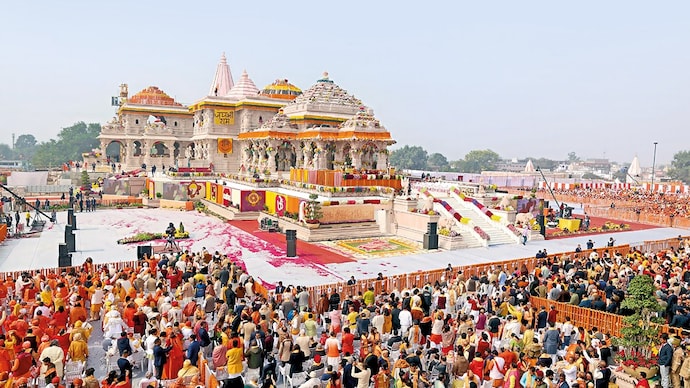


Only dharma survives, everything else is perishable—the Prince of Ayodhya had said, turning away from his royal realm and its riches, going on to live in the forest like a hermit. More than any other deity in the pantheon, Ram, the god incarnate worshipped by millions of Hindus, inscribed duty and detachment as the code of life. Mortals were bound to come up short against that archetype. A century-long political agitation that changed the course of modern Indian history bore his name; it sought ownership. Its fruit was a mammoth temple of gilded splendour that came up in Ayodhya in January 2024 and cost about Rs 2,000 crore.
Only dharma survives, everything else is perishable—the Prince of Ayodhya had said, turning away from his royal realm and its riches, going on to live in the forest like a hermit. More than any other deity in the pantheon, Ram, the god incarnate worshipped by millions of Hindus, inscribed duty and detachment as the code of life. Mortals were bound to come up short against that archetype. A century-long political agitation that changed the course of modern Indian history bore his name; it sought ownership. Its fruit was a mammoth temple of gilded splendour that came up in Ayodhya in January 2024 and cost about Rs 2,000 crore.
Ironically, the idea that Rama’s vairagya, or renunciation, could be converted into material opulence did not have to wait long to find a rather more ignoble expression. In the last week of June 2026, two months after the final bit of work was wrapped up around the 70-acre Ram Janmabhoomi temple complex, Ayodhya is awash not with divine grace, but its opposite. A pall of infamy hovers over town as a police investigation grinds forward. What they’re chasing is a spreading stain of greed: allegations that crores of rupees donated by devotees have been siphoned off by its custodians.
With state opposition leaders, led by Samajwadi Party (SP) president Akhilesh Yadav, levelling serious charges on the issue, Uttar Pradesh chief minister Yogi Adityanath announced a three-member Special Investigation Team (SIT) on June 13 to investigate not just the specific acts of corruption but also to examine the entire chain through which donations were received, counted, stored and deposited. Over the following days, operating in a surcharged political atmosphere, investigators scrutinised nearly a year of financial records, extracted hidden and tampered CCTV data, analysed bank transactions and questioned officials of the Shri Ram Janmabhoomi Teerth Kshetra Trust (SRJTKT), bank employees and those who counted the cash. On June 23, the SIT submitted its preliminary report, detailing as many as 70 instances of theft, totalling Rs 7.9 crore. Two days later, the Ayodhya police registered an FIR, naming eight accused involved in counting and depositing donations, and arresting them. But with the scandal taking on wider dimensions, two key custodians of the SRJTKT—Champat Rai, general secretary, and Anil Mishra, trustee—submitted their resignations.
‘CHANDA CHORI’
The Opposition was quick to put both the central and state government on the mat. Terming it “chanda chori” (donation theft), Akhilesh Yadav, leader of the Opposition in the UP assembly, launched a fusillade of questions: why had key CCTV footage of the donation cash counting gone missing? Had cash been diverted to political coffers? How could a government investigate itself? As events unwound, the questions seemed to multiply. Aam Aadmi Party leader Sanjay Singh raked up an older probe that had quietly buried allegations of big-ticket land deals in Ayodhya by the SRJTKT. Congress president Mallikarjun Kharge called it a “Rs 5,000 crore scam”, questioning the opacity over the vast sums collected for the temple since the 1990s. With the UP assembly polls a mere seven months away, managing the fallout has become a high-stakes game for the BJP. For it to pass muster before a sceptical public, the culprits had to be brought to justice. Equally crucially, as a BJP insider put it, “there had to be a thorough cleansing of the way the temple was being administered.”
Among the first to condemn the theft was Nripendra Misra, chairperson of the SRJTKT’s temple construction committee that had overseen the building of the Ram Mandir. Talking to India Today TV, Misra, a former principal secretary to Prime Minister Narendra Modi, termed the alleged loot of donations made in the name of Lord Ram “very, very sad indeed”. “It has eroded the faith of the devotees,” he said. Calling for a revamp of the temple management, he added, “There are two aspects to the investigation—‘criminal’ and ‘future improvement’. Only when both these aspects are addressed will we be able to regain the trust of the devotees.”
The Vishva Hindu Parishad (VHP), which for decades had spearheaded the Ram Janmabhoomi movement, was quick to not only condemn the theft but also distance itself from the incident. Though Rai continues to be its international vice president, VHP president Alok Kumar made it clear that “it is not the job of the VHP in any part of the country to construct temples or to run them. The Trust would run them and what happens in the Trust would be the responsibility of the Trust. What has happened in Ayodhya is very disgraceful and shameful. All of us, all the Hindus in the world, particularly those who donated funds, and the kar sevaks and their families, are deeply hurt. Whosoever is guilty should be tried and punished.”
CASH COURSE
How did the embezzlement happen? People familiar with the counting process corroborate the SIT’s reconstruction: it was not a single heist, but a whole system of loosely enacted protocol meant to leak systematically. Besides 10 donation counters that hand out computerised receipts, the temple complex has a total of 35-40 hundis (donation boxes), six near the sanctum sanctorum and others strewn around sub-temples and public collection points. Average daily collections can go up to Rs 13 lakh, peaking to Rs 50 lakh on weekends and big days on the religious calendar. In FY25, the Trust declared Rs 153 crore as direct contribution from devotees out of the total annual income of Rs 327 crore.
In theory, a strict SOP is meant to fully sanitise the journey of each hundi. They are required to be opened in the presence of at least four authorised individuals, with proper records of each instance. What the SIT describes is closer to laissez faire, a process not much encumbered by oversight—beginning from unauthorised custodians handling the keys, bypassing the mandatory double-lock system. The counting room in the basement of the pilgrim centre was the chief arena for this dark drama. With investigators uncovering blind spots in its camera coverage, it was pretty much an opaque proscenium with no fourth wall. Within its confines, the hundis were opened, the cash manually sorted, stacked into bundles, then counted by machines. Investigators speak of various sleights of hand: like extra notes being stealthily inserted in bundles, to be purloined later. For a while, a temporary police outpost in the complex, too, doubled up as a counting room, but security, by all accounts, was relaxed. No frisking at the exit, no pocketless clothing, no independent witnesses, no fly on the wall. The sentinel could freely turn predatory.
Speaking to India Today, a senior police official confirmed weaknesses in surveillance. Nearly 800 CCTV cameras covered the premises, he said, with live feeds from almost all cameras available at the central control room. However, feeds from four or five cameras covering the counting area remained password-protected and accessible only to a handful of individuals. “The day the issue surfaced, we went to examine those feeds and asked for access. Only then were the passwords removed,” the officer said. The lacunae are surprising, given that these formed a key part of the warnings issued by an audit and risk management review six years ago. Unheeded Warnings
In November 2020, nine months after the Trust was constituted, a private audit firm was engaged to review its working. After studying day-to-day administration, it had concluded that the Trust lacked a comprehensive protocol clearly defining responsibilities and establishing effective monitoring mechanisms. Without such a formal SOP, it warned, the system would remain fallible. Specifically, it flagged the poor recording of donations, lax monitoring of financial transactions and data, and went on to recommend separate registers for cash and jewellery donations, besides regular bank reconciliations overseen by qualified accounting professionals. Also, despite employing nearly 1,500 personnel, the Trust stuck to a personalised form of human resource management rather than professional screening.
Six years later, those words sting. Chief among the alleged culprits is Ram Shankar Yadav, alias Tinnu, a former driver of Champat Rai who is said to have acquired considerable clout owing to this proximity and apparently held the keys to the donation boxes and controlled the key counting operation personnel. The others arrested stand at lesser degrees on that patronage cline. Police raids on some of their residences as well as within temple precincts soon recovered stashes of cash totalling Rs 79.85 lakh—some of it even hidden inside temple bathrooms. Also seized were property documents reportedly adding up to a combined worth of about Rs 2 crore.
This picture broadly mirrors the account a former member of the counting team gave India Today on the condition of anonymity. He had joined the process in March 2025 after approaching Rai, who referred him to Anil Mishra. A retired homeopath with roots in the Rashtriya Swayamsevak Sangh (RSS), Mishra and his wife had played pradhan yajman at the 2024 pran pratishtha, a ritual role that required a married couple. Last March, after a brief interview, Mishra had hired him and several others on Rs 15,000 a month, which later went up to Rs 18,000. “Our job was simple. We carried two or three donation boxes at a time to the counting room, emptied them, sorted the notes, tied them into bundles with rubber bands, and put them back in the boxes for machine counting,” he said. One Trust representative, and another from SBI, were at hand.
The script, he alleges, strayed just weeks after they joined. “People wore kurtas, cargo pants, clothes with large pockets to the counting room. There were no rules. They could even bring others to assist with counting. Sometimes, forty to fifty people were involved,” he claims. “We started noticing that many of the key employees, including those who are now arrested, were removing bundles, four or five of them, mostly of Rs 500 notes. Some of us confronted them, but they denied everything.” He and several others eventually left. Meanwhile, allegations raised by Santosh Dubey, an original kar sevak named in the Babri demolition case and now Dharam Sena chief, hint at a long history of foul play. Dubey claims that around 1,250 gold, silver, diamond-studded and ashtadhatu (a traditional alloy of eight metals, including gold and silver) bricks donated during the temple movement are unaccounted for.
The extension of the SIT’s probe to July 15 and its decision to re-audit five years of accounts in their entirety, scrutinise every financial transaction, examine construction contracts and alleged commission payments, besides probing unaudited jewellery donations, indicates that investigators are looking for evidence of possible systemic financial irregularities rather than just individual wrongdoing. These development significantly raise the stakes for the investigation and suggest that the alleged theft may not have been an isolated act of embezzlement.
REBUILDING THE TRUST
What the controversy has done is put the focus on the original flaw in the Trust’s structure: the concentration of authority in individuals. On paper, it appeared well-rounded—an assemblage of Hindu seers, a VHP-RSS core, four ex-officio government members. In practice, Rai, now 80, was a singular potentate for years. Anil Mishra also gained clout, strengthening the system of crony patronage. Speaking to India Today, Mahant Dinendra Das, a trustee, called it “ekchhatra raj” (autocracy). He claimed he had been sidelined despite representing the Nirmohi Akhada, one of the original litigants in the Ayodhya case. “Ramji has saved my name from being tarnished,” he added.
The alleged theft of donations at the Ram temple in Ayodhya begs a larger question: how should India’s richest and most-visited temples protect the wealth that flows in through faith? Answering it is important because there has been malfeasance in other big temples too. And, most often, these crimes are inside jobs, as in the alleged loot of gold at the Sabarimala temple in Kerala, where records were falsified and gold-plated artefacts were moved without proper authorisation.
India has no official count of Hindu temples, but estimates put the number at around 1 million, most of them small shrines maintained by local communities, hereditary priests or families. The challenge lies in the larger temples that own substantial land, jewellery and other assets, and receive heavy donations in cash, gold, silver and precious stones. Their management varies widely: some are family-run, some controlled by mahants or akharas, others by trusts, statutory boards or government-supervised bodies.
The Constitution permits state intervention in the secular aspects of religious institutions. Article 25 protects religious freedom, but Article 25(2) allows the state to regulate “economic, financial, political or other secular activity” linked to religious practice. This has enabled states to pass temple administration laws, from Tamil Nadu’s Hindu Religious and Charitable Endowments regime to Kerala’s Devaswom Boards, Andhra Pradesh’s 1987 law covering Tirumala Tirupati Devasthanams and Uttar Pradesh’s statutory board for Kashi Vishwanath after a major theft in 1983. But the line between regulation and control remains contentious. Uttarakhand’s attempt five years ago to bring the Char Dham shrines under a state-supervised board triggered strong resistance from priests and stakeholders; the law was eventually withdrawn.
Ayodhya, meanwhile, can take a cue from the best-run temples (see How Big Temples Guard Their Donations). Tirupati sets the benchmark: sealed hundis, secure transfer to a dedicated Parakamani centre where daily offerings are counted and segregated, CCTV-monitored opening and counting, senior officials and vigilance staff present, machine counting, appraisers for precious metals, and alternating bank deposits with SBI and Union Bank. It also demonstrates the value of digitisation: almost every non-hundi donation, from sevas to trust contributions, is online, reducing the scope for pilferage. Its recent controversy arose from an entirely different issue: the alleged adulteration of its famed laddoos, with cheaper vegetable oil reportedly used in place of ghee.
A CLEAR WAY FORWARD
Shirdi and Siddhivinayak exemplify a similar ethos of operational discipline. Shirdi counts cash twice a week under CCTV in the presence of bank and trust representatives and a charity commissioner; counting staff are frisked and made to wear pocketless uniforms. Siddhivinayak follows weekly CCTV-monitored counting in the presence of trustees, officials and bank representatives; gold and silver offerings are periodically auctioned, accounts audited by a government-empanelled firm and annual reports placed before the legislature. Puri’s Jagannath temple swears by asset transparency. Donations are split into operational, foundation and corpus funds, with large sums placed in long-term deposits and surplus precious metals stored in SBI lockers. The Ratna Bhandar inventory, conducted under CCTV surveillance, undertakes periodic inventories of jewellery and valuables. At Somnath, there is daily reporting to trustees, next-morning bank deposits and a written SOP on when the cash box must be opened, who must be present and how cash moves within the premises.
For Ayodhya, the road ahead is clear: sealed and numbered hundis, CCTV-monitored transfer and counting, mandatory presence of Trust, bank, audit and security officials, frisking and pocketless uniforms for counting staff, same- or next-day bank deposits, digital inventories of gold and silver, independent valuation, online-first donations, periodic third-party audits and annual public reports. As Nripendra Misra says, “To ensure proper management of the temple, we need a total revamp. This includes a full-time CEO to handle daily operations, enforce compliance and bring administrative accountability.”
Outside, on the streets of Ayodhya, the mood remains sombre. From the tea stalls and paan kiosks to the floating, transient communities on e-rickshaws, the theft is the topic of conversation. Whether they support the BJP or the SP, whether lifelong residents or first-time visitors, everyone voices the same dismay. “I hear these things in the news, and it breaks my heart,” says Ravi Kumar, a commerce postgraduate from Karnataka who copes with the loss of his family during Covid by working at a convenience store near the temple. “I do not know what to trust anymore. I came here looking for peace. Where do I find it now?” he asks in English, handing a bottle of water to a customer. A few metres away, Adarsh, a first-time pilgrim from Mysuru, holds an umbrella to shield his family from the blazing June sun. “When these things happen, it hurts our faith,” he says. Faith may continue to bring the money in; but only the establishment of foolproof systems can keep it safe and permanently wipe the stain from India’s most revered temple.
—with inputs from state bureaus

