Angry youth | The rage of Gen Z
How a protest against an exam paper leak has become a youth movement holding the Modi government to account
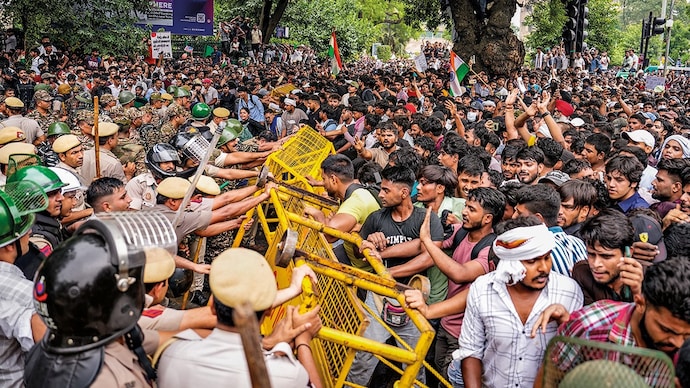


For three weeks, the protesters at Jantar Mantar in Delhi could be ignored, mocked or dismissed as another social media spectacle. That ended on July 20, when tens of thousands answered the Cockroach Janta Party’s (CJP) call to march on Parliament on the opening day of the monsoon session. Barricades fell, tear gas spread through central Delhi, and a movement with an improbable name forced itself into the centre of national politics. The immediate trigger was the leak of the National Eligibility cum Entrance Test for Undergraduate, or NEET-UG 2026, question paper. The protesters demanded accountability for the lapse, the resignation of Union education minister Dharmendra Pradhan and justice for students betrayed by the system meant to serve them. But soon NEET became only the most visible sign of a deeper breakdown: leaked examinations, cancelled recruitment tests, unfilled vacancies and years of preparation wiped out by fraud, delay or administrative failure.
For three weeks, the protesters at Jantar Mantar in Delhi could be ignored, mocked or dismissed as another social media spectacle. That ended on July 20, when tens of thousands answered the Cockroach Janta Party’s (CJP) call to march on Parliament on the opening day of the monsoon session. Barricades fell, tear gas spread through central Delhi, and a movement with an improbable name forced itself into the centre of national politics. The immediate trigger was the leak of the National Eligibility cum Entrance Test for Undergraduate, or NEET-UG 2026, question paper. The protesters demanded accountability for the lapse, the resignation of Union education minister Dharmendra Pradhan and justice for students betrayed by the system meant to serve them. But soon NEET became only the most visible sign of a deeper breakdown: leaked examinations, cancelled recruitment tests, unfilled vacancies and years of preparation wiped out by fraud, delay or administrative failure.
For three weeks, the protesters at Jantar Mantar in Delhi could be ignored, mocked or dismissed as another social media spectacle. That ended on July 20, when tens of thousands answered the Cockroach Janta Party’s (CJP) call to march on Parliament on the opening day of the monsoon session. Barricades fell, tear gas spread through central Delhi, and a movement with an improbable name forced itself into the centre of national politics. The immediate trigger was the leak of the National Eligibility cum Entrance Test for Undergraduate, or NEET-UG 2026, question paper. The protesters demanded accountability for the lapse, the resignation of Union education minister Dharmendra Pradhan and justice for students betrayed by the system meant to serve them. But soon NEET became only the most visible sign of a deeper breakdown: leaked examinations, cancelled recruitment tests, unfilled vacancies and years of preparation wiped out by fraud, delay or administrative failure.
The protesters were overwhelmingly Gen Z, or those born between 1997 and 2012, and largely peaceful. Their weapons were placards, memes and slogans. Asked why they had come, only a few said it was because of the NEET paper leak. “Nothing works,” said Samreen, 26. “The air you breathe is poison. Exams don’t happen. When they do, results take years. There are no jobs. No one listens. And when you speak, they unleash the police. Are we criminals?” Stay longer, and the anger began revealing multiple strands of grievances: that there are no fair chances, that a degree no longer guarantees a job, that institutions are slow to explain, slower to correct mistakes and slowest to punish those responsible.
WHY THE RAGE
The anger at Jantar Mantar was sparked by an examination system that tests the patience of millions. NEET-UG is the sole gateway to undergraduate medical education in India. On May 3, over 2.21 million candidates sat the exam for roughly 137,000 MBBS seats. A “guess paper” had already circulated on Telegram and WhatsApp in coaching hubs, including Sikar in Rajasthan and Latur in Maharashtra. Some 120 questions reportedly matched those in the actual exam. The National Testing Agency (NTA), the body responsible for conducting NEET, cancelled it on May 12—the first full cancellation of the exam in its history—and held a retest on June 21. Independent tallies place the number of aspirants who ended their lives in the 46 days between the cancellation and the retest from 11 to 13. Protesters claim the figure exceeded 21. There is no official count, or any compensation so far.
NEET is no outlier. One decade-long database counts 89 suspected leaks and 48 retests affecting at least 65 million candidates. Another documents 41 leaks across 15 states in five years. Congress leader Rahul Gandhi cites 152 leaks over a decade, disrupting the lives of 75 million students. Accountability has been rarer than wrongdoing: of 45 major leak cases over two decades, each involving at least 100,000 candidates, only two resulted in convictions.
The government maintains it has not ignored the crisis. The Public Examinations (Prevention of Unfair Means) Act, 2024, is the first central law aimed at organised cheating. It covers examinations conducted by the UPSC (Union Public Service Commission), State Service Commission, NTA, Railway Recruitment Boards and banking recruitment bodies, and makes all offences cognisable and non-bailable. Individuals face imprisonment of 3-5 years and fines up to Rs 10 lakh. As for the NEET lapse, the government says it swiftly arrested those involved, handed the investigation to the Central Bureau of Investigation, conducted the retest and published the results, without allowing the admission calendar to collapse.
The failure, however, is institutional as much as legal. The NTA, created in 2017 to standardise entrance exams, is not a statutory body like the UPSC. It is a society registered under an 1860 Act—a legally lightweight institution without a permanent cadre. It depends on deputed officials, and outsources printing, warehousing and transportation to private vendors. Its pen-and-paper model multiplies those risks. The K. Radhakrishnan committee’s 101 recommendations, submitted in October 2024, proposed encrypted question papers printed at secure centres, psychometric normalisation and at least 1,000 permanent testing centres. Digital gaps and bureaucratic inertia delayed their adoption. Only after this year’s fiasco did the NTA decide to shift NEET to computer-based testing (CBT) from 2027.
But computerisation alone cannot address the deeper failures afflicting the education system. Enrolment in higher education institutions is now about 45 million, 31.5 per cent higher than in 2014-15. Gross enrolment ratio has risen from 23.7 to 30. Female gross enrolment has overtaken male gross enrolment, PhD enrolment has nearly tripled, and the number of colleges has grown from 38,498 to 46,624. But much of the growth has been driven by private providers, faculty recruitment has lagged. Against an AICTE (All India Council for Technical Education) norm of 15-20 students per teacher, private colleges average 28 and public colleges 47. For every 100 additional students, fewer than one teacher is added. Less than 39 per cent of universities have National Assessment and Accreditation Council (NAAC) accreditation.
The result is a small, globally competitive tier at the top, uneven public universities in the middle, and thousands of under-resourced institutions at the bottom, issuing degrees whose value in the labour market is increasingly uncertain. According to the Graduate Skill Index 2025, only 42.6 per cent of graduates are considered employable; just about 45 per cent of engineering graduates are fit for jobs in their core field. Formal vocational training reaches only 3-8 per cent of India’s workforce; it is 75 per cent in Germany and 96 per cent in South Korea.
India has 371 million people in the 15-29 age group, more than the entire population of the United States. They are the most educated generation in the country’s history, yet many increasingly doubt whether education can still help them move up in life. Among young men, the share enrolled in education fell from 38 per cent in 2017 to 34 per cent by late 2024. Among dropouts, the proportion citing the need to support household incomes rose sharply, from 58 per cent to 72 per cent.
“Jobs are the lens through which young people see the world because it’s about their future,” says Sabina Dewan, founder of research firm JustJobs Network. “In that sense, this entire protest is really about jobs and livelihoods, and the deep insecurity the young have.” Labour force participation is a serious problem as only 46 per cent of 15- to 29-year-olds are either working or looking for work. The Periodic Labour Force Survey 2025 puts unemployment among youth at 9.9 per cent, three times the overall unemployment rate of 3.1 per cent. Nearly one in four young Indians is not in education, employment or training. The government, on its part, cites additions in EPFO (Employees’ Provident Fund Organisation) and NPS (National Pension System) payrolls, Mudra loans, PLI (production-linked incentive) schemes generated 1.45 million jobs and over 300 million e-Shram registrations and disputes the methodologies used by the CMIE (Centre for Monitoring Indian Economy) and ILO (International Labour Organization).
THE JOBS CRISIS
But the fact remains that unemployment is nearly 40 per cent among graduates aged 15-25, the highest for any educational category. Between 2004 and 2023, the number of graduates increased by nearly five million a year on average, but graduate employment rose by only 2.8 million a year and salaried graduate employment by 1.7 million, according to the ‘State of Working India 2026’ report by Azim Premji University. Close to 90 per cent of workers remain in informal employment. “More Indians are educated than ever before and yet they can’t find jobs, while employers say they can’t find skilled employees,” says Amit Basole of Azim Premji University, co-author of the report. For educated young people in smaller cities, the scarcity of stable salaried work makes government jobs disproportionately attractive, intensifying competition and feeding the coaching economy. When an examination collapses, the state blocks not just access to a job, but what for many is the only credible path to upward mobility.
The government cannot be accused of lacking proposals. The National Education Policy (NEP) 2020 promised multidisciplinary universities, four-year undergraduate degrees with multiple entry and exit options, credit portability, a single regulator through the Higher Education Commission of India (HECI), the Anusandhan National Research Foundation, foreign university campuses, digital universities and education expenditure equivalent to six per cent of GDP. On paper, it is the most extensive restructuring of education in decades. In practice, it is marred by the familiar blight of uneven implementation. Roughly 56 per cent of universities had introduced the four-year programme, 49 per cent multiple entry and exit, 41 per cent internship cells and only seven per cent apprenticeship cells. HECI was proposed but never legislated. Research funding remains thin.
The clearest measure of a government’s priorities is how it spends its money. In nominal terms, the Union education ministry’s allocation has risen from Rs 85,010 crore in 2018-19 to Rs 1.22 lakh crore in the 2025-26 Revised Estimate and Rs 1.39 lakh crore in the 2026-27 Budget Estimate. As a share of the Union budget, however, it has fallen from 4.6 per cent in 2013-14 to about 2.5 per cent. Combined Centre-state spending on education is estimated at 4.1 per cent of GDP, below the NEP target of six per cent. The shift in priorities is equally striking. In 2013-14, education and health together received 6.5 per cent of the Union budget, against 1.8 per cent for roads and highways. Twelve years later, education and health account for 4.5 per cent, while roads and highways receive a healthy 5.8 per cent.
RISE OF THE COCKROACH PARTY
This accumulation of failures provided the fuel for the anger. The CJP gave it a name, an identity and an outlet. Ironically, the party was born not in direct opposition to the Modi government, but in response to a remark attributed to the Chief Justice of India. On May 15, while hearing a contempt plea concerning fake law degrees, CJI Surya Kant called such people “parasites of society” and likened unemployed youngsters drifting into journalism, social media and RTI activism to cockroaches who “start attacking everyone”. Taking to social media platform X, Abhijeet Dipke, a 30-year-old political communications strategist, asked: what if all the cockroaches came together? The following day, he launched the CJP. On May 16, the CJI clarified that he had been misquoted.
It made little difference. Within 78 hours, the CJP’s Instagram account had crossed three million followers. Within five days, it reached 10 million, overtaking the BJP’s official handle and, by May 22, it had touched 20 million. #MainBhiCockroach trended nationally. The CJP held its first Delhi protest at Jantar Mantar on June 6, after Dipke returned from the United States. The movement soon spread to Maharashtra, West Bengal, Bihar, Madhya Pradesh, Uttar Pradesh, Jammu and Kashmir, Himachal Pradesh, Kerala, Karnataka and Goa.
The arrival of Sonam Wangchuk at the protest site became the turning point. The Ladakhi engineer, climate activist and education reformer began an indefinite hunger strike at Jantar Mantar on June 28, demanding Pradhan’s resignation and an overhaul of the examination system. His fast gave fresh emotional momentum to what had begun as a protest against examination leaks. In a pre-dawn operation on July 18, citing medical advice and high court directions, the police took Wangchuk to Safdarjung Hospital in what his wife, Gitanjali J. Angmo, called illegal detention. He was later transferred to Medanta in Gurugram after the court responded to a petition by Angmo.
The police invoked Section 163 of the BNSS (Bharatiya Nagrik Suraksha Sanhita) and refused permission for the march to Parliament. Despite rain, multi-layered barricades, 3,000 police personnel and localised internet shutdowns, tens of thousands converged, coordinating through Bluetooth mesh-messaging applications that operate without cellular networks. The CJP claimed that more than 150 protesters had been injured in police lathi-charge. Pellet guns, too, were allegedly used against the protesters. The police said 118 personnel—most of them injured in stone-pelting—and around 60 protesters were hurt. Six FIRs were registered, more than 70 people detained, and between 15 and 20 government vehicles were vandalised.
The unrest spread beyond Delhi. Mumbai Police fortified South Mumbai and registered seven FIRs against 900 people who protested at Shivaji Park. Hundreds attended vigils in Bengaluru, Goa and elsewhere. The CJP insists that their demand is about institutional accountability rather than merely the removal of one minister. “Pradhan’s resignation will be the first step towards accountability,” says Saurav Das, the CJP’s chief spokesperson (see interview, ‘We want this to remain a leaderless movement’). “Along with that, we will place our other demands before the government. We have a detailed five-point charter for education reform. It spells out our demands for transparency, accountability and other changes.”
Union health minister J.P. Nadda was tasked with opening a political channel with the protesters. On the evening of July 20, Nadda held a two-hour meeting with Das and Ashutosh Ranka. They submitted a memorandum demanding Pradhan’s resignation, an end to what the CJP described as Wangchuk’s hospital confinement, and compensation of Rs 1 crore each for the families of students who had died by suicide after the NEET leak. Nadda said the demands would be considered at the appropriate level and urged the protesters to end their sit-in. He later visited RML Hospital to meet injured protesters and police personnel.
On the night of July 21, Nadda and Union minister Jitendra Singh met Wangchuk in hospital and appealed to him to end his fast. According to Wangchuk, they assured him that the government would positively consider adequate compensation for the bereaved families and allow a meaningful discussion in Parliament on accountability, including the demand for the education minister’s resignation. Wangchuk responded the following day in an open letter to both ministers. In it, he set one clear condition for ending his fast: an unequivocal assurance that no protester would face punitive or retaliatory legal action for participating in the agitation. The government had offered a process—discussion, consideration and assurances that the demands would be examined. The letter changed the terms of the standoff, but the streets were less relenting. Then, on July 24, Wangchuk ended his 26-day hunger strike after the Centre gave him written assurances that it would discuss the NEET-UG paper leak, examination accountability and wider reforms in Parliament.
THE POLITICAL FALLOUT
This is the first major mass agitation to test Modi’s third-term government. What began as an online campaign became, in the space of two months, a contest over the government’s ability to retain the confidence of India’s young voters. It is still too early to conclude whether the CJP will damage the BJP the way the government’s more enthusiastic supporters hope or its critics fear. Street numbers do not automatically translate into votes, and the party retains an unmatched organisational machine and Modi’s personal appeal in his constituency. In its previous term, the Modi dispensation had faced the anti-CAA (Citizenship Amendment Act) and farmers’ movements—but those could be painted as having a narrower, segmental base.
The CJP may represent a more difficult kind of challenge precisely because it cannot be filed away as neatly. For all their scale, past agitations could still be associated with identifiable constituencies—Sikh and Jat farmers in one case, Muslim protesters and their allies in the other, communities a government could court, isolate or wait out. The CJP crowd resists that kind of easy classification. It includes students from elite universities and provincial colleges, English-speaking professionals and lower-middle-class aspirants, young women, parents and first-time protesters drawn from Uttar Pradesh, Bihar, Madhya Pradesh, Punjab, Uttarakhand and beyond. There is no caste, region or religion here for the government to set against one another; there is only its own most reliable constituency, asking to be heard.
The scale and shape of the anger invite comparison with youth-led uprisings elsewhere in South Asia—Sri Lanka in 2022, Bangladesh in 2024 and Nepal last year. The parallels are easy to draw: a large young population, high unemployment, leaderless mobilisation, the central role of social media, and a surge sudden enough to catch the political establishment off guard. A closer domestic parallel is Anna Hazare’s 2011-12 India Against Corruption movement. Both acquired an ostensibly non-party character, occupied public space in the capital and converted a specific grievance into a wider indictment of the government of the day.
That history is exactly why the CJP unsettles the principal Opposition party almost as much as it does the BJP. The Congress remembers how the anti-corruption movement weakened the United Progressive Alliance (UPA) but ultimately gave birth to the Aam Aadmi Party, which went on to occupy much of its political space in Delhi. A successful, independent youth platform could damage the Congress as much as it dents the BJP—which explains the party’s almost rueful ambivalence, and its scramble to reclaim the agitational space, where its own sporadic efforts never gain such traction.
Realising that it was better off joining ranks with the CJP, Congress leaders Rahul Gandhi, Priyanka Gandhi Vadra and Mallikarjun Kharge, along with Akhilesh Yadav of the Samajwadi Party, staged a surprise, unpermitted sit-in outside 7, Lok Kalyan Marg, on July 21. No Leader of the Opposition had previously protested outside a prime minister’s residence; the last comparable sit-in there was held in 1999, by the families of the IC-814 hostages. What followed handed the Congress the images it wanted. Rahul was seen lying on the road as the police tried to lift him and was then carried away, his nose bloodied. “Democracy in India is happening right now,” he said as he was being taken away. The moment did what two months of protest at Jantar Mantar had not quite managed: it shifted the target of the agitation from administrative failure to Modi personally.
THE TASK BEFORE MODI SARKAR
This agitation comes 12 years into Modi’s rule, driven by voters who have known no other government. A first-time voter in 2026 was six years old when Modi took office; much of this generation has no political memory of the UPA at all. The BJP can no longer explain institutional failure simply invoking the disorder of an earlier government. For 12 years, Modi has presented himself as the one force capable of fixing a broken system. The protesters gathered under the CJP’s banner are now asking: what if they see him not as the system’s reformer, but as a custodian, of the status quo? Amidst the Gen Z standoff at Jantar Mantar, Modi on X said his government had decided to set up fast-track courts to ensure swift and stringent punishment for those involved in paper leaks. “Those who try to harm the future of our youth will not be spared,” he added.
However, fast-tracking punishment after the fact is no longer enough. What this moment demands is a system redesign that makes a leak structurally near-impossible, rather than a crime to be punished after the event. That starts with the NTA itself. The government should publish a time-bound roadmap for implementing the Radhakrishnan committee’s recommendations rather than leaving them to gather dust. Secure computer-based testing, encrypted question papers, biometric checks, CCTV monitoring at every centre and independent forensic audits must become the default, not the exception.
Fixing the exam only fixes the trigger, not the underlying scarcity. The second priority is capacity: millions of students compete for too few affordable seats, and private medical education remains out of reach for most families. The Centre and states must expand public colleges, medical institutions in particular, and enforce transparent, capped fee regulation rather than leaving pricing to the market. Public education spending must move steadily towards the long-promised target of 6 per cent of GDP, with funds explicitly tied to filling faculty vacancies, upgrading laboratories, hostels, libraries and digital infrastructure and strengthening research. They should also provide predictable, formula-based financing for the state universities where the majority of India’s students actually study, rather than the marquee central institutions that account for only infinitesimally small numbers.
Finally, and most fundamentally, education must lead somewhere—to learning, mobility and jobs, not merely to a certificate. Curricula need updating, with industry participation built in from the start, and internships, apprenticeships, career services and functioning industry relations cells becoming baseline requirements for accreditation. Universities also need grievance systems, ombudspersons, counselling and mental-health support that actually work, given how much of this year’s anger has been driven by youngsters who felt no institution gave them an ear until they took to the streets.
The government must also release the education and employment data it has been sitting on, systematically track examination-related distress rather than treating each suicide as an isolated tragedy, and publish annual reports on student outcomes, faculty strength, employability and campus safety, so that progress—or its absence—is visible year on year. The regulatory reform promised under the NEP should finally be completed, but the autonomy it grants institutions has to come bundled with accountability, not instead of it. Stripped of its jargon, the roadmap is fairly simple: no leaks, affordable seats, better-resourced teachers, degrees or diplomas that mean something, and a reasonable shot at a job at the end of it.
There are signs the government understands the politics of moving quickly, even if the substance is still catching up. This Parliament session, Modi could announce a detailed, dated implementation roadmap rather than another round of promises. A dashboard of leaks and a roadmap of reforms are necessary, but they are not the same as being heard, and this generation has made it clear it can tell the difference. Restoring public confidence will depend less on any single policy announcement than on whether the reforms it promises this session are being tracked, and delivered, long after the crowds have left Jantar Mantar.

