Fighter jets | Seeking sixth-gen company
The future of aerial combat lies in sixth generation fighter aircraft acting as command nodes in an interconnected battlespace. India could get ahead of the game by partnering such an avant-garde jet programme
Aerial warfare is no longer what it used to be. Layered air defence networks, fighter jets with electronic warfare (EW) systems, seamless networking between ground-based, airborne and fighter-based radars, along with the inexpensive but disruptive unmanned aerial vehicles (UAVs) or drones have changed the nature of the game. Wars of the future will hinge on greater unification of all these through stealth and data fusion, as well as the ability to outmanoeuvre similar rival networks. Enter sixth-generation fighters, which are being conceived precisely for this reality—less as standalone jets and more as command nodes in an interconnected combat ecosystem. These jets are expected to include artificial intelligence (AI)-driven combat systems, manned-unmanned teaming (pairing with drones), long-range precision strike capabilities and advanced propulsion technologies. Two sixth-gen fighter programmes have caught the world’s attention: America’s F-47 under its Next Generation Air Dominance (NGAD) programme and China’s J-36 and J-50 projects.
Aerial warfare is no longer what it used to be. Layered air defence networks, fighter jets with electronic warfare (EW) systems, seamless networking between ground-based, airborne and fighter-based radars, along with the inexpensive but disruptive unmanned aerial vehicles (UAVs) or drones have changed the nature of the game. Wars of the future will hinge on greater unification of all these through stealth and data fusion, as well as the ability to outmanoeuvre similar rival networks. Enter sixth-generation fighters, which are being conceived precisely for this reality—less as standalone jets and more as command nodes in an interconnected combat ecosystem. These jets are expected to include artificial intelligence (AI)-driven combat systems, manned-unmanned teaming (pairing with drones), long-range precision strike capabilities and advanced propulsion technologies. Two sixth-gen fighter programmes have caught the world’s attention: America’s F-47 under its Next Generation Air Dominance (NGAD) programme and China’s J-36 and J-50 projects.
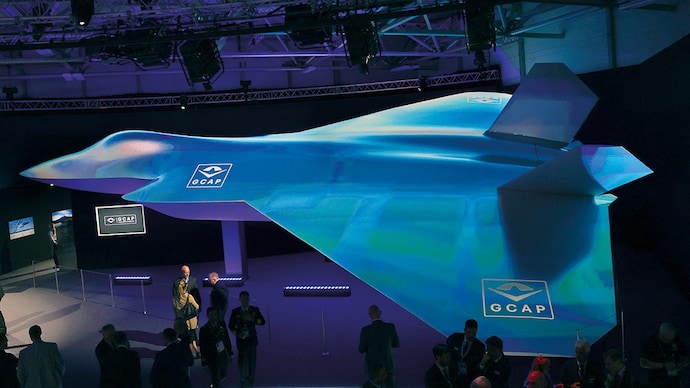
Now, India has an opportunity to join a sixth-gen fighter jet programme, with the Union Ministry of Defence informing Parliament in March 2026 of such an intent. The choice is between two other sixth-gen projects—the Future Combat Air System (FCAS) originally led by France, Germany and Spain (though France has recently pulled out of the project), and the Global Combat Air Programme (GCAP) of the United Kingdom, Italy and Japan. On April 30, defence secretary Rajesh Kumar Singh had said, “We have approached both ongoing partnerships between allied democracies and expressed interest in joining a sixth-generation fighter programme. The response is awaited.”
Air Marshal Raghunath Nambiar, former deputy chief of the Indian Air Force (IAF), believes that India’s participation in a sixth-gen fighter programme would be transformative. For India, it offers access to cutting-edge technologies in AI, engine technology and networked warfare, while enhancing deterrence against adversaries. For Europe, it provides shared development costs and an assured market. “We need to be fully involved in all niche technologies and absorb them to our benefit. This will be our challenge and we must be the sole supplier on some hardware and software,” says Air Marshal Nambiar.
Some observers believe such exposure could also support India’s own long-term military aviation goals beyond the fifth-generation Advanced Medium Combat Aircraft (AMCA) project by speeding up technology development. Currently in the prototype stage, the AMCA could enter service by 2035 if timelines hold. In contrast, China already has two stealth fighters—J-20 and J-35—operationally deployed, with Pakistan reportedly set to acquire J-35s soon. Given the fact that fighter jet technology is undergoing upgrades every decade or so, India must be abreast of latest advancements, feel experts.
The GCAP and the FCAS aim to have an operational sixth-gen fighter by 2035 and 2040, respectively. The FCAS project, however, has experienced delays due to industrial disagreements among its three European partners. Recent reports suggest that the project itself was in danger due to disagreements between France’s Dassault Aviation and Airbus, representing Germany and Spain in the programme. However, Germany has since indicated that it would seek new partners for the FCAS. With their strong defence partnership in the background, France has also indicated its interest in partnering India in any future sixth-gen project it is part of. The on-track GCAP, anchored by defence giants BAE Systems (the UK), Leonardo (Italy), and Mitsubishi Heavy Industries (Japan), is courting India to join it during its critical design and development phase between 2025 and 2027. In 2025, the defence firms established a new joint venture, Edgewing, to expedite the development of the jet.
EXPENSIVE PROPOSITION
Analysts say that full entry into GCAP will come at a steep price. Securing a 10-15 per cent stake in the programme would require India to commit an estimated $6.5-10 billion (Rs 62,500-96,150 crore). This financial burden poses a dilemma, as it risks diverting critical resources and focus away from the AMCA project, which remains central to India’s long-term airpower strategy.
According to a section of the military, instead of committing as a full partner, India should lean toward a limited ‘observer status’ arrangement for now. This would enable it to monitor technological advancements while preventing premature dependency on foreign military-industrial complexes as New Delhi evaluates the trajectories of the GCAP and FCAS before joining either camp.
As India’s military planners grapple with the question whether India should join a sixth-generation programme, they are examining three factors: technology access, industrial workshare and financial commitments—each carrying implications for India’s future air power and strategic autonomy.
SIXTH-GEN CAPABILITIES
Sixth-gen fighters are being designed as twin-engine stealth aircraft built for long-range operations inside airspace bristling with low-cost drones, advanced air defences and stealth platforms. They will combine low-observable shaping, radar-absorbent materials, infrared signature suppression and fully internal weapons carriage—all to minimise radar and thermal detection.
The platform will use adaptive-cycle engines (for subsonic, transonic and supersonic speeds) producing over 40,000 pounds of thrust (or propulsion) each, allowing Mach 2 supercruise (the ability to sustain supersonic flight).
Sixth-generation fighters will operate as flying sensor fusion hubs. Advanced AESA (Active Electronically Scanned Array) radars, EO/IR (electro-optical/ infrared) systems, passive sensors and EW suites will be integrated to provide real-time, 360-degree battlespace picture. AI will support predictive threat analysis, autonomous decision-making, rapid target prioritisation and independent kill-chain (the process to detect, track and engage enemy aircraft using early warning radars, airborne early warning aircraft, EW systems and beyond visual range or BVR weapons) generation.
A core concept is manned-unmanned teaming. The fighter will function as an airborne command node controlling swarms of loyal ‘wingman’ drones. In aerial combat, a ‘wingman’ is a companion jet flying just behind and to the side of a lead aircraft, offering mutual support. These unmanned systems will conduct reconnaissance, undertake strike, decoy and suppression missions. Launched independently from the ground, powered by AI and secure data links, they will extend a jet’s reach and firepower.
As for advanced weaponry, the jet will carry next-gen BVR missiles and hypersonic (exceeding Mach 5 speeds, roughly 6,100 kmph) strike systems.
Sixth-gen fighters will thus be airborne combat networks—an integrated ‘system of systems’ comprising a sixth-gen stealth fighter, uncrewed wingman drones, advanced sensors and network-enabled data-sharing capabilities. Open-systems architecture—that uses standardised interfaces, allowing developers to ‘plug and play’ new advancements without massive overhaul—will enable rapid upgrades and capability evolution.
On the matter of India opting for either the GCAP or the FCAS projects, Air Marshal Makarand B. Ranade (retd), former director general (inspections and aerospace safety), IAF, says, “Such partnerships carry geopolitical benefits, as they can help partner nations counterbalance China’s military activities in the Indian Ocean Region, strengthen security cooperation and improve interoperability with the Indian military.”
Frank O’Donnell, senior research adviser at the Seoul-based advocacy group Asia-Pacific Leadership Network, strikes a note of caution, though. “These [the GCAP and FCAS] may be useful for long-term technology transfer, but neither are proven platforms, and India should not prioritise strategic attention on them,” he says. According to him, while India should explore a sixth-gen programme, this should not detract from the urgency of inducting proven platforms. The induction of 114 Rafales, as approved by the Defence Acquisition Council in February, should be “a special priority”. He adds, “India should accelerate its development of combat UAVs, standoff precision-strike munitions and advanced air defences.”
The correct course for India, then, is to opt for either of the two projects as a pathway to access sixth-generation technologies that could complement, not replace, its indigenous AMCA programme and other defence projects.

