Lines of control | Delhi Thapar Gallery's exhibition on A.A. Raiba
An ongoing exhibition of preparatory sketches by the late artist A.A. Raiba at Delhi's Thapar Gallery shows his mastery over form
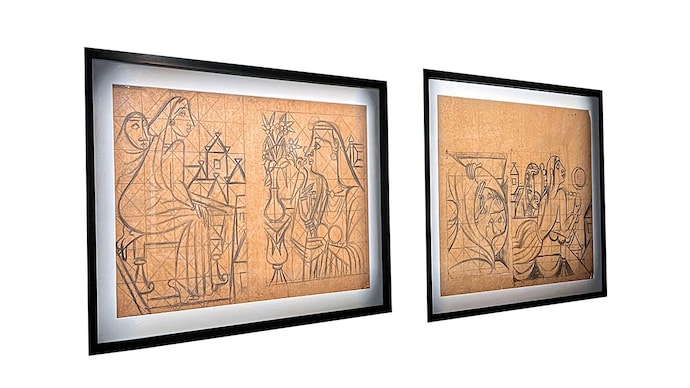
As a former scientist-in-training, I have always had a thing for graph-paper notebooks; I adore their neatness, their elegance. Moreover, there is a well-documented history of graphs/grids being important preparatory tools for artists and writers. Diego Rivera famously plotted his gigantic murals on graph beforehand, while Thomas Pynchon wrote the first draft of his masterpiece Gravity’s Rainbow on graph paper. In an ongoing exhibition at Delhi’s Thapar Gallery, one can observe the importance of grids as visual aids in the works of Indian artist Abdul Aziz Raiba (1922-2016). The show, called Master Artist A.A. Raiba: A Unilateral Eclectic, collects a series of preparatory sketches Raiba made for his more famous, large-scale paintings, as well as a series of landscape sketches made by the artist during a Kashmir stint in the late 1950s.
As a former scientist-in-training, I have always had a thing for graph-paper notebooks; I adore their neatness, their elegance. Moreover, there is a well-documented history of graphs/grids being important preparatory tools for artists and writers. Diego Rivera famously plotted his gigantic murals on graph beforehand, while Thomas Pynchon wrote the first draft of his masterpiece Gravity’s Rainbow on graph paper. In an ongoing exhibition at Delhi’s Thapar Gallery, one can observe the importance of grids as visual aids in the works of Indian artist Abdul Aziz Raiba (1922-2016). The show, called Master Artist A.A. Raiba: A Unilateral Eclectic, collects a series of preparatory sketches Raiba made for his more famous, large-scale paintings, as well as a series of landscape sketches made by the artist during a Kashmir stint in the late 1950s.
In these sketches, you can see how Raiba used grids to plot out his larger compositions, la Rivera, making sure that he got the proportions correct. Fragments of a human figure with a rooster evoke the artist’s famous 1964 painting, ‘Man With Cock’, for example. The grid helped him organise his thoughts, not to mention the precise form, colour and mood that the work required. These grid-sketches are also revelatory because we clearly see how Raiba, a man trained in the Indian miniature painting style, came to incorporate several different influences from around the world. In the essay accompanying the exhibition, art historian Shivaji K. Panikkar writes about Raiba’s “unique fusion of Indo-Islamic traditions, European academic naturalism, the Bengal school and European modernity”.
This was a versatile artist who was more than familiar with the dominant methods and applications of his day, always seeking to reinvent himself. And this exhibition gives us a peek behind the curtain, so to speak, allowing us to witness the evolution of a true original.
—Master Artist A.A. Raiba: A Unilateral Eclectic is onView until June 21 at Thapar Gallery, Delhi

