If stones could sing | Book on Ellora Caves
The photographs in Ellora complement the in-depth essays, which establish it as one of a series of sites across the Deccan with a distinct artistic style
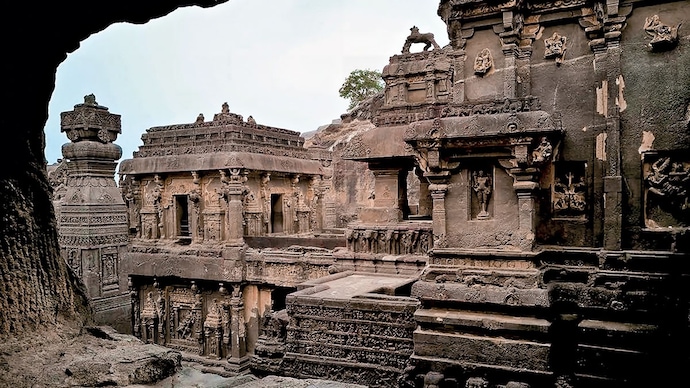
There can never be too many books with photographs of Ellora, surely one of the most visually stunning archaeological sites in the world, developed between the sixth and the ninth centuries CE. So magnificent and overwhelming are the caves that the images will always dwarf (literally and metaphorically) whatever is written about them. This book, by Deepanjana Klein and Arno Klein, is no exception to that rule despite the pretty solid essays it contains. Ellora’s rock carvings demand to be represented in black and white images and, here, Arno Klein’s pictures masterfully elevate the grey-black tones and rough textures of the basalt rock that give the carved figures their character. His photos capture the stillness of the Buddhist figures, the dynamism of Shiva and Vishnu in their iconic postures (Nataraja, Vamana, Narasimha), the austere intimacy of the vihara and the vastness of a universe teeming with other beings. The Jain caves at Ellora have never been my favourite, but in a less dramatic way, even they have sculptures that catch your breath and give you pause.
There can never be too many books with photographs of Ellora, surely one of the most visually stunning archaeological sites in the world, developed between the sixth and the ninth centuries CE. So magnificent and overwhelming are the caves that the images will always dwarf (literally and metaphorically) whatever is written about them. This book, by Deepanjana Klein and Arno Klein, is no exception to that rule despite the pretty solid essays it contains. Ellora’s rock carvings demand to be represented in black and white images and, here, Arno Klein’s pictures masterfully elevate the grey-black tones and rough textures of the basalt rock that give the carved figures their character. His photos capture the stillness of the Buddhist figures, the dynamism of Shiva and Vishnu in their iconic postures (Nataraja, Vamana, Narasimha), the austere intimacy of the vihara and the vastness of a universe teeming with other beings. The Jain caves at Ellora have never been my favourite, but in a less dramatic way, even they have sculptures that catch your breath and give you pause.
More and more, we are seeing Ellora not as unique, but one in a series of sites across the Deccan Plateau, with a distinct style of artistic expression. The essays in this volume point to these stylistically continuous spaces across Ellora itself and to the similarities of structure and depiction that were maintained over centuries in the Charanandri Hills. The jewel in Ellora’s crown is the Kailasha temple, carved from the top down through hard, unforgiving volcanic rock. It took more than a century to be completed, so the carvers who started it never saw the final monument, blazing with the glory of their back-breaking work. I’ve recently come across persuasive theories that generations of stone carving families travelled from place to place, carrying their inherited skills with them, to carve out other distant mountains. Hundreds of years later, we can marvel at the Trimurti Shiva in Ellora even as that gigantic face is enriched by our own memories of its twin on the island of Elephanta, nestling in a benign bay of the Arabian Sea.
I love Ellora. I love this book. Both remind me that there was a time when our religions were in open-hearted conversation with each other rather than in conflict.

