Shadows under a full moon | Ridham Janve's 'Hunter's Moon'
Ridham Janve's latest, Hunter's Moon, is a 'spiritual western' set in the Dhauladhars
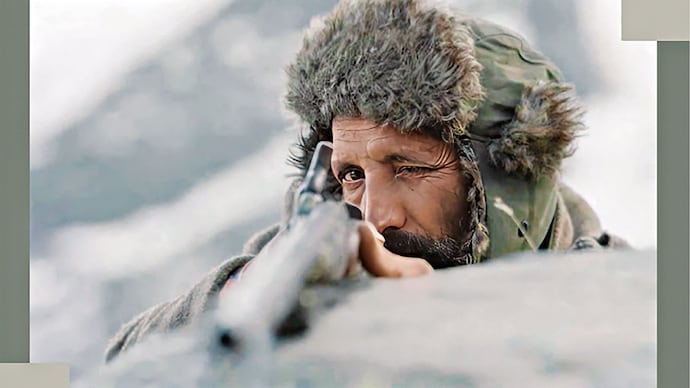
Ridham Janve’s Kaatti Ri Raatti (Hunter’s Moon), which won him the ‘Best Screenplay Award’ at the Shanghai International Film Festival, was conceived not on a writing table but around a bonfire with friends from the Gaddi community, whose tales of encounters with the unknown had started resonating with him over the years spent living in the Dhauladhars.
Ridham Janve’s Kaatti Ri Raatti (Hunter’s Moon), which won him the ‘Best Screenplay Award’ at the Shanghai International Film Festival, was conceived not on a writing table but around a bonfire with friends from the Gaddi community, whose tales of encounters with the unknown had started resonating with him over the years spent living in the Dhauladhars.
Even as the director of the acclaimed The Gold-Laden Sheep and the Sacred Mountain describes Hunter’s Moon as a “spiritual western”, he warns, “While it borrows the genre’s fixtures—a man with a gun, a hostile landscape—you won’t find the Western’s craving for conquest. What emerges is uncertainty: a conflict not between men, or even man and animal, but longing and consequence, belief and integrity.”
That sensibility was moulded as much by the landscape as by purpose. The Himalayas taught him to acknowledge what can’t always be explained—a sudden mist enveloping the world, a sound from somewhere unseen. After the birth of his son, Janve started spending time in Goa, from where he continued work on the film: “Goa introduced a different rhythm: mountains tutor stillness, the sea speaks of motion and return. Nature is not merely a backdrop but a force driving my films.”
As in The Gold-Laden Sheep, he has cast non-actors from the Gaddi community. “Their bodies belong to that world and carry a truth no trained performer can bring forth,” insists Janve.
The edit, undertaken at a distance with Amit Dutta, unfolded like a correspondence chess match: footage was sent in narrative order, with Dutta refusing to look ahead. “Out of that exchange emerged the film’s voiceovers—and a movie that revealed itself to both of us slowly.”

