Aiming higher | Sa Ladakh Biennale
The first edition of the Sa Ladakh Biennale is set to unfold across eight sites, all the way from Leh to Kargil
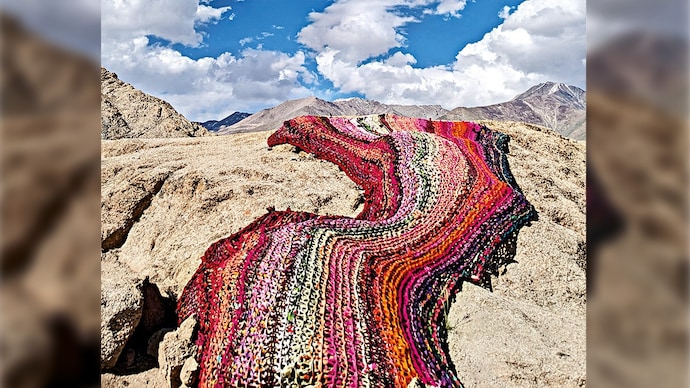
No, unlike many curators, Raki Nikahetiya didn’t descend with a concept to impose and move pieces to fit his vision. As co-founder of s Ladakh Biennale, the region’s first art biennale, he did the opposite. He listened. For someone born in Sri Lanka, raised in Austria, and now working across multiple cities, he could easily have brought a ready-made ‘mountain template’ to the icy heights. But Ladakh touched him first. “This place completely changed the rhythm at which I think,” he says.
No, unlike many curators, Raki Nikahetiya didn’t descend with a concept to impose and move pieces to fit his vision. As co-founder of s Ladakh Biennale, the region’s first art biennale, he did the opposite. He listened. For someone born in Sri Lanka, raised in Austria, and now working across multiple cities, he could easily have brought a ready-made ‘mountain template’ to the icy heights. But Ladakh touched him first. “This place completely changed the rhythm at which I think,” he says.
No, unlike many curators, Raki Nikahetiya didn’t descend with a concept to impose and move pieces to fit his vision. As co-founder of s Ladakh Biennale, the region’s first art biennale, he did the opposite. He listened. For someone born in Sri Lanka, raised in Austria, and now working across multiple cities, he could easily have brought a ready-made ‘mountain template’ to the icy heights. But Ladakh touched him first. “This place completely changed the rhythm at which I think,” he says.
Even as the first edition, ‘Signals from Another Star’, curated by artist Vishal K. Dar, will take place from August 1–10, Nikahetiya is quick to point out that he and his co-founders, Sagardeep Singh and Tenzing Jamyang, never set out to build a biennale. “It was curiosity that brought us here, not a drive to establish something,” he stresses.
While s, named for the Ladakhi word for ‘soil’, was held in 2023 and 2024 as an annual “regenerative land art exhibition and experience” in Leh, 2026 marks the inaugural edition of the biennale format, which will take place across eight sites—Leh, Likir, Basgo, Nurla, Lamayuru, Henasku, Mulbekh and Kargil—along the 230-km Leh–Kargil corridor. Participating artists include Chemat Dorjey, Tom Mller, Tundup Dorjay, Hylozoic/Desires, Avantika Bawa, and Zahara Batool.
Before the first edition of s was held in 2023, for several years, the team focused only on one thing—listening to local communities, artists, researchers, in India and abroad. Raki’s own life spent across cultures made him wary of art projects wrapped in preset answers. Ladakh revealed to him that memory doesn’t just reside in people but is also held in glaciers, monasteries and oral histories.
Raki insists that success to him is not measured only by attendance or coverage, but whether trust, knowledge and care continue to grow over time. Asked where he sees s in 10 years, he says it is what it leaves behind. A Youth Advisory Board is already being set up so the institution can keep renewing itself. “I do not think in terms of legacy, but continuity.”
—The biennale is on from Aug. 1-10

