Karnataka's D.K. Shivakumar | Rocky road ahead for the new CM
D.K. Shivakumar begins his tenure under intense pressure to deliver quickly, manage internal rivals and keep the Congress machine election-ready for the 2028 polls
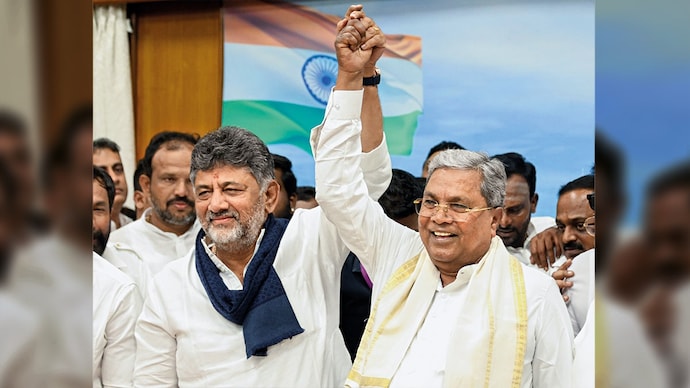
After a wait of three years, D.K. Shivakumar is finally set to become the chief minister of Karnataka, the summit of a political career that began, improbably, in defeat. In 1985, while just 23, DKS lost his first assembly contest in Sathanur to Janata Dal strongman H.D. Deve Gowda, the former prime minister. He has not lost an assembly election since. Four decades and eight consecutive MLA terms later, the long climb has ended at the top job.
After a wait of three years, D.K. Shivakumar is finally set to become the chief minister of Karnataka, the summit of a political career that began, improbably, in defeat. In 1985, while just 23, DKS lost his first assembly contest in Sathanur to Janata Dal strongman H.D. Deve Gowda, the former prime minister. He has not lost an assembly election since. Four decades and eight consecutive MLA terms later, the long climb has ended at the top job.
The denouement came on May 28, when chief minister Siddaramaiah, after two suspenseful days, hosted a breakfast for cabinet colleagues and then drove to Raj Bhavan in Bengaluru to hand in his resignation. It marked the end of the run for a leader who, just this January, had become the state’s longest-serving chief minister.
Yet the prospect of a mid-term change had loomed over the 77-year-old Siddaramaiah from the moment he returned to power in May 2023. An unwritten “pact” to hand the baton to Shivakumar midway was endlessly speculated upon, though the party never acknowledged it. As the months wore on, it became the single biggest distraction for a government that had come to power on the back of its strongest mandate since 1989.
The high command had intervened before, most recently last December, nudging the two men to meet informally and keep a lid on things. That, in hindsight, was the leadership buying time. The opening came in early May, with the conclusion of a high-stakes round of state elections in which the Congress won Kerala and emerged as a partner in the Vijay-led Tamilaga Vettri Kazhagam (TVK) coalition in Tamil Nadu.
Its position now more secure in the South, the party decided to make a firm move in Karnataka. On May 26, Siddaramaiah was summoned to Delhi for a long day of meetings, including a tte--tte with Rahul Gandhi. The ostensible reason was a discussion on possible Rajya Sabha and legislative council nominees for the elections due in June, but the real purpose was the shake-up at the top.
Siddaramaiah went gracefully. “I had always maintained that I will resign when the high command asks me to. Accordingly, I did so,” he said at a press conference on May 28, flanked by DKS and other ministers. He revealed he had been offered a Rajya Sabha berth “but I humbly declined...I have no interest”. Sidda said he would remain a legislator for the two years left of his term. “I will continue in active politics in the state and fight the communal forces.”
The exiting chief minister’s insistence on remaining active in state politics could become a headache for the man who has replaced him. “Siddaramaiah is a mass leader. If he stays engaged, he will either take on the role of a watchdog or a disruptor within the system. The decision to accept the caste survey results on the eve of his departure suggests the second role is more likely,” says a Congress general secretary.
TRUSTED TROUBLESHOOTER
But DKS is no pushover either. The Congress’s “troubleshooter” tag is not mere party folklore, but a job description earned over a quarter of a century. From 2002, when he spirited away some 40 Congress legislators to a Bengaluru resort to help Vilasrao Deshmukh survive a no-confidence vote in Maharashtra, to 2017, when he engineered the late Ahmed Patel’s improbable Rajya Sabha victory from Gujarat, and then the 2018 Karnataka hung verdict, when DKS kept the flock together, denying B.S. Yediyurappa and the BJP a majority and paving the way for the Congress-JD(S) coalition, Shivakumar has repeatedly proved his worth as the party’s crisis manager. As late as in February 2024, the party had rushed him to Himachal Pradesh, where cross-voting had imperilled the Sukhvinder Sukhu government. He emerged to declare it safe. The resorts, the negotiations, the late-night vigils, this is the terrain where Shivakumar’s politics thrives.
That utility has bought him unusual standing with the Gandhis. They have repaid the trust in kind: Sonia Gandhi visited him in Tihar Jail in October 2019, during the weeks he spent in custody in an alleged money laundering case. Months later, even with that case live, the high command installed him as Karnataka Congress president, with public backing from the Gandhis.
DKS is also someone who does not take no for an answer. The trait was on display in December 2024, when, paying tribute to his late mentor and former CM S.M. Krishna in the assembly, DKS recalled how he became a minister in the latter’s government (1999-2004). “I had sat with Krishna to make the list of ministers and their portfolios. But in the final list that went to the governor, my name was missing,” he told the House. Heeding his astrologer’s advice to “take by force” what was owed to him, he woke Krishna up: “Nothing doing. Without me, you cannot run a government,” and argued through the night until he got his way.
All of this has made DKS a formidable leader, and also a rich one. His 2023 election affidavit declared assets of over Rs 1,413 crore, which makes him the richest among chief ministers, alongside 19 pending criminal cases (many of them protest-related, but there are also others concerning tax, alleged disproportionate assets and money-laundering enquiries). Not one has produced a conviction, and the most serious of them have eased: the income-tax complaints ended in his discharge, upheld by the Karnataka High Court in 2021. The 2018 money-laundering case was brought to a close by the Supreme Court in March 2024.
A few others persist. A 2020 CBI case alleging disproportionate assets of about Rs 75 crore, which the courts declined to quash, was withdrawn from the agency by the Siddaramaiah government and handed to the Lokayukta. A separate Enforcement Directorate matter remains under challenge, with the Delhi High Court extending him interim protection from coercive action as recently as April 2026.
THE CASTE CRISIS
As party president for the past six years and the acknowledged architect of the 2023 campaign, Shivakumar is the Congress’s structural mainstay in Karnataka. His base is the Vokkaligas, one of the state’s two dominant caste blocs, the other being the Veerashaiva-Lingayats. This is a different coalition from the one that powered Siddaramaiah, a leader of the OBC Kuruba community whose strength lies in the grouping of minorities, backward classes and Dalits known by the Kannada acronym, AHINDA.
Reconciling these two power bases will be the first item on the new CM’s agenda. The party must now rejig its Karnataka unit, appoint a successor as president, keep caste equations in balance and Siddaramaiah’s bloc onside, all while staying alert to the challenge a BJP and JD(S) front could mount.
And then there is the caste survey, the challenge that arrived a day before the handover. On May 27, the Karnataka State Backward Classes Commission handed Siddaramaiah the report of the Social and Educational Survey 2025 at Vidhana Soudha. Its contents have not been made public, but its lineage is incendiary. The exercise had been ordered afresh after its predecessor’s data, gathered in 2015, and thus deemed outdated, drew fierce opposition from the Vokkaligas and Lingayats, who rejected the ‘undercounting’, suspecting that it had been engineered to favour Siddaramaiah’s Kurubas.
The caste census is also a signature campaign for Rahul Gandhi, who oversaw a similar exercise in Telangana. By leaving the 2025 report on the table, Siddaramaiah has bequeathed DKS a hot potato that pits his community’s anxieties against his party’s stated conviction. The Opposition will be watching for the slightest hint of a crack. So far, the Congress has had it easy, helped by the disarray in the rival camp, above all in the BJP, whose state unit has lumbered along for three years amid infighting.
THE WAY FORWARD
The bigger threat to the new dispensation may be fatigue. The party has delivered on the five welfare guarantees it promised in 2023 and shown an appetite for reform in areas such as revenue and excise. What it now needs is fresh momentum. Shivakumar’s window is narrow. Before the 2028 election year closes in, he must deliver on marquee projects, chief among them his ambition to transform the face of capital Bengaluru. There is also the neglected rural infrastructure and the long-pending demand to fill government vacancies. Besides that, there are the civic polls to fight: the Bengaluru city body by August, and the overdue gram panchayat elections. By Siddaramaiah’s reckoning, the government has met 300 of the 550-odd manifesto promises, and left the state’s finances within fiscal-responsibility norms. “No. 1 in the country in per capita income,” he claimed on his way out, “No. 2 in GST collections.”
The task before DKS is to carry the legacy forward. For a quarter of a century, he was the man the Congress sent for when a government was slipping away. Now, the government is his own, and the first crisis on his desk is one no resort retreat or midnight vigil can settle: a sheaf of caste numbers that sets his community against his party’s conscience. The fixer has finally arrived at the one government he cannot be sent in to rescue, because it is his to run.

