Bihar | Samrat gets going
A month and a half into office, Bihar chief minister Samrat Choudhary is driving a governance model centred on speed, visibility, administrative control and aggressive political messaging
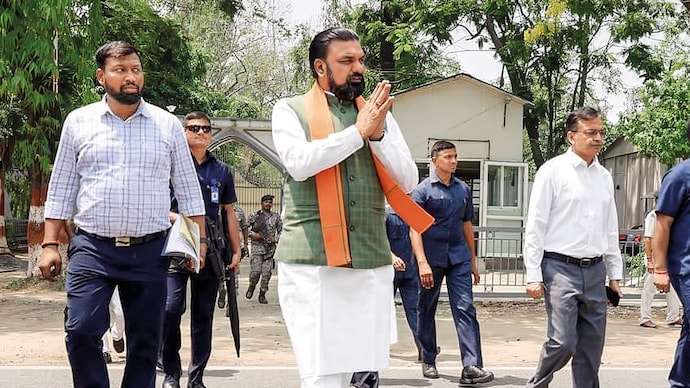
It is the weekend, yet Bihar chief minister Samrat Choudhary’s residential office at 1, Anne Marg in Patna is unusually abuzz with activity. An additional chief secretary, a couple of MLAs and the administrative head of a management institute wait patiently for their turn to meet the man who is close to completing two months in office.
It is the weekend, yet Bihar chief minister Samrat Choudhary’s residential office at 1, Anne Marg in Patna is unusually abuzz with activity. An additional chief secretary, a couple of MLAs and the administrative head of a management institute wait patiently for their turn to meet the man who is close to completing two months in office.
At the other end of the corridor, seated behind a desk strewn with files, loose papers and handwritten notes, Choudhary exudes visible command—a reflection of the distinct shift now underway in Bihar’s governance style. If his predecessor Nitish Kumar’s administrative culture was often defined by long, painstaking reviews, detailed file readings and interruptions such as ‘go back to the previous presentation slide and explain’, Choudhary’s approach appears outcome-driven: ‘Show me the result’.
The underlying political signal is unmistakable: the Bharatiya Janata Party (BJP) wants Bihar, under its leadership, to project visible momentum, speed and authority.
Last month, in a packed review session attended by district magistrates and superintendents of police, the CM spoke in clipped, impatient bursts for nearly 25 minutes. Criminals, Choudhary declared, must face relentless pursuit. Those who assault young girls, he told the senior officers, should be dealt with firmly. “Mala pehna dijiye” (garland their photographs), he said, which is understood as a signal to neutralise hardened criminals. “He does not speak in the old bureaucratic idiom of ‘the law will take its own course’, as his predecessor often did,” says one senior official. “The Samrat doctrine appears direct: if criminals challenge the state’s authority, respond swiftly—within 48 hours.”
The messaging is not confined to rhetoric. Overall, there have been a dozen police encounters involving alleged criminals, with police firing killing two people and injuring the others. On April 29, within hours of the murder of Bihar Administrative Service officer Krishna Bhushan Kumar in Bhagalpur, police identified the alleged mastermind, who was later killed in an encounter. Days later, on May 3, another alleged criminal was gunned down in the same manner in Siwan.
District officials speak of late-night follow-up calls from the top. Police officers are pressured for quick results. On May 14, after a spice trader was shot dead in Patna, officials say, Choudhary made seven phone calls to top officers through the night, pressing for immediate results. Within two days, a juvenile contract killer was arrested in connection with the murder.
During this period, a major social-policing initiative—the Police Didi Scheme—has also been launched, under which women police personnel will be stationed near educational institutions to prevent crimes against women. “I have given the Bihar Police a free hand,” Choudhary said on May 18. “No one should dare take the law into their own hands, and the police are continuously responding firmly to such challenges.”
GOVERNANCE PUSH
Beyond restoring law and order, the Samrat Choudhary government’s agenda ranges from ambitious urban planning and education spending to grievance redressal and administrative reform.
One of the most ambitious initiatives is the blueprint for 11 satellite townships across 10 districts—envisioned as planned urban spaces, with residential colonies, commercial zones, wide roads and green belts lined with plantations and public parks.
The government has also rolled out Sahyog ki Triveni, a three-tier public grievance and accountability system to address complaints related to block offices, police stations and revenue departments. Importantly, the government has imposed a strict 30-day deadline for resolving complaints, warning officials of disciplinary action, including suspension, for delays.
In the education sector, the government has attempted to push both infrastructure expansion and institutional reform. It has approved Rs 800 crore to convert all district schools and one selected higher secondary school in every block into ‘Model Schools’. Besides, Rs 104 crore has been sanctioned to establish degree colleges in 208 blocks that currently lack one, a move expected to create more than 9,000 new positions.
Another politically significant decision has been the amendment to the Bihar Public Works Code, giving preference to Bihar-based contractors for civil projects worth up to Rs 50 crore.
The government has simultaneously attempted to push administrative reform through measures aimed at reducing corruption, increasing transparency and cutting bureaucratic delays. Among them is an e-registration system for land and property registration, while individuals above 80 years of age are now eligible for home registration services.
“Zero tolerance” for corruption is another key plank of Choudhary’s agenda. On May 30, he suspended IAS officers Abhilasha Kumari Sharma and Yogesh Kumar Sagar, alleged beneficiaries of a tender-manipulation scam. He has also sought to bring technology into the state’s anti-corruption framework by introducing AI-based scrutiny of engineering estimates across departments—a move officials say directly targets inflated project costs. “In many places, where an estimate used to be around Rs 1 lakh, we have already started seeing a reduction of 5-6 per cent. Once AI becomes integrated into governance, duplication and inflated projections will disappear,” the CM said.
For years, the BJP functioned in Bihar as the junior partner in Nitish’s coalitions, despite its growing electoral heft. The saffron party supplied political energy and organisational muscle; Nitish supplied administrative legitimacy. But by the end of Nitish’s long tenure, the administrative machine had acquired a certain lethargy.
Inside party circles, there had long been frustration that Bihar’s political discourse remained trapped between nostalgia and caste arithmetic while younger voters increasingly cared about visible delivery—roads, policing, urban infrastructure, jobs and digital responsiveness. Party strategists believed that if they ever acquired greater operational control over the state apparatus, they would need to create an impression of kinetic governance. Choudhary, with his naturally combative style, emerged as a useful embodiment of that approach.
To operationalise that shift, Choudhary has installed his own handpicked officers in the CM secretariat, shifting two senior IAS officers known for their proximity to the Nitish regime to other departments while a third has moved on central deputation.
REALITY CHECK
Yet, for all the muscular messaging and administrative urgency, Choudhary faces formidable challenges. Bihar’s Rs 3.17 lakh crore budget for FY26 is heavily burdened by committed spending, with salaries, pensions, interest payments and welfare obligations consuming a substantial share of resources. At the same time, Choudhary cannot politically afford to dilute prohibition—one of the defining policies of the Nitish era. The liquor ban has not only deprived Bihar of a major potential revenue stream, but has also tied down significant police and judicial resources in enforcement and litigation.
The CM, therefore, is exploring alternative revenue models, such as the expansion of toll taxation to strengthen the non-tax revenue base. Simultaneously, the government is aggressively courting private investment. On May 17, Choudhary’s meeting with Adani Group chairman Gautam Adani in Patna was an attempt to establish direct channels with India’s largest industrial groups and project Bihar as investment-ready. The group has already committed major investments in the state, including the Pirpainti power project.
A day after the meeting, on May 18, Choudhary announced that Bihar was now moving beyond the old developmental vocabulary of “sadak, bijli aur moolbhoot suvidha” (road, electricity and basic amenities). “By the time the NDA government completes one year in office, investment proposals worth nearly Rs 5 lakh crore will be implemented in Bihar.”
On the CM’s desk lie three TV remote controls, resting within his easy reach. The symbolism is hard to miss: in a state being governed through centralised command, the controls appear firmly in his hands.

