Madhya Pradesh | In troubled lands
Allegations over his family's growing land holding threaten to derail the equity Mohan Yadav has painstakingly built in his chief ministerial tenure so far
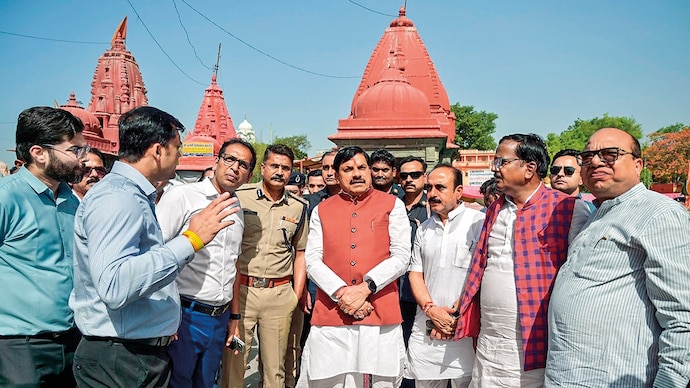
June 23 began like any other Tuesday for Madhya Pradesh chief minister Mohan Yadav. The day is reserved for the weekly cabinet meeting at the Mantralaya in Bhopal, and officials at the CM’s residence on the Shyamla Hills were finalising the day’s agenda when one of Yadav’s trusted political aides called an assistant’s phone.
June 23 began like any other Tuesday for Madhya Pradesh chief minister Mohan Yadav. The day is reserved for the weekly cabinet meeting at the Mantralaya in Bhopal, and officials at the CM’s residence on the Shyamla Hills were finalising the day’s agenda when one of Yadav’s trusted political aides called an assistant’s phone.
“I got a call from a central BJP leader in Delhi,” the aide told Yadav. “He forwarded a report published in today’s Indian Express. It is about land ownership involving you and your family in and around Ujjain.” Yadav took a longish pause to process the information before hanging up.
Within hours, the report had triggered the biggest political challenge of Yadav’s tenure. For more than two and a half years after taking office in December 2023, the CM had largely escaped sustained political attacks. The report revealed that land holdings belonging to Yadav, and his immediate and extended family members, had grown multifold during the years he rose from minister to chief minister. It further claimed that several parcels acquired by family members were located in areas that later stood to benefit from government development projects announced during his tenure.
The Congress seized on the report, seeking Yadav’s resignation and alleging that his family had made windfall gains while he held high office. State party president Jitendra Patwari demanded that Yadav explain the allegations in the media. At a press conference in Delhi, he also asked for a probe headed by a serving Supreme Court judge.
Yadav, however, chose to remain silent, while the BJP quickly closed ranks behind him. Around half a dozen party leaders came out in his defence, with party IT cell chief Amit Malviya issuing a statement backing the CM. State BJP president Hemant Khandelwal rejected the allegations, arguing that the combined land holdings of Yadav and his wife, Seema, in Ujjain had remained unchanged since before he became CM. He said members of Yadav’s extended family had been in the real estate business for years. He also pointed out that Ujjain’s Development Plan had been announced in May 2023, before Yadav became CM.
Khandelwal, however, did not address allegations that Siddhivinayak Devcon—a company in which Yadav and his wife together hold a 73 per cent stake—had purchased 2.6 acres after he became CM, sold 12 acres to a firm owned by Yadav’s cousin, Neelesh, during his tenure, or that the CM’s daughter-in-law acquired another 10 acres in mid-2025.
The issue is likely to come up during the monsoon sessions of both Parliament and the state assembly this month.
THE YADAV ASCENDANCY
When the BJP picked Yadav as CM after its sweeping victory in the 2023 assembly election, it surprised even seasoned party observers. First elected from Ujjain South in 2013, Yadav had won three consecutive terms and served as higher education minister in the Shivraj Singh Chouhan government between 2020 and 2023, yet he was hardly among the frontrunners for the top job. A farmer by background, Yadav also worked in the family’s restaurant business before he and his brothers diversified into real estate around Ujjain.
As CM, Yadav has sought to leave an imprint distinct from that of his predecessor, Chouhan. His government unveiled a new industrial policy, shifted from city-specific planning to developing metropolitan regions centred around Bhopal, Indore and Ujjain, and identified dairying as a priority sector to boost farm incomes. His government’s ambitions, however, have been constrained by finances. With flagship welfare schemes such as Ladli Behna consuming over Rs 20,000 crore annually, besides the CM Kisan Samman Yojana, there has been little room for new capital-intensive programmes.
Officials who have worked closely with Yadav describe him as decisive. “The CM’s core strength is his decision-making ability. If he is convinced about something, one can expect it to be cleared in the shortest possible time,” says a principal secretary-rank IAS officer. He cites the long-pending issue of reservations in promotions—stuck for nearly a decade—as an example of Yadav pushing through a resolution once he had made up his mind.
That decisiveness, however, has not always translated into a smooth relationship with the bureaucracy. It is an open secret in Bhopal that Yadav and chief secretary Anurag Jain, an officer said to have impeccable credentials, do not see eye to eye on certain issues, especially bureaucratic postings. The CM’s secretariat has also seen frequent changes at the top, though over time Yadav has built a trusted inner circle comprising additional chief secretaries Neeraj Mandloi and Rajesh Rajora, public relations commissioner Manish Singh and several officers posted in his hometown.
Even so, many BJP legislators believe that the bureaucracy has become increasingly assertive in the past few months, citing the recent ‘transfer season’ as a case in point. “If an MLA has a personal rapport with a departmental secretary or district collector, the chances of getting a recommendation accepted are much higher. Even if a minister approves a proposal and marks it to the department, there is no guarantee it will go through,” says a first-time BJP MLA from the Mahakoshal region. He also cites the discontinuation of regular divisional review meetings involving senior bureaucrats as one reason decision-making has slowed in recent months. Some smaller initiatives—the PM Shri Air Ambulance Service and PM Shri Heli Paryatan Seva—have also faced operational disruptions.
POLITICAL TIGHTROPE
But governance is not the only thing testing Yadav’s mettle, politics is proving to be equally challenging. To begin with, the CM inherited a government with multiple power centres. But the BJP’s central leadership sought to ease the transition by limiting the old guard’s representation in the cabinet. Even so, it is well known that Yadav’s equations with senior colleagues such as Kailash Vijayvargiya, Prahlad Patel and Vijay Shah have not been smooth.
One of Yadav’s most striking decisions has been to retain as many as 11 portfolios, while most senior ministers in his 30-member cabinet handle just one prominent department. Besides heading the government, Yadav holds Home, Industries, Mining, Forest, Public Relations and Narmada Valley Development, among others—an unprecedented concentration of authority in recent politics in Madhya Pradesh. Chouhan retained far fewer departments during his tenure, while Digvijaya Singh held virtually none in his final term. “Retaining such a large number of portfolios takes a toll on the functioning of departments,” says a political observer in Bhopal. “But it has been done to keep the CM clearly above his cabinet colleagues.”
At the same time, Yadav has cultivated his own political team. Ministers such as Rao Uday Pratap Singh, Rakesh Singh, Chetanya Kasyap and Narendra Patel are regarded as close to him, although speculation over a cabinet reshuffle continues. Whenever it comes, it is likely to provide another opportunity for the CM to stamp his authority on the government.
Yadav—regarded as a protg of former Rashtriya Swayamsevak Sangh (RSS) Sah Sarkaryavah, Suresh Soni—has also tried to balance governance with the RSS ideological priorities. His government has initiated the process for implementing the Uniform Civil Code, while the ban on liquor sales in 19 towns of religious significance was widely viewed as another pro-Sangh move, though it appears to have had little practical impact. Alcohol is available outside municipal limits, and there is no ban on drinking, only on its sale within the prescribed area. However, at the same time, sections of the Sangh privately express disappointment over the limited emphasis on expanding Sanskrit education.
Within the BJP organisation, Yadav now commands greater influence. The election of Betul MLA Khandelwal as state BJP president, the reconstitution of the state executive and the appointment of political heads to state corporations and boards have all been widely seen as reflecting the CM’s growing clout. Recently, he also earned goodwill with the central leadership by helping the BJP secure a third Rajya Sabha seat from the state despite lacking the numbers on paper.
That political capital is now being tested. With the Uttar Pradesh assembly election due next year and resignations over media reports largely a thing of the past, Yadav appears focused on challenges closer home. An upcoming byelection in Datia will test the BJP’s electoral machinery, while mending ties with senior colleagues will be crucial if he is to lead the party into the 2028 assembly election.
But, for now, Yadav must overcome the land row to regain the political narrative.

