Building investor confidence | India Today Smart Money Financial Summit
At a time of heightened geopolitical and economic uncertainty, policymakers and market leaders shared strategies to help investors manage risk and seize emerging opportunities
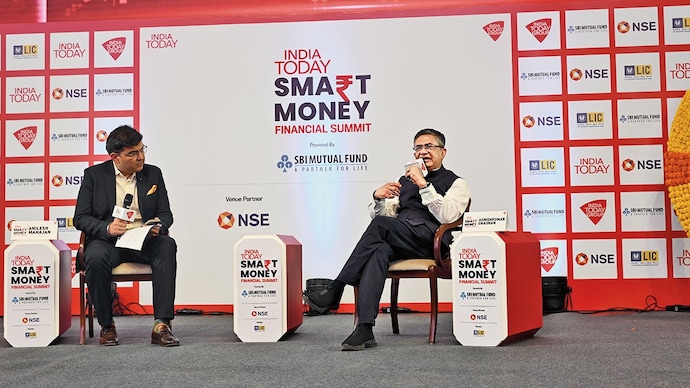
Few venues better symbolise India’s financial ambitions than the National Stock Exchange (NSE). It was there in Mumbai that the second edition of the India Today Smart Money Financial Summit unfolded on June 18, coinciding with the “truce” between the US and Iran, and reports that the NSE was preparing for what could become the country’s second-largest initial public offering.
However, the renewed tensions in West Asia have reinforced the need for investors to brace for uncertainty. Ashishkumar Chauhan, MD & CEO, NSE, set the tone for the event by emphasising the power of technology and why the Mythos scare should prod organisations to be more prepared for tomorrow. Niranjan Hiranandani, founder and chairman, Hiranandani Group drew an optimistic picture of the real estate sector, which has opened up new avenues to investors through the real estate investment trusts (REITs). But the big concern was in affordable housing where sales had fallen 20 per cent.
Mutual funds (MF) have emerged as a favourite investment tool. Nilesh Shah, MD, Kotak Mahindra Asset Management Company, said while all the macro indicators so far have been positive for the markets, a deficient monsoon could play spoiler. Moreover, market volatility is something investors will have to live with. This was followed by a high-powered panel comprising leaders from the MF industry—Nimesh Shah, CEO, ICICI Prudential MF; Vetri Subramaniam, MD & CEO, UTI Asset Management; Rishi Kohli, chief investment officer, Jio BlackRock Mutual Fund; and Kailash Kulkarni, CEO, HSBC Mutual Fund—on the prospects of the sector. They seemed to agree that the economic fundamentals could not have been better for India. However, the war and tepid corporate earnings were a concern. Radhika Gupta, MD & CEO, Edelweiss Mutual Fund, said she was a big believer in investing in India, and preferred a multi-cap portfolio with meaningful exposure to both large and mid-cap companies.
Economists D.K. Joshi of Crisil, Ila Patnaik of the Aditya Birla Group and Madan Sabnavis of the Bank of Baroda debated the Reserve Bank of India’s recent measures to boost capital inflows. Sabnavis had a word of caution: The markets were overvalued, and there is a big reduction in the overall quantity of investable resources. So, markets could remain under pressure. Patnaik wanted more discussions around the RBI move, because it marked a shift in policy that always preferred equity to debt. Joshi was optimistic that the war had ended and that inflation was still under control.
No discussion today would be complete without analysing the impact of artificial intelligence, and Srikanth Velamakanni, group chief executive, Fractal, and chairperson, Nasscom, stressed the need to have our most critical infrastructure continuously tested using the latest AI models to identify vulnerabilities. “Security has to be built into systems by design, not added later,” he said.
These were only some of the many conversations that converged on a common message: navigating a more challenging financial environment will require innovative ways to attract investors and sustain India’s long-term growth story. The pages that follow delve into the ideas and insights shared by the speakers.
Photographs by Milind Shelte
Few venues better symbolise India’s financial ambitions than the National Stock Exchange (NSE). It was there in Mumbai that the second edition of the India Today Smart Money Financial Summit unfolded on June 18, coinciding with the “truce” between the US and Iran, and reports that the NSE was preparing for what could become the country’s second-largest initial public offering.
However, the renewed tensions in West Asia have reinforced the need for investors to brace for uncertainty. Ashishkumar Chauhan, MD & CEO, NSE, set the tone for the event by emphasising the power of technology and why the Mythos scare should prod organisations to be more prepared for tomorrow. Niranjan Hiranandani, founder and chairman, Hiranandani Group drew an optimistic picture of the real estate sector, which has opened up new avenues to investors through the real estate investment trusts (REITs). But the big concern was in affordable housing where sales had fallen 20 per cent.
Mutual funds (MF) have emerged as a favourite investment tool. Nilesh Shah, MD, Kotak Mahindra Asset Management Company, said while all the macro indicators so far have been positive for the markets, a deficient monsoon could play spoiler. Moreover, market volatility is something investors will have to live with. This was followed by a high-powered panel comprising leaders from the MF industry—Nimesh Shah, CEO, ICICI Prudential MF; Vetri Subramaniam, MD & CEO, UTI Asset Management; Rishi Kohli, chief investment officer, Jio BlackRock Mutual Fund; and Kailash Kulkarni, CEO, HSBC Mutual Fund—on the prospects of the sector. They seemed to agree that the economic fundamentals could not have been better for India. However, the war and tepid corporate earnings were a concern. Radhika Gupta, MD & CEO, Edelweiss Mutual Fund, said she was a big believer in investing in India, and preferred a multi-cap portfolio with meaningful exposure to both large and mid-cap companies.
Economists D.K. Joshi of Crisil, Ila Patnaik of the Aditya Birla Group and Madan Sabnavis of the Bank of Baroda debated the Reserve Bank of India’s recent measures to boost capital inflows. Sabnavis had a word of caution: The markets were overvalued, and there is a big reduction in the overall quantity of investable resources. So, markets could remain under pressure. Patnaik wanted more discussions around the RBI move, because it marked a shift in policy that always preferred equity to debt. Joshi was optimistic that the war had ended and that inflation was still under control.
No discussion today would be complete without analysing the impact of artificial intelligence, and Srikanth Velamakanni, group chief executive, Fractal, and chairperson, Nasscom, stressed the need to have our most critical infrastructure continuously tested using the latest AI models to identify vulnerabilities. “Security has to be built into systems by design, not added later,” he said.
These were only some of the many conversations that converged on a common message: navigating a more challenging financial environment will require innovative ways to attract investors and sustain India’s long-term growth story. The pages that follow delve into the ideas and insights shared by the speakers.
Photographs by Milind Shelte

