AAP under siege
The defection of its Rajya Sabha MPs—and former close aides— throws AAP off balance ahead of the battle for Punjab next year
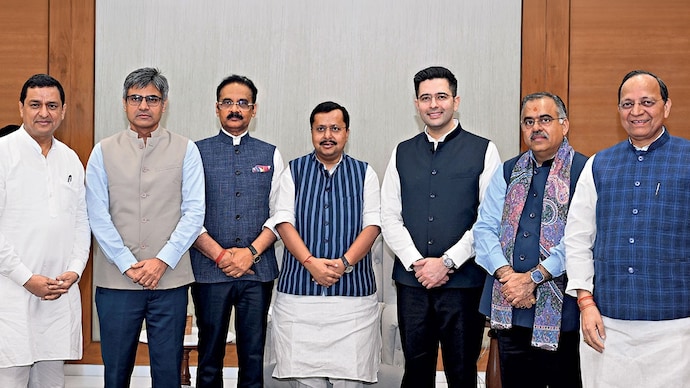


The election churn was in Bengal and elsewhere, but that didn’t stop the Bharatiya Janata Party (BJP) from doing a surgical strike on the Aam Aadmi Party (AAP) in the capital. On April 24, seven of the latter’s 10 Rajya Sabha MPs—six from Punjab and one from Delhi—crossed over to the saffron side. They include AAP chief Arvind Kejriwal’s proteges Raghav Chadha and Sandeep Pathak, businessmen Ashok Mittal, Vikramjit Singh Sahney and Rajinder Gupta, cricketer Harbhajan Singh as well as activist-politician Swati Maliwal (from Delhi).
The election churn was in Bengal and elsewhere, but that didn’t stop the Bharatiya Janata Party (BJP) from doing a surgical strike on the Aam Aadmi Party (AAP) in the capital. On April 24, seven of the latter’s 10 Rajya Sabha MPs—six from Punjab and one from Delhi—crossed over to the saffron side. They include AAP chief Arvind Kejriwal’s proteges Raghav Chadha and Sandeep Pathak, businessmen Ashok Mittal, Vikramjit Singh Sahney and Rajinder Gupta, cricketer Harbhajan Singh as well as activist-politician Swati Maliwal (from Delhi).
The numbers alter the balance in the Upper House. Splitting over two-thirds of its parent legislative unit, Chadha’s faction beat the disqualification clause under the anti-defection provisions. The BJP now controls six of Punjab’s seven Rajya Sabha seats—in a state where they managed just two MLAs (out of the total 117) in the 2022 assembly election. Its Rajya Sabha tally moves to 113, just 10 short of a simple majority on its own. The NDA moves up to 149 in the 245-MP House. AAP is now reduced to six MPs—three in the Lok Sabha, and its rump unit in the RS.
An inkling of what lay ahead came on April 5, when the AAP leadership removed Chadha as the party’s deputy leader in the Rajya Sabha, replacing him with Ashok Mittal. Rumours that a disaffected Chadha—one of AAP’s most recognisable faces—might jump ship had been circling for months now. The surprise was in the kind of coup he would engineer. Sanjay Singh, AAP’s leader in the House, posted on social media that joining the BJP was tantamount to a “treachery of Punjab’s people and of the Constitution”.
For the BJP, the biggest catch was perhaps AAP national general secretary Sandeep Pathak, who was central to the party’s organisational design. An academic from IIT-Delhi, he brought a methodical approach to AAP’s political mobilisation, building booth-level systems, expanding volunteer networks and creating data-driven feedback loops. His role was critical in Punjab, where the party moved from 20 seats in 2017 to a sweeping mandate of 92 out of 117 assembly seats in the 2022 Punjab election. He also helped lay the groundwork for AAP’s early push in Goa and Gujarat.
Of the others, on April 15, the Enforcement Directorate (ED) had raided premises linked to Mittal in Punjab as part of a FEMA investigation. Incidentally, Mittal, whose family has old RSS links, was part of the BJP-appointed delegation that went to the US to make India’s case post-Operation Sindoor in 2025. Maliwal was anyway persona non grata in the party after the blowout with Kejriwal in 2024.
For AAP, the coordinated exit of senior leaders will hit at the heart of its identity. The party’s rise rested on cohesion and a tightly knit leadership structure. It prided itself on discipline and controlling the message it put out. That model delivered successive victories in Delhi and powered its expansion into Punjab. Now, after the loss in the 2025 Delhi election, the latest defections could create a perception of drift that has to be contained fast.
STRONG UNDERCURRENTS
The BJP also seems to have got the timing down pat. Punjab, the only state where AAP is still in power, is headed for an assembly election in February 2027. Here, the internal equations become more complex. The Bhagwant Mann-led government enjoys a massive majority in the House, yet the influence of leaders such as Chadha and Pathak on the legislative party cannot be underestimated. Both leaders were key in the ticket distribution process during the 2022 assembly election, and have maintained connections with many MLAs.
AAP leaders like Sanjay Singh and Mann have rubbished Chadha’s claims that 65 MLAs from the state are in touch with him. “The party had given them respect, positions and power, but they chose to defect. They are the traitors of Punjab. They forget that the people of Punjab don’t forgive traitors,” said Mann, while expressing confidence that none of his MLAs would stray.
But BJP insiders echo the claim that between Chadha and Pathak, they command the loyalty of around 60 MLAs. The party leadership apparently is not keen on triggering defections that could destabilise the last year of the Mann government to avoid generating sympathy for AAP. The defection of their colleagues has already strengthened the bargaining position of the MLAs in the faction-ridden Punjab unit of AAP. In fact, the BJP is hoping that this and anti-incumbency will create enough jitters within the AAP Punjab unit for things to unravel on their own by the time the election rolls in.
DAMAGE CONTROL
Ask about AAP’s latest troubles and Sanjay Singh will tell you that the BJP has perfected the “politics of defections”, using the ED and CBI as instruments to poach MPs who “benefited from AAP’s ticket and then sold us out”. “Our people everywhere are being persecuted by the BJP to [force them to] quit,” Singh says. He cites the examples of party MLAs Mehraj Malik in J&K and Chaitar Vasava in Gujarat, who were jailed on “trumped-up charges”. On the Rajya Sabha MP defections, Singh says AAP will move the Supreme Court to seek their disqualification.
Meanwhile, AAP chief Kejriwal does not seem to have even a day to spare on internal damage control. “The BJP wants this episode (the exit of the seven MPs) to take over the narrative, but we will not allow that. This has no bearing on the larger fight,” says a senior AAP functionary. The excise case in the Delhi HC has been top of the agenda for Kejriwal and AAP, and visibly so. The AAP chief has announced that he will abstain from all future hearings before Justice Swarana Kanta Sharma, who is hearing a CBI challenge to a lower court’s ruling discharging him, close aide Manish Sisodia and others.
Kejriwal had written directly to the judge after a court rejected his petition for Justice Sharma’s recusal from the case. In his plaint, he had cited her “public association with the RSS’s legal front” and the fact that her children are on the panel of the central government counsel under solicitor general Tushar Mehta, who is appearing on behalf of the CBI in the excise policy case. Sisodia has also announced he would abstain, citing the same reasons and saying he “did not expect to get justice” in judge Sharma’s court. The judicial boycott also gives AAP workers something to rally around—a persecution narrative far simpler than any anti-defection petition. The AAP top leadership now says “there is no path left except for satyagraha”. Kejriwal even led a march of AAP workers to Rajghat in the capital, where he and others paid floral tributes at Gandhiji’s samadhi.
AAP finds itself in a piquant situation today, another victim of the BJP’s ‘thousand cuts’ strategy. Corruption allegations, defections, the defeat in Delhi, they have all but erased memories of the brief high after Kejriwal’s discharge in the excise case in February. Yet the situation is not completely lost. AAP’s immediate challenge is to regain control of the narrative. The leadership will need to reassure the cadre in times when the words ‘organisational discipline’ will ring hollow. It will also have to refocus attention on governance outcomes rather than the internal churn. The next few months will test the mettle of Kejriwal and Co. like no other period before. AAP will have to minimise the damage and rebuild momentum ahead of the 2027 election or risk being pushed to the margins for ever.

