Madhya Pradesh | The big dairy push
CM Mohan Yadav bets on breed improvement, technology and cooperatives to double milk output, but caste calculus appears to shape the push
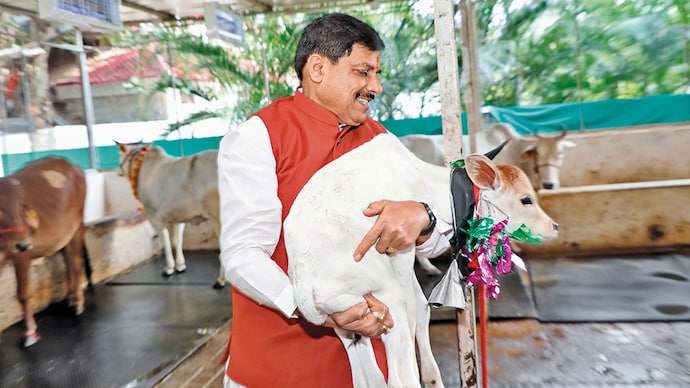
Within months of taking over as chief minister of Madhya Pradesh in December 2023, Mohan Yadav announced an ambitious plan to more than double milk production in the state over the next five years. The state currently accounts for about 9 per cent of the country’s dairy output, a share he aims to raise to 20 per cent. MP ranks third in milk production, behind Uttar Pradesh (16 per cent) and Rajasthan (15 per cent). “We are following a multi-pronged approach to develop the sector,” says CM Yadav.
Within months of taking over as chief minister of Madhya Pradesh in December 2023, Mohan Yadav announced an ambitious plan to more than double milk production in the state over the next five years. The state currently accounts for about 9 per cent of the country’s dairy output, a share he aims to raise to 20 per cent. MP ranks third in milk production, behind Uttar Pradesh (16 per cent) and Rajasthan (15 per cent). “We are following a multi-pronged approach to develop the sector,” says CM Yadav.
CASTE SUBTEXT?
Political watchers, however, see the dairy push as linked to the CM’s caste background. A large share of those engaged in the milk business belong to the Yadav and Pal communities—estimated at around 10 per cent of the state’s population. So, strengthening the sector is likely to benefit them. The promotion of dairy aligns with a broader effort to highlight ideas associated with the Yadav identity. For instance, there is a plan to develop a Shri Krishna Pathey Tirth to promote religious destinations linked to Lord Krishna, who holds special significance for the Yadavs. Also in the pipeline are 300 Sandipani schools—the name referencing Krishna’s guru—and Gita Bhawans in all urban local bodies. But Yadav denies any narrow focus and maintains that dairy promotion will benefit all.
Breed improvement, feed and vaccination, and milk marketing are the key features of Yadav’s new dairy push. According to the 2019 livestock census, nearly 70 per cent of MP’s cattle are nondescript—only about 30 per cent have known lineage and yield a reasonable amount of milk. The task is to increase the share of these animal breeds through artificial insemination—and, to some extent, in-vitro fertilisation—and to castrate those that cannot be improved in order to discontinue their genetic line.
Although artificial insemination was widely performed in the state, there was no feedback system. Nor was there any documentation of the offspring breed. “To address this, we decided to train our veterinarians in the latest techniques and eliminate the possibility of ‘artificial inseminations on paper’, where they simply filled in numbers to meet targets,” says Umakant Umarao, principal secretary, animal husbandry. “We have trained the AVFOs (assistant veterinary field officers) in how to communicate and convince cattle owners to opt for breed improvement.” The results are already showing. Between FY25 and FY26, the number of artificial insemination procedures increased from around 1.25 million to 2.09 million, while the number of animals on whom the procedure was performed rose from 1.08 million to 1.68 million.
However, the problem with artificial insemination is that even with documentation, it can take up to 20 years and six generations to produce a pure-bred animal. IVF shortens this timeline. “A 100 per cent pure-bred embryo implanted in an animal can yield a pure-bred offspring in a single generation,” says Dr Anand Kushwaha, in charge of the IVF lab at Bhopal’s Bull Mother Farm, which has produced 450 offspring.
Promotion of quality feed is another critical area. Good feed means an animal comes into heat at around 1.5 years, compared to three years in its absence, affecting productivity. An app guides farmers on the right green fodder to enhance milk production. In MP, green fodder is sown over a mere 29,000 hectares, compared to 1.7 million hectares in Gujarat, which is widely regarded as a model for success in the dairy sector. The animal husbandry, forest and agriculture departments in MP are working together to promote green fodder cultivation.
While the state’s potential is immense, challenges remain. For one, there seems to have been no fresh recruitment of veterinarians, with reliance on contract AVFOs and private hires. Equipment used for artificial insemination and IVF is largely imported, slowing servicing and repairs. Budgetary support, though higher, remains inadequate.
COOP REVAMP
MP embarked on its white revolution journey in April 2025, when it signed an MoU with the National Dairy Development Board (NDDB), handing over management control of the MP State Cooperative Dairy Federation (MPSCDF). Since then, the NDDB has focused on boosting milk collection and diversifying products to drive demand. The number of villages with collection points has risen from 5,763 to 6,989, lifting daily procurement from 950,000 litres to 1.15 million litres. “Our target is to expand to about 26,000 villages—half the state—and raise collection to five million litres a day in five years,” says Sanjay Govani, MD, MPSCDF. The dairy farmer membership base has also grown from 214,000 to 250,000 in a year. Payment to dairy farmers supplying milk to the federation has been increased by Rs 2 to Rs 8.5 per litre.
The role of cooperatives in boosting dairy incomes is critical: Gujarat channels 90 per cent of its milk procurement through cooperatives, while MP manages only 4 per cent—making a clear case for strengthening the MP milk cooperative union.
Ultimately, though, results—not rhetoric—will matter.
Interview | Mohan Yadav
“More milk will help tackle malnutrition among children”
The Madhya Pradesh chief minister speaks to India Today on his plans to develop MP’s dairy sector. Excerpts:
Q. You have announced that milk production will be doubled. How do you plan to achieve this?
A. When we handed over the state’s milk cooperative to the National Dairy Development Board last year, daily milk collection stood at 9.55 lakh litres and has now increased to 11.72 lakh litres per day. We plan to take the same model forward to eventually reach 50 lakh litres per day. The state’s milk production is much higher, at around 5.5 crore litres per day, which is why there is tremendous potential in this sector.
Q. Many BJP-run states focus on the gaushala model to protect cows. Your approach seems more rooted in economics.
A. We cannot be dependent only on charity and religion for the protection of cows; we must become self-sufficient. There is a focus on breed improvement, proper and nutritious diets for cattle and the modernisation of processing units. One eye has to be on the market. We are also concerned about the marginal farmer, who can raise his income.
Q. It is said that your focus on the dairy sector is aimed at strengthening your political position, as you hail from a community engaged in rearing cattle.
A. Who is a gopal? Anyone who has a cow is a gopal. All communities engaged in agriculture also keep cattle and earn from them. Any community involved in milk production, regardless of caste or religion, will benefit from the development of the sector. Milk would also help tackle malnutrition. n

