Goa | Marathi versus Konkani
An old ghost stalks pre-poll Goa. Marathi activists demand official status for their language. Konkani speakers say 'naka'
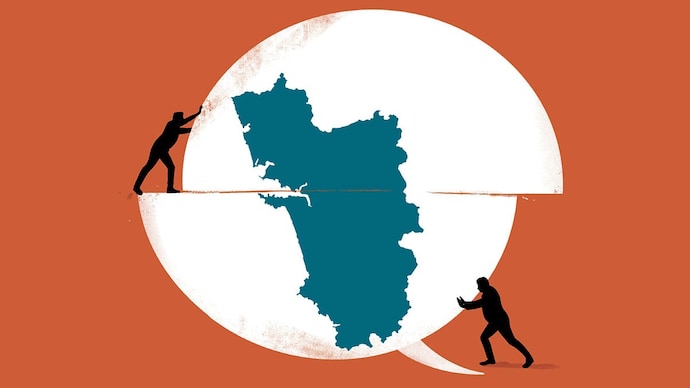
In goa, a founding tension has again found words to speak its mind. And speakers hard to dismiss for the ruling Bharatiya Janata Party (BJP). Fanning the embers of a language war almost as old as Goa, Subhash Velingkar, a rare renegade from the Rashtriya Swayamsevak Sangh (RSS) who formerly headed its local chapter, has launched a movement seeking co-official status for Marathi. If the demand is not fulfilled, he warns, the Marathi vote bank would vote against the BJP in the 2027 state polls.
In goa, a founding tension has again found words to speak its mind. And speakers hard to dismiss for the ruling Bharatiya Janata Party (BJP). Fanning the embers of a language war almost as old as Goa, Subhash Velingkar, a rare renegade from the Rashtriya Swayamsevak Sangh (RSS) who formerly headed its local chapter, has launched a movement seeking co-official status for Marathi. If the demand is not fulfilled, he warns, the Marathi vote bank would vote against the BJP in the 2027 state polls.
In response, Konkani activists, too, have switched to battle mode—their language, they warn, is central to Goa’s identity and any party promising to upgrade Marathi’s status would face a Konkani backlash. A section, largely comprising Catholics, also wants Konkani in the Roman script—called Romi Konknni or Concanim—to be recognised as an official script.
The status quo leaves things in a half-formed compromise. In 1987, after a two-year agitation that saw seven deaths (and a language martyr in tribal youngster Floriano Vaz), Konkani in the Devnagari script was recognised as Goa’s official language. The law also provides that Marathi may be used “for all or any of the official purposes”.
The 2011 census recorded 964,000 native Konkani speakers; 159,000 who listed Marathi as mother tongue. But Marathi is widely spoken and read—many Goan Hindus read Marathi newspapers. It’s a linguistic ease between sibling languages fostered by, among others, the Maharashtrawadi Gomantak Party (MGP) that came to power in 1963.
A NATIVE COLONIAL
But that ease is shot through with existential anxieties: Marathi is also a bridge to the old argument that Goa should have been made part of Maharashtra—a view, then championed by the MGP, that was beaten back after a a referendum in 1967. Konkani, in this colonising view that leaves Goans irate, is a mere “dialect of Marathi”, not a fully autonomous language.
All this brings a dire sense of dj vu for the Pramod Sawant regime. In 2016, Velingkar was the vanguard against the ruling BJP’s decision to allow grants to English-medium schools, including those run by the archdiocese. In the 2017 state election, his splinter outfit allied with the MGP, Shiv Sena et al. It didn’t prosper, but its campaign hit BJP cadre morale, leading to a debacle in which then-CM Laxmikant Parsekar and five ministers were defeated.
Now, Velingkar is at it again before another election. His Marathi Rajbhasha Nirdhar Samiti demands a resolution in the next assembly session formally elevating Marathi. Else, he warns, a ‘Marathi and Hindu vote bank’ would dethrone the BJP. “Marathi is no import from Maharashtra. It developed in Goa,” he says, harking back to its use in pre-colonial and colonial times. “Even those who write pieces criticising Marathi do so in Marathi.”
Caste stirs the mix, with the Marathi side saying standardised Konkani, with its Portuguese loanwords, is a tool of social dominance for the Saraswat Brahmins and Catholics and alienates the backwards, who they claim have “an affinity to Marathi”. Language activist G.R. Dhavalikar cites pro-Marathi resolutions passed by panchayats as proof. His colleague Pradeep Ghadi Amonkar urges a higher vote for Marathi as mother tongue in the 2027 census.
Multiple BJP leaders told india today that the regime isn’t too keen to let the language genie out of the bottle in the polls runup. Especially since it has religious undertones: Velingkar has in the past attacked St Francis Xavier. This is a raw wound, after the remarks by YouTuber Gaurav Khattar against Goa’s patron saint.
REVERSE MOBILISATION
Konkani groups, in turn, threaten to boycott pro-Marathi parties. The BJP’s rivals spot tactical space in the evolving mood. Says AAP’s Pratima Coutinho, “The BJP is up to communal polarisation.” Kennedy Afonso of Global Romi Lipi Abhiyan says even “Marathi schools are shifting to English”. He seeks recognition for Romi Konknni, and for it to be taught in schools. An RSS elder says the dispute may impact pockets of North Goa’s 40 assembly segments, which have significant Hindu populations. But analyst Raju Nayak feels “a majority of youth are not moved by language politics”.

