Maharashtra | When in Maharashtra, AI speaks in Marathi
An innovative AI policy sees the state at the helm of a race to harness the technology for local jobs
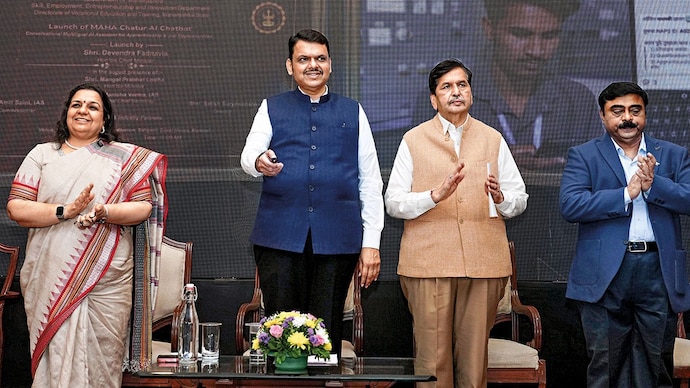
The world at large is stricken by anxiety about what the arrival of Artificial Intelligence means for the old economy, but Indian states may be devising an ingenious workaround—one that not only maximises its potential but actually widens the technology’s capacity itself. While other states have the ink still wet on their versions, Maharashtra has become the one of the first to roll a full-fledged AI policy. Its twin premises: that AI can be turned into a jobs-and-growth engine rather than just a threat to existing work, and that making the technology speak Indian languages kills two birds with one stone.
The world at large is stricken by anxiety about what the arrival of Artificial Intelligence means for the old economy, but Indian states may be devising an ingenious workaround—one that not only maximises its potential but actually widens the technology’s capacity itself. While other states have the ink still wet on their versions, Maharashtra has become the one of the first to roll a full-fledged AI policy. Its twin premises: that AI can be turned into a jobs-and-growth engine rather than just a threat to existing work, and that making the technology speak Indian languages kills two birds with one stone.
With investments of up to Rs 10,000 crore by 2031, the AI policy approved by the Devendra Fadnavis cabinet, targets the creation of around 150,000 jobs, with training for roughly 200,000 youth and professionals in AI, big data, cloud services and other emerging tech. Officials call it the next logical step for a state that’s already a major software exporter and a key IT hub, aiming to put it at the front of an Indian AI market that’s projected to leapfrog in size in the near future. The framework is modelled on the Centre’s IndiaAI Mission, with the promise of a “clear roadmap” for businesses, startups and research institutions.
At its core, the policy tries to argue that AI will reshape rather than kill work. Ashish Shelar, the state minister for electronics, IT and AI, says the focus is not just on automating existing jobs but on creating new AI-related jobs—or, in his words, “AI enabled development of human resources”.
‘AAMCHI AI’
The plan fairly bristles with ideas that mix the hardware of policy with people-oriented plans. At one end, there will be an AI backbone with 2,000 GPUs, local data ecosystems and a state-level AI data exchange; a Maharashtra Centre for Advanced Training in AI (MCAT) to be set up with industry and academic participation; a central ‘Maha AI Tools Hub’; a Rs 500 crore AI Startup Venture Fund, with the state matching industry contributions; and 12 AI incubators with funding support of up to Rs 1 crore each.
Inevitably, the conceptualisation does not miss out on the spiffy, highrise vocabulary that attends to most emerging tech, especially in the way it interacts with global finance. So you get a planned 300-acre ‘Innovation City’ in Navi Mumbai, a startup accelerator called ‘M Hub’, Global Capability Centre Parks in Mumbai, Pune, Nagpur, Chhatrapati Sambhajinagar (Aurangabad) and Nashik to attract R&D and backoffice operations from global tech firms.
But the policy then also flows ingeniously into how all this can make sense for local small entrepreneurs. Take the way the policy promises to help at least one AI startup grow into a unicorn; up to Rs 1.25 crore plus an additional 25 per cent financial assistance for women-led startups; even subsidies to MSMEs to adopt AI, a layer that marks a bold first anywhere.
Yet, all these means of integrating AI into the local economy may pale in front of one: building datasets and tools in Marathi and other local languages so people can actually use the technology. The ‘MahaChatur’ chatbot, with which the state will converse with its citizens, is a highlight. That comes with a tacit subtext: global AI is out of quality data, learning newer languages is its way of enriching its proprietary models. The question is: who will own the data?

