West Bengal | Iron Man, remade in Bengal
Suvendu gets off the blocks with tough measures, says no violator will be spared as the "rule of law" returns
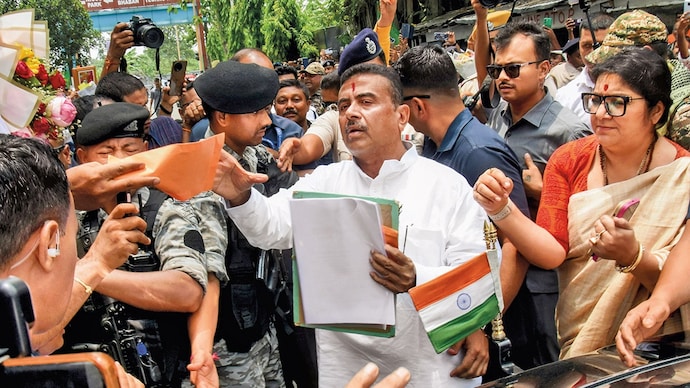
It hasn’t taken long for the Suvendu Adhikari imprint to be felt on the visible—and audible—parts of governance in West Bengal. Days into office, the new chief minister is sending out a clear message. The way he describes it, the era of “ruler’s law” is over, and “rule of law” is back—wrought in iron. From riots to post-poll violence, and restrictions on street gatherings, loudspeakers as well as alleged illegal slaughterhouses, an array of high-octane issues saw speeches from the CM, all delivered in a hard, magisterial tone. Action followed.
It hasn’t taken long for the Suvendu Adhikari imprint to be felt on the visible—and audible—parts of governance in West Bengal. Days into office, the new chief minister is sending out a clear message. The way he describes it, the era of “ruler’s law” is over, and “rule of law” is back—wrought in iron. From riots to post-poll violence, and restrictions on street gatherings, loudspeakers as well as alleged illegal slaughterhouses, an array of high-octane issues saw speeches from the CM, all delivered in a hard, magisterial tone. Action followed.
The sharpest articulation came on May 18 after violence erupted in Kolkata’s Park Circus-Tiljala area. The Adhikari regime’s inaugural measure was meant to be impactful: a bulldozer drive targeting alleged illegal structures, a dialect of governance associated with Yogi Adityanath of Uttar Pradesh. In a city rife with unauthorised structures, such action was bound to be selective. Protests erupted soon enough; six police personnel and two CRPF jawans were injured in alleged stone-pelting. At least 40 protesters were arrested.
After visiting injured personnel, Adhikari declared that the police would no longer function with “tied hands and feet”. “There will be zero tolerance towards this kind of unrest, hooliganism and anti-national, anti-social activities,” Adhikari said, in a roster-call that notably conflated all manner of deviations. “Take this as the last warning. If such incidents are repeated, no one will be worse than me as the home minister.” Bengal, in his visualisation, became a microcosm of India. “Stone-pelting at police in Srinagar and Kashmir has stopped; I believe it will stop in West Bengal and Kolkata too,” he said.
Both word and deed fit a familiar pattern. The BJP government announced stricter implementation of the West Bengal Animal Slaughter Control Act, 1950. Simultaneously, it declared that religious gatherings would no longer be permitted to block roads and that loudspeakers during prayers would face stricter regulation.
In one of his first meetings, the CM reportedly said “everyone will be free to practise religion independently”, but “worship by blocking roads will not be permitted” and loudspeakers would not be allowed. As controversy erupted over the policy, the government clarified that the law applies to all. “Not just Muslims. Even Hindus use microphones at temples. None of that would be allowed,” said cabinet minister Agnimitra Paul.
WARNING TO STRONGMEN
At a rally in Falta ahead of a crucial repoll, Adhikari targeted controversial local Trinamool figure Jahangir Khan, whom he described as a “notorious criminal” and called him “my responsibility”—words widely interpreted as a warning that politically connected strongmen could face direct action. In fact, multiple Trinamool leaders have started facing police raids and arrests.
Two major commissions have been set up, headed by retired judges: one to probe alleged institutional corruption in Amphan relief, MGNREGA, mid-day meals, housing projects, et al; another will examine atrocities against women and girl children. Notably, the R.G. Kar rape-murder case has been reopened. The state won’t get involved in the main case investigated by the CBI, but it has suspended three IPS officers, initiating a probe into their roles as investigators.
The Trinamool, meanwhile, alleges widespread retaliatory attacks after the BJP’s victory—counting 3,000 incidents, including arson at the house of former Olympian Swapna Burman’s house, as well as 10 murders of its workers. Adhikari dismissed this in the assembly, but added: “If anyone has been forced to leave home, give the list to the DGP.” For now, he has plenty of choices on how his governance ethos is perceived at large.

