Delhi hotel fire | Capital apathy
The Hauz Rani fire, which claimed 22 victims, bears all the marks of the capital's regulatory chaos. Let alone learning from the past, a booming Delhi careens ever closer to the brink in its daily life
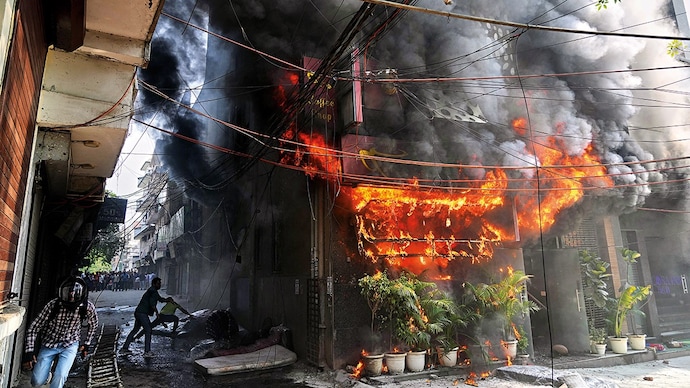
It’s a lane that could have been in any of the scores of urban villages that dot Delhi. Dark, skinny backalleys where the sun doesn’t reach, because it can’t find a way through haphazardly stacked matchbox buildings without getting entangled in a drooping mass of power cables. Hauz Rani, sandwiched between Malviya Nagar and Saket, is no different from all those: it’s a traffic jam of a village. But being across the road from the hospitals in Saket, a floating population of ‘medical tourists’ looking for affordable pads has been added on to its older residents and the usual crowd of cut-rate tenants.
It’s a lane that could have been in any of the scores of urban villages that dot Delhi. Dark, skinny backalleys where the sun doesn’t reach, because it can’t find a way through haphazardly stacked matchbox buildings without getting entangled in a drooping mass of power cables. Hauz Rani, sandwiched between Malviya Nagar and Saket, is no different from all those: it’s a traffic jam of a village. But being across the road from the hospitals in Saket, a floating population of ‘medical tourists’ looking for affordable pads has been added on to its older residents and the usual crowd of cut-rate tenants.
Flourish Stay catered to them. It was built like the others: restaurant below, B&B above. It had the licence for six rooms, but ran about 28—the sort of infraction that usually causes no wrinkle in Delhi. Except that, on June 3 morning, this squat piece of architecture in five storeys played host to one of the deadliest fires the capital has seen in years. The likely cause: an electric oil fryer that overheated and sparked. As flames engulfed the kitchen, the chef in his panic apparently switched off the mains before fleeing. Unintentionally, that disabled the building’s electronic door-locking system, trapping guests inside the rooms.
Asphyxiation, not fire, finally killed 22 of them—13 from countries like Nigeria, Mozambique, Kyrgyzstan, Uzbekistan, Bangladesh, Congo, Iraq and Liberia, in Delhi for treatment or to be with people being treated. Eight of an affluent Gurgaon family perished too: they had made a group booking for the ease of visiting an 80-year-old patriarch, who was in the Intensive Care Unit of Max Hospital Saket, across the road. The toll would have been higher but for locals improvising a rescue operation. Waseem, who works as a security officer at Max, was among those who rushed to help. “There’s a mattress store run by a boy, Armaan, and his father Riyazuddin Mansuri,” he says. “He gave us all his mattresses, we spread them out on the ground, and got many people to jump down...it saved their lives.” The Mansuris, who lost about Rs 2 lakh, are now being called the “heroes of Hauz Rani”.
EMBERS OF UPHAAR
The Hauz Rani tragedy mirrors a pattern often found in large fire mishaps, where deaths are most likely to occur not from the first exposure to fire, but due to a kind of trap. Delhi has been here too many times. Recall only June 13, 1997. A transformer fire at Uphaar Cinema in Green Park that afternoon claimed 59 lives and injured over 100.
The images of Malviya Nagar were all too familiar to Neelam Krishnamoorthy, who lost two children at Uphaar. She argues that the problem is not merely of officials passively “looking the other way” when violations occur, but of active and systematic corruption. “We all know that NOCs are issued for a price,” she says. “There will be knee-jerk action. They’ll inspect the buildings, shut them for a while...they will reopen when the public has forgotten about it.” Sure enough, the fire forced the closure of nine guesthouses nearby, all exhibiting the same pattern of constricted exits and mixed use.
Such tragedies are born at an intersection of failures—by multiple regulatory agencies who need to pull off a daily miracle of seamless coordination but, as can be expected, routinely produce the exact opposite.
For instance, Delhi Fire Service (DFS) is responsible for fire prevention and response. Building plans are the subject of municipal authorities. Police licensing authorities have jurisdiction over several commercial activities. Urban development comes under multiple agencies: Delhi Development Authority, district bodies.
UNCHECKED MEGALOPOLIS
An enforcement regime based on inspections and certifications is already prone to human weaknesses. Now it’s also unable to keep pace with a booming megalopolis whose population has now reached 35.5 million. Delhi counts 1,731 unauthorised colonies. This April, it was announced that 1,511 of them would be regularised on an “as is, where is” basis—4.5 million people will emerge from a grey zone and become legal Delhizens.
Delay in regularisation and substandard planning controls have always been a concern to urban planners and fire-safety experts. Fire tenders have difficulty accessing the scene through narrow roads and encroachments. Residential buildings become guest houses, clinics, warehouses and restaurants, but no safety measures are taken. One-use electrical systems are over-extended for many others.
No wonder Delhi has long grappled with a fire-safety challenge. The data is scary. Delhi Fire Service records show an average of 20,000-plus emergency calls a year. In the first four months of 2026 alone, 6,693 fire incidents were reported—April saw a 73 per cent spike in fire calls compared to March. Chief minister Rekha Gupta has called a high-level review meeting. As after every tragedy, a series of measures have also been announced—joint inspection teams, drone surveys, satellites to monitor construction work, digital mapping of construction activity, and more powers for district magistrates and tougher action on errant officials.
The government’s goal is a “foolproof system” that will stop such incidents, says Delhi home minister Ashish Sood. But even he agrees that “due to the fragmented authority of various agencies and bodies in Delhi, strict enforcement of rules has remained difficult....” That perilous alleyway is where Delhi is in still.

