Kerala | White paper versus Red economics
Satheesan sparks a debate on Kerala's fiscal mess with stark data, but critics ask what his alternative is
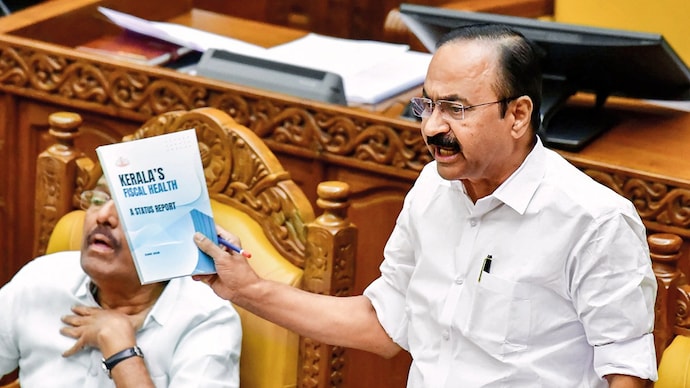
Eleven Kerala’s finances have been the subject of a running argument between Thiruvananthapuram and New Delhi for a decade: the state accusing the Centre of starving its high welfare model, the latter warning about rising debt and “off budget” borrowing. With the Left now voted out, that argument has come home as the Congress-led United Democratic Front (UDF) opens its innings with a contentious audit of the account books it has inherited. The V.D. Satheesan government, facing a daunting fiscal task ahead as it looks to realise its own welfare promises, has chosen to hold up its empty wallet for all to see.
Eleven Kerala’s finances have been the subject of a running argument between Thiruvananthapuram and New Delhi for a decade: the state accusing the Centre of starving its high welfare model, the latter warning about rising debt and “off budget” borrowing. With the Left now voted out, that argument has come home as the Congress-led United Democratic Front (UDF) opens its innings with a contentious audit of the account books it has inherited. The V.D. Satheesan government, facing a daunting fiscal task ahead as it looks to realise its own welfare promises, has chosen to hold up its empty wallet for all to see.
On June 4, Satheeshan tabled a white paper on the state’s finances in the assembly. What it spelt out promises to spur lasting academic and political debate: accumulated liabilities of Rs 5.07 lakh crore, a perilous 35.5 per cent of GSDP, far above the prescribed ‘healthy limit’ of 20 per cent. Also, arrears of Rs 48,733 crore. The document squarely blames the Kerala Infrastructure Investment Fund Board (KIIFB), the showpiece financing vehicle of the Pinarayi Vijayan era that helped fund roads, schools and hospitals via bond issues and loans rather than straight budget spending. KIIFB, the paper argues, turned into a “white elephant” that kept stacking hidden debt repayment obligations onto an already fatigued exchequer.
Satheeshan insists the exercise is not a witch hunt. “The white paper is not political. It talks about the current fiscal status—where we are, what we have and how we must go ahead. It’s not an exercise to find faults with the former government,” he told india today. The document—drafted by a panel headed by former cabinet secretary K.M. Chandrasekhar, with economists from the Gulati Institute of Finance and Taxation and the Centre for Development Studies—is meant to guide the new government’s course over the next five years. At least, that’s the intention.
ONLY 12.3% TO SPEND
Yet, its polemical function is hard to miss: it’s as much a chargesheet as a balancesheet. Minus the context, the stark naked data slices through the Left’s narrative of a “new Kerala” built on its own steam. The paper notes that 77.7 per cent of the state’s revenue is committed to salaries, pensions and interest payments, leaving little room for fresh welfare or investment. As of May 16, the state’s closing balance was just Rs 2,211.93 crore. This is while dearness allowance arrears add up to Rs 36,057 crore, Rs 1,500 crore is owed to university employees, Rs 3,431 crore to banks and contractors, and Rs 2,893 crore to the state-run Supplyco alone.
The Left, in turn, mounts a defence that may yet prove useful to the UDF as well, since it now steers the same ship. Its leitmotif: systemic central neglect, captured in a squeeze of federal funds. Kerala’s share in central tax devolution, it points out, has been progressively slashed by Finance Commissions: from 3.875 per cent in 1995-2000 to just 1.925 per cent now. Then, the sudden termination of the GST compensation regime, the winding down of revenue deficit grants, and the cost that had to be borne to mount high-quality responses to catastrophes like the 2018 floods, a multi-year pandemic et al.
The critique of KIIFB has drawn flak for being a back handed endorsement by the UDF of views expressed by the Union finance ministry, as also for what it prescribes. One of its ideas was to raise the retirement age of state employees from 56 to 60 years. That would immediately save roughly Rs 6,000 crore in gratuity and pension payouts, it said, and the cash could be redirected to clearing off some arrears. The government had to shed the thought forthwith after protests. “Why float ideas that are anathema to the youth and the unemployed?” asks a former chief secretary. “Or talk of privatising public sector units? I feel the chief minister was misled by people who have little sense of the state’s political realities.”
BABY AND BATHWATER
Some grant that Satheeshan has at least put the problem in black and white. “It’s natural for a new regime to blame its predecessor. But do they have a plan for the future?” asks Shaju Antony, a lawyer in the Kerala High Court. “I appreciate the CM for providing landmarks to rescue the state, but the real test is whether he can raise revenues and rationalise spending without tearing up Kerala’s social compact.”
Left economists are sticking to their guns, saying a genuine human-led welfare model is far more effective for India than high-cost showpiece infrastructure, and the results show in indices where Kerala uniquely matches First World standards in quality of life. So Satheeshan also has a positive inheritance that he needs to sustain.

