Samik Bhattacharya | Bengal's spokesman
Samik Bhattacharya emerges as BJP's 'soft' counterweight to Suvendu's tough act
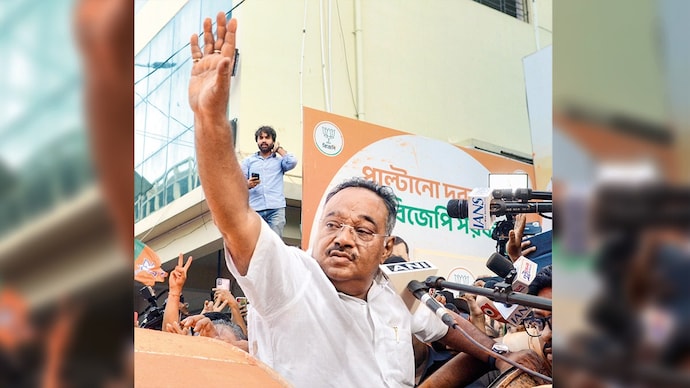
A certain duopoly was at the heart of West Bengal’s ruling structure before it was abolished by Mamata Banerjee—a model presently being torn apart by a crippling revolt within the ranks. Before her, power was never exercised solely by a chief minister-potentate. Even with Left titans like Jyoti Basu and Buddhadeb Bhattacharjee in Writers’ Building, many believed real authority often flowed from Alimuddin Street, where CPI(M) state secretary Anil Biswas wielded immense organisational control. Decades later, Bengal may be seeing the tentative return of that model—in an altered form.
A certain duopoly was at the heart of West Bengal’s ruling structure before it was abolished by Mamata Banerjee—a model presently being torn apart by a crippling revolt within the ranks. Before her, power was never exercised solely by a chief minister-potentate. Even with Left titans like Jyoti Basu and Buddhadeb Bhattacharjee in Writers’ Building, many believed real authority often flowed from Alimuddin Street, where CPI(M) state secretary Anil Biswas wielded immense organisational control. Decades later, Bengal may be seeing the tentative return of that model—in an altered form.
Now, Samik Bhattacharya is no Anil Biswas. The latter was a deadpan, one-man data centre humming in the background, crafting strategy as sharp as his occasional wit. The state chief of the Bharatiya Janata Party (BJP) and Rajya Sabha MP, by contrast, is more a gregarious user interface: a communicator, a public face, not shy of the dais or of TV.
‘THE GOOD COP’
But the way the chips are falling, it seems that as chief minister Suvendu Adhikari reigns from Nabanna as the new regime’s sinewy face, Bhattacharya is not subsumed within it. Instead, he buzzes with a certain presence in a parallel sphere. Maybe not quite a fully fledged power centre yet, but vital all the same—not just to the party’s organisation, but to its messaging and public image-making.
Bhattacharya’s contrast with Adhikari’s blunt-spoken sheriff act is a useful one. As a native speaker of Kolkata’s bhadralok dialect, with a softer tone to boot, his job is to reassure and woo sections of Bengal that remain wary of the BJP. He’s now expanding on the utility of that social niche, positioning himself as a bridge between government, industry and the urban classes—with intellectuals listening in for friendly signals. His words reach for the right buttons in the Bengali mind. “We have a huge task ahead. Rebuilding Bengal can only be complete if we can revive its lost cultural, industrial and historic significance,” Bhattacharya tells india today.
His growing influence has a visible marker. Even before the BJP’s ascension, it had rented a three-storeyed building in Salt Lake for Bhattacharya. Visitors, petitioners and cadre flock there. Even if a coordination cell keeps regular contact with the CM’s office, many insiders are describing it as an alternative centre of decision-making.
The BJP gets that winning Bengal and governing Bengal are two different challenges. The state is steeped in traditions of debate, pluralism and suspicion of aggressive majoritarianism. Many who abandoned the Trinamool Congress did so because of corruption, syndicate control and administrative decline, not ideological shift.
So one sees Bhattacharya, even as a party figure, moving on key themes that fall in the province of government. Like economic revival—the nub of urban/suburban aspirations. Even in the Rajya Sabha, he used to highlight Bengal’s industrial decline. Now, he’s acting on it: addressing chambers of commerce, promising a new investment climate—almost as if he were Bengal’s principal ambassador to industry.
A WIDER ROLE
His message is quite unequivocal: Bengal is open for business again. He advocates a new land policy, promises freedom from political interference and reiterates that investors should not fear extortion, syndicates or local political pressures. He has publicly campaigned to bring the Tatas back to Bengal, presenting Singur as a symbol of lost opportunity. He’s also pushing discussions around Deocha Pachami, oil reserves in North 24 Parganas and mineral resources in western Bengal.
Economics hardly exhausts his remit. One of the BJP’s biggest concerns is the possibility of ‘Trinamoolisation’—the influx of defectors, strongmen and power-brokers seeking proximity to the new rulers. Bhattacharya is trying to keep vigil, warning the cadre against violence, intimidation and extortion. Disciplinary action has become common. Here, his interface is with government, with some crucial questions increasingly passing through him: especially on who gets accommodated within administrative structures.
Culturally, a deep river flows between the BJP’s hardline bent and cosmopolitan Kolkata. He seeks to lay a bridge over that, expressing a spirit more kindred to Bengal’s culture of free thought. His attendance at a theatre production featuring TMC MP Partha Bhowmick was seen as a soft signal on this front, meeting the BJP’s greatest weakness in Bengal: the perception that it remains culturally alien.
If the arches and trusses on his bridge seek to be pleasing, its piers are built on ideas of growth. That’s meant to persuade those to cross over who are still on the other side, and may be repelled by the language of war: the business class, the urban street, the undecided in the outback. Whether the soft touch filters into the more contentious issues—detention, deportation, demolition—remains to be seen.
Can such a division of labour endure? Duality is tricky. Yet, for now, the BJP seems to view the idea as a plus, not a contradiction. Thus, outside Nabanna, Bhattacharya stands as a key counterweight in its Bengal experiment.

