The Jharkhand jungles quieten | Maoist surrenders
Often put in the shade by news from Chhattisgarh, its sibling state is pacifying Maoism in its own way
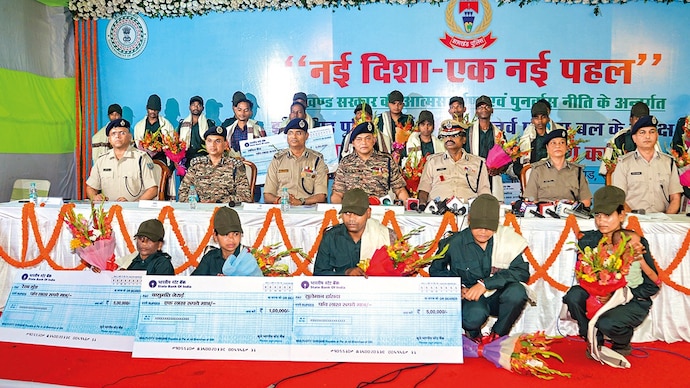
Jharkhand’s recent mass maoist surrender shows how this part of the war against Left-Wing Extremism (LWE) is winding down. Unlike the first chapter in Chhattisgarh, the endgame won’t be dramatic. More akin to its latter half, it’s enabled by policy deftness. Chief minister Hemant Soren’s Nai Disha (New Direction) policy aims to ensure it truly delivers a sense of closure. Not just an abrupt termination—prefixed by an ‘ex’, if you like—that leaves seeds on the forest floor. Proof of concept came on May 21 when 27 Maoist cadres came in from the bush at Ranchi’s police HQ—25 from the CPI (Maoist), two from another faction, six zonal commanders among them, together facing over 400 cases. They qualified for reward money totalling about Rs 33 lakh, plus compensation for surrendered arms.
Jharkhand’s recent mass maoist surrender shows how this part of the war against Left-Wing Extremism (LWE) is winding down. Unlike the first chapter in Chhattisgarh, the endgame won’t be dramatic. More akin to its latter half, it’s enabled by policy deftness. Chief minister Hemant Soren’s Nai Disha (New Direction) policy aims to ensure it truly delivers a sense of closure. Not just an abrupt termination—prefixed by an ‘ex’, if you like—that leaves seeds on the forest floor. Proof of concept came on May 21 when 27 Maoist cadres came in from the bush at Ranchi’s police HQ—25 from the CPI (Maoist), two from another faction, six zonal commanders among them, together facing over 400 cases. They qualified for reward money totalling about Rs 33 lakh, plus compensation for surrendered arms.
A young couple, part of the group, showed why that works. Bij Hansda and his wife Vandana arrived with a six-month-old daughter. Cited reasons for surrender: security, stability. Glimpses of that would have come soon, as they were moved to the Hazaribagh open prison. The facility allows family co-residence; offers education, vocational training, aid.
That’s key to Soren’s line that it’s a human-led policy that will sap the insurgency’s appeal. What the shadows are lengthening on is a landscape of conflict almost as old as Naxalism—dating from the early 1970s, the insurgency here was a key strand that flowed into the consolidated CPI (Maoist) in 2004. Insurgent footprints, once all over, have thinned to the Saranda-Kolhan forests of West Singhbhum.
Jharkhand had presaged the steep decline Maoist incidents saw nationally. In 2009, it even got its first ex-Maoist zonal commander to enter the Lok Sabha: in Kameshwar Baitha.
Yet its fragmented theatres remain violent. January saw nearly 300 anti-LWE operations in Saranda; one left 16 dead Maoists. The surrenders are from squads linked to top guerrillas Misir Besra and Asim Mandal, who are still at large. Will they follow?

