Bengal plugs borders
The new BJP regime turns up the heat on Bangladeshi illegals, opening another front for Dhaka to tackle
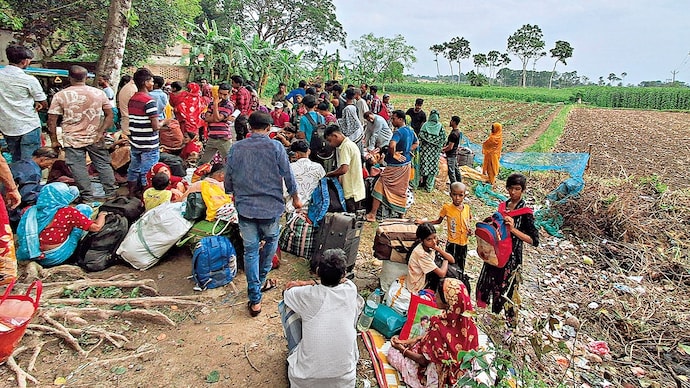
On June 7, West Bengal chief minister Suvendu Adhikari of the BJP announced at a party event that around 4,800 illegal immigrants had been deported to Bangladesh from holding centres set up in the state’s border districts. Some 836 more, he added, were awaiting repatriation. The BJP election manifesto had promised to ‘rid Bengal of illegal immigrants and secure the borders’, and the new CM had got cracking within weeks.
On June 7, West Bengal chief minister Suvendu Adhikari of the BJP announced at a party event that around 4,800 illegal immigrants had been deported to Bangladesh from holding centres set up in the state’s border districts. Some 836 more, he added, were awaiting repatriation. The BJP election manifesto had promised to ‘rid Bengal of illegal immigrants and secure the borders’, and the new CM had got cracking within weeks.
On May 23, the state’s home and hill affairs department issued a letter to the district magistrates, asking them ‘to take appropriate action to set up holding centres’ for the arrested illegal Bangladeshis and Rohingyas. The letter came three days after the government transferred 120 acres of land to the Border Security Force (BSF) to fence nearly 600 km of the India-Bangladesh border. Another 280 acres are to be transferred later.
The Centre had been pushing the state to take these steps for years, but the former Mamata Banerjee-led Trinamool Congress regime largely ignored the directives. With panic spreading, there have been large queues at major crossing points along the border areas of North 24 Parganas and Malda districts, with the Hakimpur checkpoint being a main exodus point for those looking to return to Bangladesh.
Meanwhile, across the border, there has been some consternation over the happenings. Asked for a reaction on the border fencing issue, Bangladesh home minister Salahuddin Ahmed tried to play it down, saying it was an “internal matter” of India. However, Humayun Kabir, the Bangladesh Nationalist Party (BNP) leader who advises Prime Minister Tarique Rahman on international relations, took a tougher stand, saying his country would not be “intimidated” by any fencing.
LAYING DOWN THE LAW
On May 20, Adhikari had announced that the procedure laid out in a May 2, 2025 letter issued by the Foreigners Division of the Union home ministry would be followed to identify and deport illegals. The letter had instructions to states and Union territories on the ‘detect, detain and deport’ plan, including recording their biometric and demographic details on the Foreigners Identification Portal (FIP). As of now, the state has set up 11 holding centres across the border districts.
If a detainee claims Indian citizenship, verification with the claimed home state must be completed within 30 days, failing which deportation proceedings may continue. The rules also mandate blacklisting of deportees, inter-state coordination during transfers, and monthly updates to the home ministry. The Bureau of Immigration will maintain a public list of deportees and share data with the Unique Identification Authority of India (UIDAI), the Election Commission and other agencies to suspend identity documents and such.
The Centre’s earlier ‘nationwide drive’ had run into controversy after a number of Bengali-speaking Indian Muslims were allegedly pushed into Bangladesh despite having identity documents. One such case involved the pregnant Sunali Khatun, who was later brought back to India following Supreme Court orders. The incidents triggered concern in Dhaka, which has maintained that it will not accept unilateral ‘push-ins’ without verification.
Dhaka has found some reassurance in the thirteenth point of the May 2025 document, which says that after an arrest, states and UTs must share the illegal’s details with the external affairs ministry, which would coordinate with the Bangladesh high commission or the Myanmar embassy (for Rohingyas) to expedite verifications and the deportation process. “If this process is followed, we’ll have to be involved... there will be no rampant deportation from the Indian side,” says a Bangladeshi foreign service officer.
THE NEW FLASHPOINTS
Under Clause 8(c) of the 1975 Joint India-Bangladesh Guidelines (JIBG) for border authorities, neither side is allowed to keep permanent or temporary armed personnel within 150 yards of the International Border (IB), and ‘no permanent post will be constructed’ until final demarcation is completed. Fencing disputes between India and Bangladesh often centre around this restricted zone. At least two incidents have been reported in which BSF attempts to fence the IB were met with resistance from the Border Guard Bangladesh (BGB). The border has remained tense in recent months after Bangladesh alleged that BSF personnel shot and killed several Bangladeshi citizens along the frontier. In some sectors, the BGB also apparently retaliated with firing. Stopping border killings was one of the major promises in the BNP political manifesto, making the issue both a diplomatic and domestic political flashpoint for the Rahman-led administration.
India, however, points to a bilateral understanding from 2017 (when the Awami League’s Sheikh Hasina was in power), which directed ‘their respective [security] agencies to ensure that development work, including construction of integrated check posts, is allowed within 150 yards of the zero line, on the basis of prior intimation from the other side’.
Since then, Hasina has been ousted from power and it is unclear whether Rahman and his BNP will uphold the 2017 understanding. Meanwhile, uncertainty looms in Bengal over the 2.7 million people who have lost their voting rights under the special intensive revision (SIR) process of the electoral rolls. Reports suggest that by mid-May, 12 of the 19 Supreme Court-mandated Appellate Tribunals had disposed of only 6,581 of the 2.49 million appeals filed.
DISTRESS AND DIPLOMACY
Many among those excluded are Indian citizens who failed to make it to the voter list because of administrative lapses and documentation-related issues. These people fear the revised SIR list could eventually become the baseline for determining citizenship status, and that those whose names do not appear on it may face serious consequences.
Amid these developments, India-Bangladesh relations, which had hit rock bottom following Hasina’s ouster in 2024, face further strain. Former foreign secretary Harsh Vardhan Shringla, now a Rajya Sabha MP from the BJP, feels that cooperation on sensitive matters is the only way forward. “There is direct correlation between Bengal and Bangladesh on administrative issues. Fencing the borders and putting an end to illegal immigration will help both nations. Our neighbours should cooperate with us,” he says. Across the border, ex-Bangladeshi diplomat M. Humayun Kabir points to India’s domestic rhetoric as a possible hurdle. “It so happens that certain statements made by Indian politicians have triggered reactions in our country. Neither is welcome,” he says.
What began as a drive against illegals is fast turning into a larger political and diplomatic test for both India and Bangladesh. As West Bengal’s new BJP government sharpens its stand, ties between the two neighbours will be tested.

