Manipur | A fresh fault line
Three years after violence erupted, a new Naga-Kuki divide threatens to redraw Manipur's conflict map
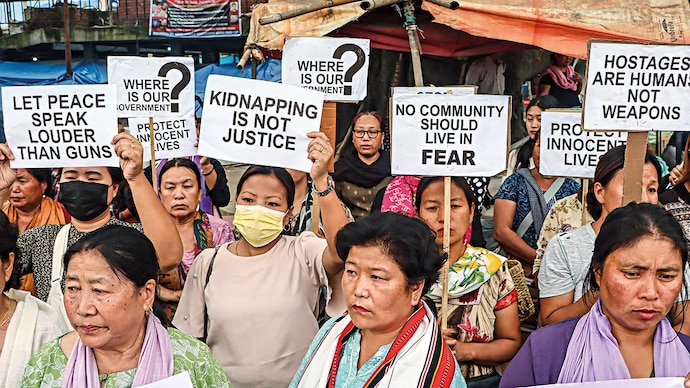


For more than three years, the dominant narrative of Manipur’s conflict has revolved around the Meitei-Kuki divide that erupted on May 3, 2023. It split the state between the Meitei-dominated Imphal Valley and the Kuki-dominated hill districts of Churachandpur, Kangpokpi and Pherzawl, leaving hundreds dead and thousands displaced. The Naga-majority districts of Senapati, Ukhrul, Tamenglong, Kamjong and Noney stayed largely untouched.
For more than three years, the dominant narrative of Manipur’s conflict has revolved around the Meitei-Kuki divide that erupted on May 3, 2023. It split the state between the Meitei-dominated Imphal Valley and the Kuki-dominated hill districts of Churachandpur, Kangpokpi and Pherzawl, leaving hundreds dead and thousands displaced. The Naga-majority districts of Senapati, Ukhrul, Tamenglong, Kamjong and Noney stayed largely untouched.
Not principal participants, Nagas, along with the Muslim-Pangal community, were among the few who could move across territory held by both sides. That neutrality began to crack in early 2026. Tensions between Nagas and Kukis in Kangpokpi, Senapati and parts of Ukhrul have opened a fresh front. Abductions, retaliatory violence, blockades and fresh displacement show the crisis is no longer confined to the old fault line.
THE FEBRUARY SPARK
The first signs appeared on February 7, after a reported drunken brawl between Kuki and Naga men in Ukhrul’s Litan Sareikhong village. Localised clashes followed across the hill districts. Sources estimate nearly 20 people were killed in separate incidents in the early days of the violence. The situation deteriorated sharply on May 13, when three Thadou (Kuki-Zo sub-group) church leaders and their driver were killed in Kangpokpi.
The killings triggered outrage across the Kuki-Zo community. Kuki organisations blamed the Naga armed groups. Naga organisations denied it and demanded a probe. While responsibility remains disputed till now, retaliatory abductions followed at once. According to reports, 28 Kukis were taken from Senapati and adjoining areas, and 20 Nagas from Leilon Vaiphei village and nearby locations in Kangpokpi.
THE VIOLENT FALLOUT
On May 14, within 24 hours, 14 hostages from each side were freed after negotiations. But 14 Kukis and six Nagas stayed in captivity. Following this, Nagas in Kuki-majority areas moved to Naga regions, and Kukis in Naga areas relocated to Kuki areas. Relief camps came up to house the displaced. On May 17, the United Naga Council called an inter-district bandh along National Highway 2, citing the hostage crisis. It hit Kangpokpi hardest. Since 2023, the Imphal-Kangpokpi route has remained closed to Kukis and Meiteis, leaving NH-2 as the district’s lifeline to Nagaland, Assam and the rest of the country. Food, fuel and medicines all travel along it.
With the highway choked, prices have soared. A sack of rice now costs nearly Rs 5,000 in Kangpokpi, a cooking gas cylinder more than Rs 5,000 and petrol Rs 230 a litre. Traders and leaders warn that if the blockade holds, Kangpokpi could run short of essentials within days. Stocks of grain, gas, fuel and medicines are dwindling.
A breakthrough seemed near on June 8, when the remaining 14 Kuki hostages were freed after 25 days. However, the hope collapsed the next day: security forces recovered six bodies of the missing Naga abductees near Leilon Vaiphei village.
Organisations from both sides condemned the deaths, but none agreed on who was to blame. Naga civil society rejects the claim that Naga groups carried out the May 13 killings. Pricilla Thiumai, president of the Naga Women Union, Manipur, asked how Naga militants could enter an area ringed by Kuki villages, strike and slip away unseen. She alleged the Kuki National Front-President (KNF-P) was behind attacks on Nagas and urged action against Kuki groups under the Suspension of Operations (SoO) agreement. Leaders of Kuki Inpi, the apex social body of the tribal community, condemned the killing of the six Nagas. Thangminlen Kipgen, president of Kuki Inpi Sadar Hills, traced the conflict to the February altercation and alleged the involvement of the NSCN-IM and United Naga Defence Force (UNDF) in attacks on Kuki villages—claims that Naga groups deny.
The violence has revived the debate over the SoO armed groups. Rohan Kuki, representing the Kuki National Front (KNF) in the SoO Joint Monitoring Group, denies any role, saying the front’s name surfaces whenever Nagas or Meiteis are attacked, and that such claims aim to derail peace talks with the central government.
The Coordinating Committee on Manipur Integrity (COCOMI), an influential Meitei body, reads the events more broadly. Spokesperson Shanta Nahakpam said the crisis cannot be separated from insurgency, territorial demands and Manipur’s political future. Meiteis and Nagas, he argued, share worries over illegal immigration and SoO groups, and the Centre’s approach to Kuki groups has fed distrust.
THE CONFLICT SPREADS
The violence soon engulfed the Imphal valley. On June 15 and 16, protests broke out outside the Regional Institute of Medical Sciences (RIMS) in Imphal after three Kuki youths were admitted there for treatment. They had been injured in an explosion in Kangpokpi’s Leilon Munlui village. The protesters objected to their treatment at RIMS, located in Meitei-dominated Imphal, forcing authorities to tighten security around the hospital. On June 17, the three were transferred to Churachandpur Medical College under heavy escort.
Since the elected government returned on February 4, its response has remained largely reactive, imposing curfews and internet shutdowns, concentrating forces, ordering National Investigation Agency probes and negotiating local de-escalation after each flashpoint. In March, new chief minister Yumnam Khemchand Singh opened direct talks with the Kuki-Zo Council, and on April 1, Union home minister Amit Shah reviewed the situation in Manipur with him. But independent observers say the free flow of arms among civilians remains a major obstacle to peace. The police admit that only about 70 per cent of the looted weapons have been recovered so far.
Three years on, Manipur’s divisions are growing more layered. The valley stays cut off from the hills, and the hills themselves are now splitting along ethnic lines. The hostage crisis of 2026 may mark a new phase in Manipur’s conflict.

