Punjab | A crisis of authority
For the first time, Sikh clergy has ostracised a serving CM, opening a volatile new chapter in Punjab politics
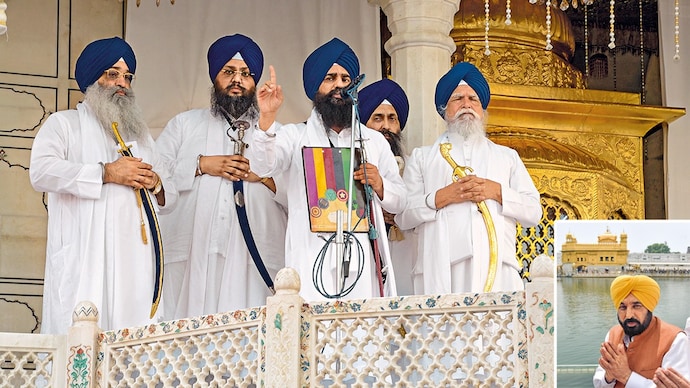
On June 15, from the faseel (podium) of the Akal Takht—Sikhism’s supreme seat of authority—in Amritsar, acting jathedar (chief cleric) Giani Kuldeep Singh Gargaj delivered an extraordinary verdict. Reading out the decision of the five Singh Sahiban, the heads of Sikhism’s five takhts, he declared Punjab chief minister Bhagwant Mann a ‘Guru Dokhi’ (one who has wronged the Sikh Gurus) and ‘Khalsa Panth Virodhi’ (an opponent of the Khalsa community), directing Sikhs worldwide not to associate with him. In the same sitting, the clergy summoned every Sikh legislator and minister who had supported Punjab’s new anti-sacrilege law to appear before the Akal Takht on June 29.
On June 15, from the faseel (podium) of the Akal Takht—Sikhism’s supreme seat of authority—in Amritsar, acting jathedar (chief cleric) Giani Kuldeep Singh Gargaj delivered an extraordinary verdict. Reading out the decision of the five Singh Sahiban, the heads of Sikhism’s five takhts, he declared Punjab chief minister Bhagwant Mann a ‘Guru Dokhi’ (one who has wronged the Sikh Gurus) and ‘Khalsa Panth Virodhi’ (an opponent of the Khalsa community), directing Sikhs worldwide not to associate with him. In the same sitting, the clergy summoned every Sikh legislator and minister who had supported Punjab’s new anti-sacrilege law to appear before the Akal Takht on June 29.
Religious censure has long figured in Punjab’s political history. Yet never before has such a sanction been imposed on a sitting CM. With the assembly election less than a year away, the confrontation threatens to snowball into a full-blown crisis. Opposition parties have already begun fielding leaders with Panthic standing to target Mann, hoping to convert religious disquiet into political momentum against his Aam Aadmi Party (AAP) government.
VIDEO BEHIND THE VERDICT
The trigger was a video that began circulating months ago, purportedly showing a man sprinkling liquor on the portraits of the ten Gurus and an image of the slain militant Jarnail Singh Bhindranwale. Allegations surfaced that the person in the footage was the CM himself. Summoned, Mann appeared before the Akal Takht on January 15 and described the video as an AI manipulation. According to the Takht, he was asked to nominate a forensic lab to examine the footage but failed to do so. The institution subsequently sent the video to two labs recognised by the Centre, which reportedly concluded that the footage was authentic. Delivering the verdict, Gargaj said that Mann had lied before the Akal Takht and questioned his fitness to take decisions in the interest of the Sikh community.
Mann has refused to accept the findings. In a video statement the following day, he reiterated that the individual in the footage was not him, arguing that the forensic reports did not establish who the person was. Going further, he described the Takht’s present office-bearers as political appointees serving their “political masters” and accused them of building a false narrative to malign him. AAP’s Punjab media in-charge, Baltej Singh Pannu, was blunter, calling the verdict a conspiracy orchestrated by the Badals and Gargaj a “pawn” of the Shiromani Akali Dal.
That line of attack represents a significant departure from past confrontations. Punjab’s politicians may challenge decisions of the Akal Takht, but most have ultimately performed penance rather than question the legitimacy of those delivering them. Mann had been moving in that direction for some time. Earlier this year, he publicly questioned the “fairness” of Gargaj’s appointment, describing it as inconsistent with Sikh maryada (religious code and tradition). The friction, therefore, predates the disputed video.
THE LAW OF CONTENTION
It also extends beyond it. Beneath the immediate controversy lies the Jaagat Jot Sri Guru Granth Sahib Satkar (Amendment) Act, 2026, Punjab’s new anti-sacrilege law. The Akal Takht argues that the legislation was passed without adequate consultation with Sikh institutions despite objections conveyed through the assembly speaker. Historically, both the Centre and the Punjab government have generally consulted the Shiromani Gurdwara Parbandhak Committee (SGPC) on laws affecting Sikh religious affairs, reinforced by the 1959 pact between prime minister Jawaharlal Nehru and Akali leader Master Tara Singh. Mann, in turn, has accused the religious leadership of a volte-face, noting that those who once sought an anti-sacrilege law are now rejecting it.
The confrontation is unfolding on unfamiliar ground. In the past, the Akali Dal stood as the principal vehicle of Panthic politics. Today, it has been weakened by electoral decline and internal divisions. New claimants have moved into the space, most notably Khadoor Sahib MP Amritpal Singh, a jailed Khalistan sympathiser whose Akali Dal (Waris Punjab De) is seeking to expand its influence ahead of the 2027 election.
AAP, which came to power on promises of governance and reforms, now finds itself drawn onto this terrain shaped by religious identity. The danger is that periods of uncertainty within the mainstream tPanthic order have often brought unpredictable political consequences and heightened security concerns in Punjab.

