Bengal's new road to industrialisation
The BJP government aims to unlock urban industrial land clogged with closed factories, draw investment and kickstart Bengal's re-industrialisation
The intent to restore Bengal’s industrial fortune has been an old one. Yet slogans like ‘Bengal means business’ emblazoned across investors’ summits had little to back them up. Now, in a determined push to right decades-old neglect, the BJP government in West Bengal is preparing one of the state’s most significant land policy overhauls, seeking to unlock idle industrial land and position itself as an unabashedly pro-investment administration.
The intent to restore Bengal’s industrial fortune has been an old one. Yet slogans like ‘Bengal means business’ emblazoned across investors’ summits had little to back them up. Now, in a determined push to right decades-old neglect, the BJP government in West Bengal is preparing one of the state’s most significant land policy overhauls, seeking to unlock idle industrial land and position itself as an unabashedly pro-investment administration.
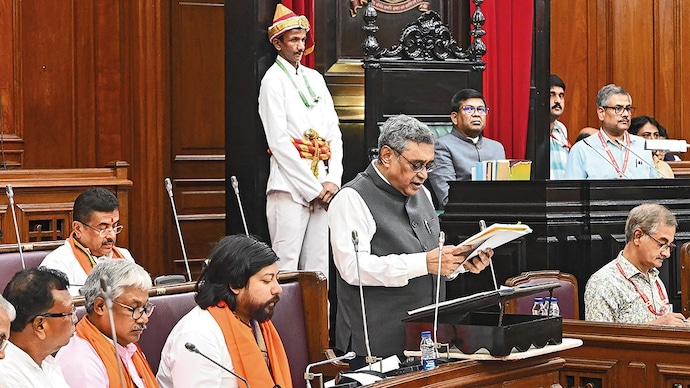
Finance minister Swapan Dasgupta, who presented the state’s maiden budget on June 22, tells India Today that the government is drafting a policy to reclaim land occupied by defunct factories and recycle it for fresh investments, instead of allowing it to languish in litigation or be converted into lucrative real estate.
“There are dozens of such parcels that have remained idle,” Dasgupta says. “Take the Jessop factory land in Dumdum or the Hind Motors campus in Uttarpara. Through legislation or executive action, they will be made available to investors.” The minister stressed on retaining the industrial character of such land. “If land is reclaimed under this policy, it will carry a legal obligation to be used only for industrial purposes. The objective is job-creation, manufacturing and economic activity.”
Between 2011 and 2025, West Bengal’s state gross domestic product (SGDP) averaged around Rs 11 lakh crore annually, with industry contributing 27-28 per cent—an average of Rs 3 lakh crore a year. Leading industrial states have annual industrial values of over Rs 10 lakh crore. Though the BJP government has not set a numerical target, it has promised to boost manufacturing through land reforms like this, infrastructure expansion and investment incentives.
During its tenure, the Trinamool Congress (TMC) government spent around Rs 18,500 crore annually on capital expenditure—the broadest measure of investment in infrastructure and industrialisation. However, actual spending routinely fell short of this. In contrast, the budget has proposed a record Rs 39,338 crore in capital outlay for new airports, a deep-sea port at Dadanpatrabar, a semiconductor ecosystem in Durgapur and major road and bridge projects.
SHARP DEPARTURE
The proposed land policy marks a sharp departure from the TMC government’s cautious approach to industrial land after the political fallout over Singur and Nandigram, where protests against compulsory acquisition reshaped Bengal’s land politics. The BJP government believes that reviving abandoned industrial sites offers a less contentious and economically quicker route to industrialisation. Also, it might get involved in acquiring land for private projects on a case to case basis.
The land reforms will also include scrapping the Urban Land (Ceiling and Regulation) Act, 1976, which restricts ownership of vacant urban land in major cities. The state government argues that the law—retained by Left Front and TMC regimes—is an impediment to industrialisation. Though most states repealed it after Parliament enacted the Urban Land (Ceiling and Regulation) Repeal Act in 1999, West Bengal continued to retain it.
TARGETED POLICY
According to Dasgupta, land initiatives form part of a broader policy reset. “We have identified around ten sectors where dedicated policy frameworks are being prepared,” he says, naming a few, such as an industrial policy, an artificial intelligence policy and a startup policy.
“It will probably take a year or two before the state becomes fully infrastructure-ready for large investments,” says Dasgupta. “Our effort is to ensure that when investment decisions are made, West Bengal is no longer held back by policy uncertainty, inadequate infrastructure or land constraints.” Bengal’s industrial wasteland awaits a midas touch.

