Punjab | The Takht has the last word
The Akal Takht's intervention over Punjab's anti-sacrilege law reasserts the primacy of Sikh religious authority
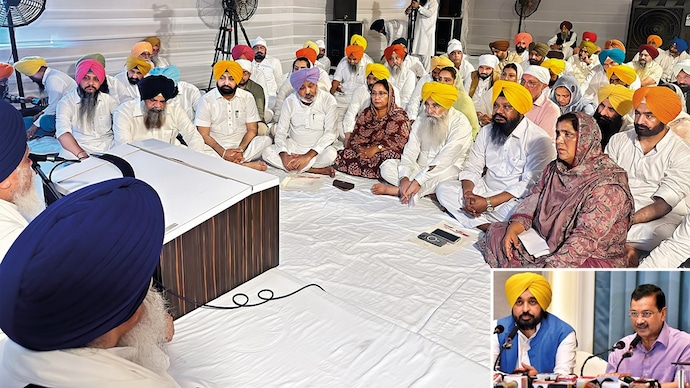
On June 29, the Akal Takht ordered the Punjab government to amend its controversial new anti-sacrilege law within 30 days and suspend its implementation until the changes were made. The directive followed an extraordinary hearing that brought together Punjab’s Sikh political establishment in a way never seen before. Cabinet ministers, ruling and opposition MLAs, independents and assembly speaker Kultar Singh Sandhwan appeared before the Akal Takht, Sikhism’s supreme seat of authority, to answer for a law—Jaagat Jot Sri Guru Granth Sahib Satkar (Amendment) Act, 2026—the assembly had passed unanimously in a special session on Baisakhi (April 13). Chief minister Bhagwant Mann was absent—not because of protocol, but because he had been excommunicated over an alleged sacrilege video a fortnight earlier.
On June 29, the Akal Takht ordered the Punjab government to amend its controversial new anti-sacrilege law within 30 days and suspend its implementation until the changes were made. The directive followed an extraordinary hearing that brought together Punjab’s Sikh political establishment in a way never seen before. Cabinet ministers, ruling and opposition MLAs, independents and assembly speaker Kultar Singh Sandhwan appeared before the Akal Takht, Sikhism’s supreme seat of authority, to answer for a law—Jaagat Jot Sri Guru Granth Sahib Satkar (Amendment) Act, 2026—the assembly had passed unanimously in a special session on Baisakhi (April 13). Chief minister Bhagwant Mann was absent—not because of protocol, but because he had been excommunicated over an alleged sacrilege video a fortnight earlier.
The Akal Takht’s directives, known as hukumnama, are regarded as binding by Sikhs around the world. With the assembly election due in early 2027, the ruling Aam Aadmi Party (AAP) finds itself confronting a political reality in which religious legitimacy can carry as much weight as a legislative majority.
The Mann regime has argued that the law was enacted to address a governance vacuum that allowed repeated desecrations of the Guru Granth Sahib, fuelling deep public anger over the past decade. Unlike the largely regulatory 2008 law, the 2026 amendment prescribes imprisonment of up to life and fines of up to Rs 25 lakh. The Akal Takht has made it clear that it supports stringent punishment for sacrilege. Its objections centre on jurisdiction and provisions that could bring Sikh religious institutions and functionaries—granthis, sewadars and others—within the ambit of criminal liability. It has also criticised the government for fast-tracking the legislation without wider consultations. That runs contrary to the understanding reaffirmed by the 1959 agreement between prime minister Jawaharlal Nehru and Akali leader Master Tara Singh, under which neither the Centre nor the states were to enact laws affecting Sikh religious affairs without consulting the clergy and the Shiromani Gurdwara Parbandhak Committee (SGPC).
The confrontation had been building for weeks. Sandhwan had first been summoned on May 8 and given 15 days to amend the act. Written objections followed on May 11. When the government kept sitting on it, the five Singh Sahibans (the heads of five takhts) decided on June 15 to summon the state’s Sikh legislators. The nearly two-hour hearing resembled less a consultation than a public audit of both the law and competence of those who enacted it. When AAP MLA Inderbir Singh Nijjar requested that the proceedings be held behind closed doors, acting jathedar (chief cleric) Giani Kuldeep Singh Gargaj refused, insisting on a live telecast.
Gargaj questioned ministers and legislators on the law’s provisions, and several senior AAP representatives struggled to explain clauses they had collectively endorsed. He also challenged the government’s attempt to define Sikh religious terminology through law, objecting in particular to the replacement of the traditional term ‘bir’ with ‘saroop’, meaning a copy of the Guru Granth Sahib. He further objected to provisions relating to the SGPC’s role in printing and publishing these copies. The assembly, he argued, had no authority to determine Sikh terminology, and such decisions rested solely with the Akal Takht. By the end of the hearing, lawmakers raised their hands to signal agreement to review the law and assured the takht they would carry out the amendments within the prescribed deadline.
POLITICAL TIGHTROPE
Yet outside, finance minister Harpal Singh Cheema and Sandhwan struck a guarded note, saying the government would first examine the proposed amendments before taking a final decision. Later, even Mann remained non-committal, saying he would consider the Akal Takht’s “suggestions” once he received them. The Akal Takht secretariat, however, maintained that the jathedar had “ordered” the government to carry out the revisions within the stipulated timeframe.
The response contrasted with the political caution that had been building within AAP for weeks. It was evident on June 28, when national convener Arvind Kejriwal travelled to Amritsar for a closed-door meeting with Sikh ministers and MLAs. Several leaders reportedly argued that any impression of challenging the Akal Takht or the jathedar on an issue as sensitive as sacrilege could prove costly politically, particularly among rural Sikh voters.
Mann, too, appeared to be softening his stance on the eve of the hearing. He said he would submit his explanation in the controversial video case in writing and that the government would respond similarly on the anti-sacrilege law. But he sought to shift the focus by criticising the Maharashtra government’s proposal to replace the 1956 law governing Takht Sachkhand Sri Hazur Sahib in Nanded with legislation granting the state greater control over its management board. Urging Maharashtra not to interfere in Sikh religious affairs, he cast his own government as a defender of Panthic autonomy. Yet the contrast remained awkward. While Maharashtra CM Devendra Fadnavis has promised consultations with Sikh institutions before proceeding, the Mann regime faces criticism precisely for legislating without consultation.

