Rajasthan | Kirori kicks up a storm
The agriculture minister and agent provocateur has put the party on the spot again, this time with reason
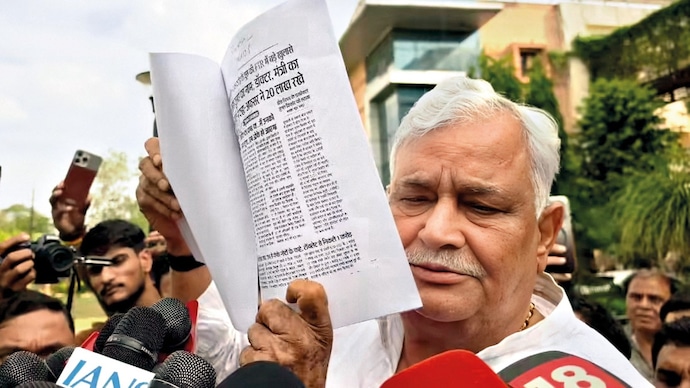
The Bharatiya Janata Party (BJP) has finally pressed the reset button in Rajasthan. After close to two and a half years, it has filled the key post of state organisational general secretary by appointing Ajaey Kumar, a move seen as a precursor to the long-pending panchayat and urban local body elections. Yet, even as so much is going on, the party finds itself grappling with a political challenge from within. Agriculture minister Kirori Lal Meena, a constant bugbear for the state government, is again in the news after turning what began as an anti-corruption bureau (ACB) investigation into a wider confrontation involving the Opposition Congress, the ACB and, increasingly, his own party.
The Bharatiya Janata Party (BJP) has finally pressed the reset button in Rajasthan. After close to two and a half years, it has filled the key post of state organisational general secretary by appointing Ajaey Kumar, a move seen as a precursor to the long-pending panchayat and urban local body elections. Yet, even as so much is going on, the party finds itself grappling with a political challenge from within. Agriculture minister Kirori Lal Meena, a constant bugbear for the state government, is again in the news after turning what began as an anti-corruption bureau (ACB) investigation into a wider confrontation involving the Opposition Congress, the ACB and, increasingly, his own party.
The controversy erupted after the ACB arrested officials and middlemen allegedly involved in the fake seeds/fertilisers scam. Ironically, the investigation arose out of the crackdowns that Meena had built his political identity around through surprise raids, seizures and prosecutions over the past two years. But instead of emerging politically stronger, he has found himself battling speculation following media reports, citing investigative sources, of intercepted conversations mentioning a ‘doctor’ and a ‘minister’. Meena—both a medical doctor and cabinet minister—claimed the selective leaks were intended to malign him.
His response: storming the ACB headquarters, questioning senior officers and publicly demanding that the agency either prosecute him or declare him innocent. Meena has also expanded the political battlefield. He has accused the ACB—which reports to chief minister Bhajal Lal Sharma—of sitting on corruption complaints he had filed against leaders of the previous Congress government and has also launched an offensive against Rajasthan Congress president Govind Singh Dotasra. Meena has alleged that Dotasra influenced the state Public Service Commission during the previous Ashok Gehlot regime to secure the selection of his relatives as Rajasthan Administrative Service (RAS) officers. Dotasra has flatly rejected the allegations and leveled his own list of corruption charges against Meena. Whether Meena’s latest attack is retaliation for the ACB episode or not remains open to interpretation. But the campaign has attracted support from some unlikely quarters. Education minister Madan Dilawar has publicly vouched for his integrity, while Rashtriya Loktantrik Party MP, Hanuman Beniwal, too, has defended him.
For CM Sharma, the developments reinforce the need for some political recalibration. Since assuming office, Sharma has carried out a number of bureaucratic reshuffles in an effort to improve governance. Yet the Opposition continues to portray his government as administratively weak, even as Meena’s repeated public ‘interventions’ created an impression of competing power centres. Many within the BJP now believe that the time has come for a performance review and a cabinet reshuffle before the local body elections.
SHIFTING SANDS
Sharma, though, has somewhat insulated himself from this periodic speculation over his continuation in the top job. He has done this mostly by doing precisely what the BJP leadership expects of him—carrying out assignments without creating friction while also maintaining cordial ties with the Rashtriya Swayamsevak Sangh (RSS). Party insiders point to Sharma’s willingness to accommodate Sangh recommendations in high-level appointments as proof of his ability to balance the expectations of both Delhi and the RSS.
But now he has more to do. The long-delayed local body polls will be the BJP’s first major electoral test since returning to power in 2023-end. Sharma, along with Kumar, whose role in the same post in Uttarakhand had come in for commendation, has a big task on his hands. The latter’s appointment was intended to end a prolonged organisational vacuum and strengthen coordination between the BJP and the RSS.
The BJP’s Rajasthan reset, then, is still in the process. Party sources say the attempt is to synchronise the government, organisation and the Sangh ahead of a crucial electoral cycle. But organisation alone cannot overcome political contradictions. As long as Meena continues to chart an independent course and the cabinet reshuffle remains pending, the BJP’s big challenge will not be fighting the Opposition—it will be ensuring its own government speaks in one voice.

