Kerala | It rains errors in Wayanad
Two monsoons after Kerala's worst recorded disaster, a lethal landslide shows the state has learnt little
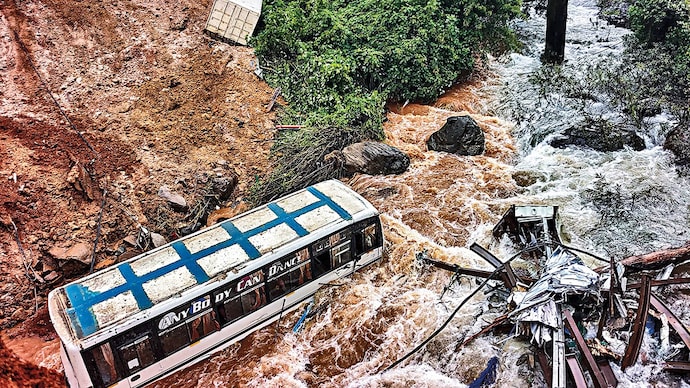
Imagine an idyll where tragedy comes like a repeat tourist, writing into the visitor’s book a lethal pattern that grows more predictable each year. In Wayanad, the highland of Kerala’s northeast, the sense of tragedy can be juxtaposed. The latest disaster, on July 7 at Kalladi, seems to conform to that line of thought. We have heard it all before: a mass of earth and rock, loosened by heavy monsoon rain, breaks free. Only the place, time, scale and victim details differ. This one was near the mouth of the Anakkampoyil–Kalladi tunnel, near Meppadi. The human cluster awaiting sudden burial was a worksite being operated by a Bhopal firm, Dilip Buildcon Ltd. Eight workers were killed—all from northern states. One body was recovered only on July 12, from a pond in a tea estate 1.5 km downslope, after five days of searching.
Imagine an idyll where tragedy comes like a repeat tourist, writing into the visitor’s book a lethal pattern that grows more predictable each year. In Wayanad, the highland of Kerala’s northeast, the sense of tragedy can be juxtaposed. The latest disaster, on July 7 at Kalladi, seems to conform to that line of thought. We have heard it all before: a mass of earth and rock, loosened by heavy monsoon rain, breaks free. Only the place, time, scale and victim details differ. This one was near the mouth of the Anakkampoyil–Kalladi tunnel, near Meppadi. The human cluster awaiting sudden burial was a worksite being operated by a Bhopal firm, Dilip Buildcon Ltd. Eight workers were killed—all from northern states. One body was recovered only on July 12, from a pond in a tea estate 1.5 km downslope, after five days of searching.
Imagine an idyll where tragedy comes like a repeat tourist, writing into the visitor’s book a lethal pattern that grows more predictable each year. In Wayanad, the highland of Kerala’s northeast, the sense of tragedy can be juxtaposed. The latest disaster, on July 7 at Kalladi, seems to conform to that line of thought. We have heard it all before: a mass of earth and rock, loosened by heavy monsoon rain, breaks free. Only the place, time, scale and victim details differ. This one was near the mouth of the Anakkampoyil–Kalladi tunnel, near Meppadi. The human cluster awaiting sudden burial was a worksite being operated by a Bhopal firm, Dilip Buildcon Ltd. Eight workers were killed—all from northern states. One body was recovered only on July 12, from a pond in a tea estate 1.5 km downslope, after five days of searching.
If dej vu strikes, it’s not accidental. The site lies literally five kilometres from Chooralmala, where two hillsides gave way after torrential rain in July 2024, wiping out a village or two and taking about 420 lives in one of Kerala’s worst recorded disasters. This time, what it took down was much smaller: a twin tube tunnel, 8.73 km long and budgeted at Rs 2,134 crore, which has been under construction since August 2025. Meant to ease traffic on the tricky Thamarassery Ghat road to Kozhikode, the tunnel is also seen as a less benign element in these parts.
“The Kalladi tragedy is a man-made disaster, not a natural calamity,” says N. Badusha, 75, general secretary, Wayanad Environmental Protection Council, who has opposed the project for years. He says the previous Left government pushed it through without fully accounting for the area’s ecological sensitivity. “More disasters may happen if the project is continued, with its massive tunnelling through the inner rock of the hills,” Badusha tells India Today.
FRAGILER AND FRAGILEST
The veteran eco-warrior’s warnings trace what amounts to a history sheet. The Madhav Gadgil panel’s 2011 report had classified Wayanad into three zones with different degrees of precarity: fragile, medium fragile and less fragile. When it sought a ban on ‘environmentally hazardous’ activities there, it was not idealism—just plain realism. In 2026, even the Union environment ministry notified 13 villages as ecologically sensitive and asked the state to curb quarrying and big construction. Yet tunnel work went ahead without a clear environmental management plan.
Worse, its waste soil was piled onto slopes above settlements. “We flagged it and directed the company to remove it before the monsoon as it posed threats...but no action was taken,” says Ramla Hamsa, president, Meppadi panchayat. T. Siddique, state agriculture minister and Kalpetta MLA, echoes the charge: “The district administration, too, had issued directions to remove the soil and stop construction during the monsoon. But the firm continued work at the site.”
An expert panel, including geologist C.P. Rajendran, will now review the project. After Chooralmala, Kerala had announced an early warning system for landslides, but slope-specific alerts, evacuation protocols and last-mile communication are missing in much of Wayanad. The laxity is criminal after decades of excess, where forests have given way to plantations, and hillsides cut, drilled through and tunnelled. Idukki, Palakkad and Wayanad have been colonised by the construction lobby. Climate change now comes in as the nemesis for all that, and the pattern repeats like a dirge on loop.

