Madhya Pradesh | Not such a uniform code
After Uttarakhand and Gujarat, MP passes a Uniform Civil Code, with exceptions for its tribal people
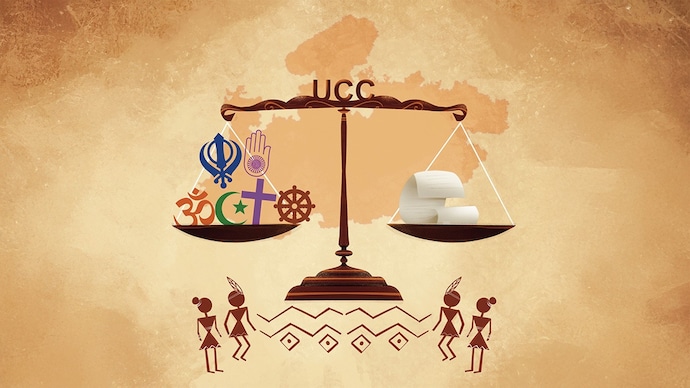
With competitors like Maharashtra, Assam and Chhattisgarh still in the drafting stages, Madhya Pradesh has won the race among saffron-ruled states to be the third one in the country to pass a Uniform Civil Code (UCC). On July 21, the Mohan Yadav-led cabinet passed the UCC Bill in the monsoon session of the assembly. With the ruling Bharatiya Janata Party (BJP) at 164 seats in a House of 230, the legislative passage was smooth. The next step is presidential assent. Uttarakhand’s UCC, the beta prototype, has received it; Gujarat’s version still awaits it.
With competitors like Maharashtra, Assam and Chhattisgarh still in the drafting stages, Madhya Pradesh has won the race among saffron-ruled states to be the third one in the country to pass a Uniform Civil Code (UCC). On July 21, the Mohan Yadav-led cabinet passed the UCC Bill in the monsoon session of the assembly. With the ruling Bharatiya Janata Party (BJP) at 164 seats in a House of 230, the legislative passage was smooth. The next step is presidential assent. Uttarakhand’s UCC, the beta prototype, has received it; Gujarat’s version still awaits it.
With competitors like Maharashtra, Assam and Chhattisgarh still in the drafting stages, Madhya Pradesh has won the race among saffron-ruled states to be the third one in the country to pass a Uniform Civil Code (UCC). On July 21, the Mohan Yadav-led cabinet passed the UCC Bill in the monsoon session of the assembly. With the ruling Bharatiya Janata Party (BJP) at 164 seats in a House of 230, the legislative passage was smooth. The next step is presidential assent. Uttarakhand’s UCC, the beta prototype, has received it; Gujarat’s version still awaits it.
Madhya Pradesh’s bill shares the core features of its two predecessors—a ban on polygamy, mandatory registration of live-in relationships et al—but, like Gujarat, it’s not a carbon copy of Uttarakhand’s UCC. Rather, some parts of it are tailored to fit the state’s unique social landscape, especially the fact that 21 per cent of its population is tribal.
A founding irony in a code that purports to be uniform is that an exception has to be built into it at the outset. This is to exclude the Scheduled Tribes: the customary practices of indigenous communities are constitutionally protected. There was some speculation that Madhya Pradesh’s UCC would not extend that licence to tribals who have converted, but the final bill had no such ‘exemption within an exemption’.
WHOSE DOST IS IT ANYWAY?
Yadav used the optics to send a political message—with the choice of venue for the cabinet meeting. Jagdishpur, formerly Islam Nagar, was the first capital of Bhopal state, as established in the early 18th century by Afghan adventurer Dost Mohammed Khan, an Orakzai Pathan who had fled the frontier after committing a crime. It was he who constructed Chaman Mahal, where the cabinet meeting was held. Islam Nagar had earlier become one among many places that have been renamed in the past few years when it transitioned to being Jagdishpur in 2023.
Speaking before the meeting, Yadav alluded to the region’s history, including its original identity as a Gond realm. “Jagdishpur has been witness to a long struggle, rich heritage and civilisation and is a symbol of Gond, Scindia and Rajput rule,” said the CM, omitting the connection with the Bhopal state, ruled by a line of nawabs and begums. “The cabinet meeting being hosted in Jagdishpur is a mark of respect to the rich history of the place,” he added.
Doubtless, the omission in the realm of names was meant to reflect the erasure from the list of exceptions in civil law. Here, this bill is identical to the previous two UCCs. The six-member committee formed in April-end to draft it was also chaired by the same personage: retired Supreme Court judge Ranjana Desai.
The state government expects certain aspects of the code, especially provisions that will alter the Muslim community’s recourse to personal law, to be challenged in court. Bhopal North Congress MLA Atif Aqueel’s response gave advance notice of this. “The meeting to invite objections and suggestions was a mere formality,” he says. “The draft panel did not have members of all communities.”
Babasaheb Ambedkar, Aqueel points out, had consulted all communities and incorporated their views in the Constitution. “Why have you invited me to the meeting when you (the committee) have decided to pass the UCC without considering my views?” he asks.
The framework for live-in relationships, too, largely treads the known path. Registration is mandatory, and avoidance brings on penal provisions, though lighter than Uttarakhand’s and applicable only within the state’s jurisdiction, unlike Gujarat. Once registered, the parents of partners would be informed. Deserted women become eligible for maintenance, and children born through live-ins would enjoy property rights.
REFORMIST IN PART
On property, the bill continues in the reformist vein of the previous two provisions: it is to be distributed equally among all heirs of a deceased person. An interesting addition in the MP UCC: both parents are granted a share in a son’s property, along with his wife and children. Earlier, only the mother had a share. The idea is to save the elderly from neglect. A parent’s death will see that share transfer to the spouse, not child.
As for the tribals, it’s a demographic large enough for the BJP to want to keep on its side. Tribal groups had warned they would brook no interference in their traditions—in response to the line that a UCC is meaningless if it does not abolish all customary laws, including polygamy among tribals. The bill tiptoed around the issue, including for converts. An officer associated with the drafting voiced caution: “There is a lot of variation in customs even among tribals. It would not be prudent at this time to attempt a UCC that includes tribals.”
Otherwise, of course, polygamy stands abolished—a central feature widely seen as targeting polygyny in Islamic personal law. That has stayed constant since India’s first common civil code, the one drafted in Goa under the colonial Portuguese in 1867.

